
Table of Contents
Loknath is a powerful Sanskrit name that carries profound spiritual significance in Hindu culture. Meaning ‘Lord of the World’ or ‘Master of the Universe’, this name has been cherished for centuries as both a divine epithet and a meaningful personal name. With its roots in ancient Indian scriptures, Loknath represents protection, universal responsibility, and divine guardianship. This comprehensive guide explores the rich etymology, cultural context, and modern usage of this traditional name.
Meaning of Loknath
Loknath derives from classical Sanskrit, combining ‘Loka’ (world/universe) and ‘Nātha’ (lord/protector). The term ‘Loka’ appears extensively in Vedic and post-Vedic literature, referring to the perceived world, realms of existence, or people collectively. ‘Nātha’ comes from the Sanskrit root meaning ‘to seek help’ or ‘to protect’, evolving to mean ‘lord’ or ‘refuge’. Together, they form a compound that literally translates to ‘Lord of the World’. In Hindu theology, this is primarily an epithet for Lord Vishnu, the preserver deity in the Trimurti who maintains cosmic order. The name embodies the concept of divine protection over all creation and has been used in religious texts for millennia.
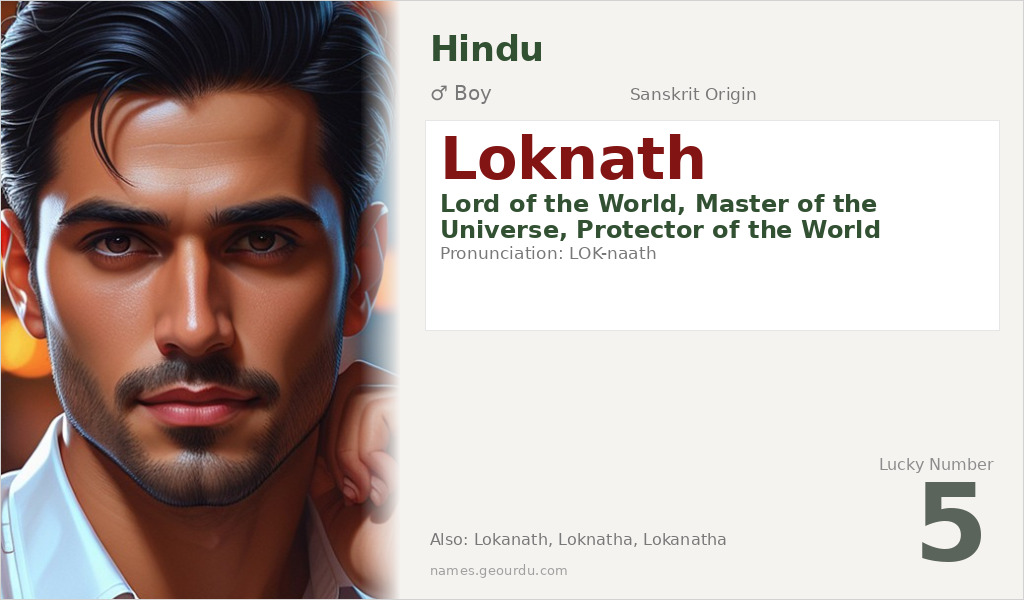
| 📛 Name | Loknath |
| 💎 Meaning | Lord of the World, Master of the Universe, Protector of the World |
| 👤 Gender | Boy |
| 🕌 Religion | Hindu |
| 🌍 Origin | Sanskrit |
| 🗣 Pronunciation | LOK-naath |
| ✍️ Urdu | لوک ناتھ |
| ✍️ Arabic | لوك ناث |
| 🔢 Numerology | 5 |
| ✨ Spellings | Lokanath, Loknatha, Lokanatha |
Origin & Cultural Significance
Loknath originates from Sanskrit, the classical language of ancient India that has influenced numerous South Asian languages. As a compound theophoric name, it follows the common Sanskrit naming pattern where divine attributes become personal names. The name appears in Puranic literature and regional Hindu traditions across India, particularly in Odisha, Bengal, and other eastern regions where Vaishnavism (worship of Vishnu) is prominent. While fundamentally Hindu in religious association, the name’s linguistic components have parallels in other Indo-European languages through shared Proto-Indo-European roots. The cultural practice of naming children after divine epithets reflects the deep integration of spirituality in traditional Hindu naming conventions.
Personality Traits
The name Loknath suggests personality traits aligned with its meaning of universal lordship and protection. Those bearing this name are often associated with leadership qualities, broad-mindedness, and a protective nature. The ‘world’ component implies someone with expansive thinking and global perspective, while the ‘lord’ element suggests authority and responsibility. In cultural interpretation, such names are believed to influence character development toward guardianship and wise stewardship.
Similar Names
If you like Loknath, consider: Vishnu, Jagannath, Lokesh, Narayan, Vasudev
Famous People Named Loknath
- Lokanath Misra — Indian politician and former Governor of Assam and Meghalaya
- Lokanath Behera — Indian Police Service officer and former police commissioner of Kochi
Frequently Asked Questions About Loknath
What does Loknath mean?
Loknath means 'Lord of the World' or 'Master of the Universe' in Sanskrit. It is a compound of 'Loka' (world) and 'Nātha' (lord/protector).
Is Loknath a boy or girl name?
Loknath is exclusively a boy's name in Hindu naming tradition. The '-nath' suffix is masculine in Sanskrit grammar and the name's meaning relates to masculine divine figures.
What is the origin of Loknath?
Loknath originates from Sanskrit, the classical language of ancient India. It is fundamentally a Hindu name with religious significance as an epithet for Lord Vishnu.





