
Table of Contents
Kanishka is a name that echoes through ancient history, carrying the legacy of one of South Asia’s most influential empires. While commonly used in modern Hindu communities, this name has roots that stretch back to the mighty Kushan rulers who bridged Eastern and Western civilizations. Today, Kanishka remains a powerful choice for parents seeking a name with historical depth and regal connotations.
Meaning of Kanishka
The name Kanishka derives from ancient Central Asian languages, most likely Scythian or Old Iranian origins. Scholars trace it to possible roots meaning ‘gold’ or ‘golden’, connecting to the Iranian ‘kani-‘ element. Historically, it’s most famously associated with Kanishka I, the great Kushan emperor who ruled from approximately 127 to 150 CE. His empire stretched from Central Asia through Afghanistan and into northern India, making the name significant across multiple cultural regions. The Kushans were originally a nomadic tribe from the Central Asian steppes who adopted elements of Greek, Persian, Indian, and Buddhist cultures, with Kanishka becoming particularly important in Buddhist history as a major patron of the faith.
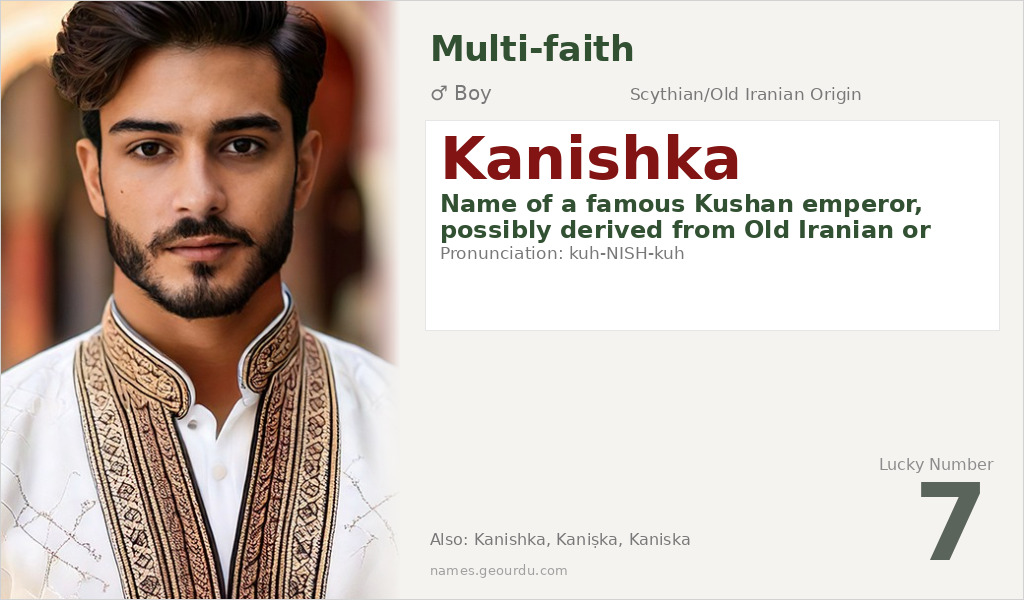
| 📛 Name | Kanishka |
| 💎 Meaning | Name of a famous Kushan emperor, possibly derived from Old Iranian or Scythian roots meaning 'gold' or 'golden' |
| 👤 Gender | Boy |
| 🕌 Religion | Multi-faith |
| 🌍 Origin | Scythian/Old Iranian |
| 🗣 Pronunciation | kuh-NISH-kuh |
| ✍️ Urdu | کنشک |
| ✍️ Arabic | كانيشكا |
| 🔢 Numerology | 7 |
| ✨ Spellings | Kanishka, Kaniṣka, Kaniska |
Origin & Cultural Significance
Kanishka originates from the Kushan Empire, a syncretic civilization that flourished from the 1st to 3rd centuries CE. The Kushans were part of the Yuezhi confederation, originally nomadic tribes from Central Asia who spoke Eastern Iranian languages. Emperor Kanishka I’s reign marked a golden age where Gandharan art flourished and Buddhism spread along the Silk Road. The name appears in various historical records including the Rabatak inscription and coins minted during his rule. While the name has historical connections to Buddhist patronage, it has been adopted by Hindu communities in modern times and appears across South Asia without exclusive religious affiliation.
Personality Traits
Those named Kanishka often inherit the leadership qualities of their historical namesake. They tend to be strategic thinkers who balance ambition with wisdom, much like the emperor who successfully governed a vast multicultural empire. Many exhibit natural authority combined with cultural appreciation, reflecting the Kushan legacy of bridging Eastern and Western traditions. Their personality often blends practical governance with philosophical depth.
Similar Names
If you like Kanishka, consider: Kanishk, Kanish, Kanishaq, Kanishth, Kanishwar
Famous People Named Kanishka
- Kanishka I — Great Kushan Emperor who ruled from Purushapura (modern Peshawar), patron of Buddhism and arts
- Kanishka Thakker — Indian television actor known for roles in Hindi TV series
Frequently Asked Questions About Kanishka
What does Kanishka mean?
Kanishka likely means 'gold' or 'golden' from Old Iranian/Scythian roots, and is most famously known as the name of the great Kushan Emperor Kanishka I who ruled in the 2nd century CE.
Is Kanishka a boy or girl name?
Kanishka is primarily a masculine name, historically borne by male rulers and currently used for boys in South Asian communities, though rare feminine usage exists.
What is the origin of Kanishka?
Kanishka originates from Scythian/Old Iranian languages through the Kushan Empire, a Central Asian civilization that ruled parts of South Asia from the 1st to 3rd centuries CE.





