
Table of Contents
Luit is a distinctive name with intriguing cross-cultural connections that span from the riverbanks of Assam to the historical regions of Northern Europe. While relatively uncommon globally, this name carries different meanings and associations depending on linguistic and geographical context. Whether connected to South Asian river poetry or Germanic tribal traditions, Luit offers a unique naming choice with layered historical resonance.
Meaning of Luit
The meaning of Luit varies significantly across different linguistic traditions. In Assamese and Bengali contexts, Luit refers specifically to the Brahmaputra River, derived from the Sanskrit term ‘Lauhitya’ which describes the river’s characteristic reddish-brown hue from Himalayan sediments. This poetic usage appears in regional literature and folk traditions. In Germanic languages, particularly Dutch and Frisian, Luit functions as a diminutive or short form of names containing the element ‘liut’ (meaning ‘people’ or ‘tribe’), such as Ludger (‘people-spear’) or Ludwig (‘famous warrior’). There’s also a potential connection to Latin ‘luceo’ (to shine) through historical linguistic exchange. These diverse etymological paths make Luit a name with multiple possible interpretations rather than a single definitive meaning.
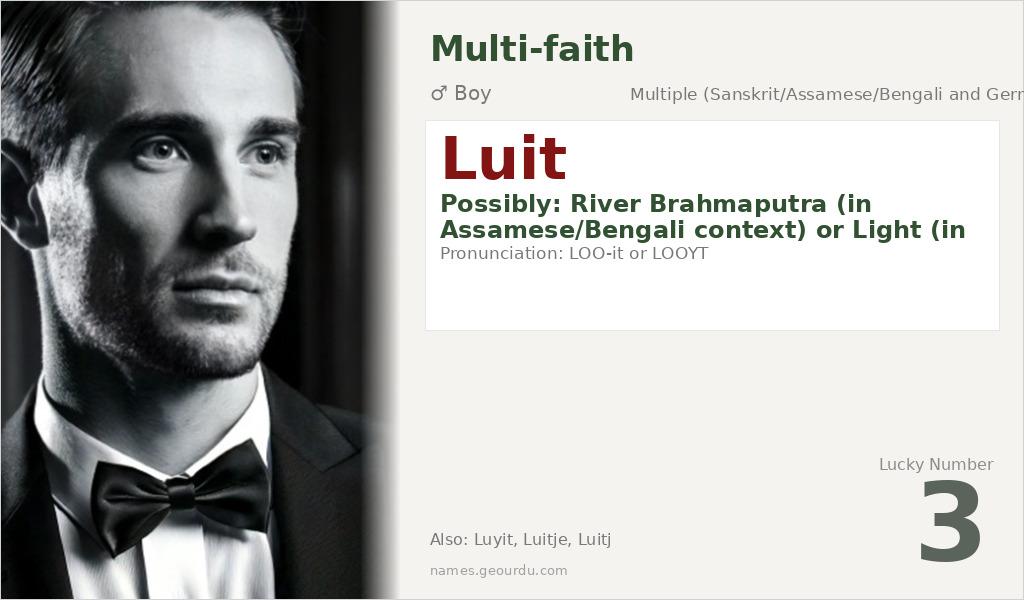
| 📛 Name | Luit |
| 💎 Meaning | Possibly: River Brahmaputra (in Assamese/Bengali context) or Light (in Germanic context) |
| 👤 Gender | Boy |
| 🕌 Religion | Multi-faith |
| 🌍 Origin | Multiple (Sanskrit/Assamese/Bengali and Germanic) |
| 🗣 Pronunciation | LOO-it or LOOYT |
| ✍️ Urdu | لوئت |
| ✍️ Arabic | لويت |
| 🔢 Numerology | 3 |
| ✨ Spellings | Luyit, Luitje, Luitj |
Origin & Cultural Significance
Luit has dual origins that reflect different cultural spheres. In South Asia, particularly Assam and Bengal, the name originates from Sanskrit ‘Lauhitya’ through regional linguistic evolution, appearing in poetic references to the Brahmaputra River since ancient times. This usage is cultural rather than religious, associated with geographical identity. Simultaneously, in Northwestern Europe, Luit emerges from Germanic naming traditions, where it served as a diminutive form in Dutch, Frisian, and Low German communities. Historical records show its usage in medieval documents from regions that are now part of the Netherlands and Germany. These parallel developments occurred independently, resulting in a name that coincidentally shares the same spelling across unrelated language families.
Personality Traits
Those named Luit often exhibit characteristics of adaptability and cultural curiosity, reflecting the name’s diverse origins. They may demonstrate creative problem-solving abilities and a tendency to bridge different perspectives or communities. Their communication style typically combines expressiveness with thoughtful consideration, making them effective in social and collaborative environments.
Similar Names
If you like Luit, consider: Ludger, Ludwig, Luitpold, Luitgard, Luitfried
Famous People Named Luit
- Luit van der Tuuk — Dutch historian and author specializing in early medieval history
- Luit de Jong — Dutch footballer who played as a midfielder in the 1960s-70s
Frequently Asked Questions About Luit
What does Luit mean?
Luit has multiple possible meanings: in Assamese/Bengali context, it refers to the Brahmaputra River (from Sanskrit 'Lauhitya' meaning reddish); in Germanic context, it may derive from 'liut' meaning 'people' or relate to 'light' concepts.
Is Luit a boy or girl name?
Luit is primarily masculine in both South Asian and European usage, though naming conventions vary by region and culture.
What is the origin of Luit?
Luit has dual origins: from Sanskrit/Assamese/Bengali languages in South Asia referring to a river, and from Germanic languages (Dutch/Frisian) in Europe as a diminutive form of names containing 'liut'.





