
Table of Contents
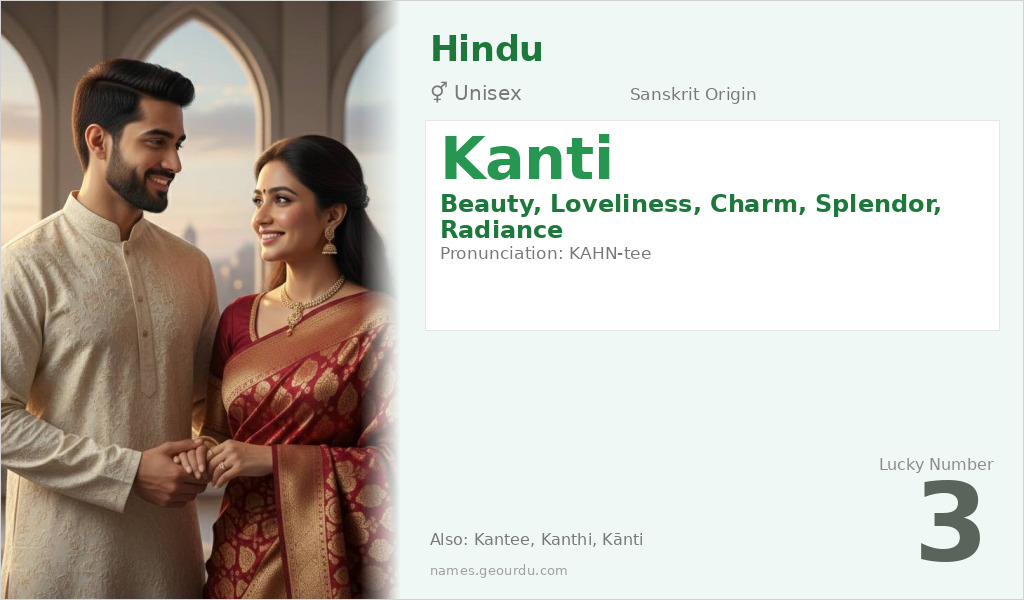
Kanti is a beautiful Sanskrit name that carries deep cultural and spiritual significance in Hindu traditions. Meaning ‘beauty’, ‘loveliness’, or ‘radiance’, this name has been cherished for centuries in Indian culture. Unlike many names that are gender-specific, Kanti is traditionally used for both boys and girls, reflecting its universal appeal. Its connection to aesthetic and spiritual beauty makes it a meaningful choice for parents seeking a name with philosophical depth.
Meaning of Kanti
Kanti originates from the Sanskrit word ‘कान्ति’ (kānti), which specifically means ‘beauty’, ‘loveliness’, ‘charm’, ‘splendor’, or ‘radiance’. This is distinct from generic terms for light—while light can be implied through radiance, the core meaning centers on aesthetic and spiritual beauty. In Hindu philosophy, Kanti represents the divine beauty that emanates from enlightened beings and deities. The name appears in ancient texts like the Rigveda and Puranas, often describing the radiant beauty of goddesses like Lakshmi or the splendor of spiritual attainment. Linguistically, it derives from the Sanskrit root ‘kam’ (to desire) through ‘kānta’ (lovely, desired), emphasizing desirable beauty rather than mere illumination.
| 📛 Name | Kanti |
| 💎 Meaning | Beauty, Loveliness, Charm, Splendor, Radiance |
| 👤 Gender | Unisex |
| 🕌 Religion | Hindu |
| 🌍 Origin | Sanskrit |
| 🗣 Pronunciation | KAHN-tee |
| ✍️ Urdu | کانتی |
| ✍️ Arabic | كانتي |
| 🔢 Numerology | 3 |
| ✨ Spellings | Kantee, Kanthi, Kānti |
Origin & Cultural Significance
Kanti has its roots in ancient Sanskrit language and Hindu culture, where it has been used for millennia. The name appears in classical Hindu scriptures, including the Vedas and Puranas, often in contexts describing divine beauty and spiritual radiance. While primarily associated with Hindu traditions, the name has also been adopted in Buddhist and Jain contexts due to shared Sanskrit linguistic heritage. In modern times, Kanti remains popular across India and among Hindu communities worldwide, particularly in regions with strong Sanskrit traditions. The name’s unisex nature reflects the universal appreciation of beauty in Hindu philosophy, transcending gender boundaries.
Personality Traits
Those named Kanti are often believed to embody the qualities their name represents—beauty, charm, and radiance. They may have a natural aesthetic sense and appreciation for art, nature, and spiritual pursuits. The name suggests someone who brings loveliness into their interactions and surroundings, often attracting others through their charismatic presence. While personality traits vary individually, the name’s meaning provides a cultural framework for understanding potential characteristics associated with it.
Similar Names
If you like Kanti, consider: Kanta, Kanti Devi, Kanti Prasad, Kanti Swarup, Kanti Bhushan
Famous People Named Kanti
- Kanti Prasad — Indian politician and former Member of Parliament from Bihar
- Kanti Bhatt — Gujarati writer and journalist known for his travelogues and biographies
Frequently Asked Questions About Kanti
What does Kanti mean?
Kanti means 'beauty', 'loveliness', 'charm', 'splendor', or 'radiance' in Sanskrit, the classical language of Hindu scriptures.
Is Kanti a boy or girl name?
Kanti is traditionally a unisex name in Hindu culture, used for both boys and girls, though it may be more common for girls in some regions.
What is the origin of Kanti?
Kanti originates from Sanskrit (कान्ति), the ancient language of Hindu philosophy and literature, with deep roots in Indian culture and spirituality.