
Table of Contents
Kapi is a fascinating name with deep roots in ancient Sanskrit and Hindu mythology. While it literally means ‘monkey’ or ‘ape,’ it carries rich symbolic weight from epic tales like the Ramayana. This name is rarely used in modern Hindu naming traditions but remains significant in literary and religious contexts. Explore the origins, meaning, and cultural background of Kapi in this detailed guide.
Meaning of Kapi
Kapi originates from the Sanskrit word कपि (kapi), which directly translates to ‘monkey,’ ‘ape,’ or ‘simian creature.’ In Hindu scriptures, particularly the Ramayana, Kapi refers to the monkey army led by Hanuman that aided Lord Rama in rescuing Sita. The term appears in ancient texts such as the Rigveda and Mahabharata, where it describes monkey-like beings or deities in simian form. Linguistically, it derives from the Sanskrit root ‘kap,’ which relates to movement or agility, reflecting the animal’s nature. While Kapi is a standard word in Sanskrit and Indian languages, it is not commonly adopted as a personal name in contemporary Hindu culture, unlike other mythological names.
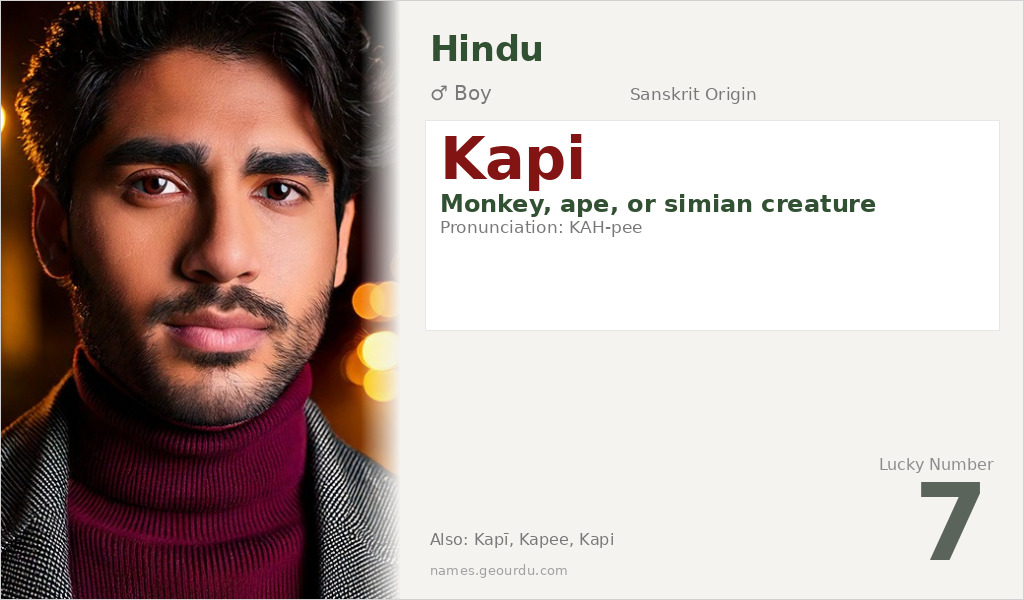
| 📛 Name | Kapi |
| 💎 Meaning | Monkey, ape, or simian creature |
| 👤 Gender | Boy |
| 🕌 Religion | Hindu |
| 🌍 Origin | Sanskrit |
| 🗣 Pronunciation | KAH-pee |
| ✍️ Urdu | کپی |
| ✍️ Arabic | كابي |
| 🔢 Numerology | 7 |
| ✨ Spellings | Kapī, Kapee, Kapi |
Origin & Cultural Significance
Kapi has its origins in Sanskrit, an ancient Indo-Aryan language central to Hindu religious texts. It is prominently featured in Hindu mythology, especially in the Ramayana, where the Kapi (monkey) warriors play crucial roles in the epic’s narrative. Culturally, the name symbolizes strength, loyalty, and divine assistance, as seen in Hanuman’s devotion. However, despite this mythological significance, Kapi is not traditionally used as a given name in Hindu communities, likely due to its literal animal meaning. It remains more common as a term in literature and religious discourse rather than personal nomenclature.
Personality Traits
Drawing from its mythological associations, Kapi might inspire personality traits such as agility, intelligence, and unwavering loyalty. Those connected to this name could be seen as resourceful problem-solvers with a playful spirit. In cultural context, it reflects devotion and teamwork, akin to the monkey warriors’ role in Hindu epics.
Similar Names
If you like Kapi, consider: Hanuman, Kesari, Sugriva, Vali, Angada
Famous People Named Kapi
- None documented — Kapi is not used as a personal name in historical or contemporary records
- In mythology: Kapi refers collectively to monkey warriors in the Ramayana, not an individual
Frequently Asked Questions About Kapi
What does Kapi mean?
Kapi means 'monkey' or 'ape' in Sanskrit, with roots in Hindu mythology where it refers to simian creatures or warriors.
Is Kapi a boy or girl name?
Kapi is traditionally a boy name, based on its usage in Hindu mythology for male monkey characters, though it is rarely used as a personal name.
What is the origin of Kapi?
Kapi originates from Sanskrit, an ancient Indian language, and is deeply embedded in Hindu religious texts like the Ramayana.





