
Table of Contents
Kapilashwa is a powerful Sanskrit name with deep roots in Hindu mythology and Vedic tradition. Meaning ‘possessor of tawny horses,’ this name carries the majestic imagery of divine chariots and celestial power. Primarily used as an epithet for Lord Indra, the king of gods, Kapilashwa represents strength, leadership, and spiritual authority. This ancient name continues to be chosen by parents seeking a name with mythological significance and noble connotations.
Meaning of Kapilashwa
Kapilashwa derives from two Sanskrit words: ‘kapila’ (कपिल) meaning ‘tawny, reddish-brown, or dun-colored’ and ‘ashwa’ (अश्व) meaning ‘horse.’ The compound thus literally translates to ‘possessor of tawny horses’ or ‘one who has reddish-brown horses.’ In Vedic literature, this specific epithet describes Lord Indra’s divine chariot and horses, symbolizing his power and celestial status. The name appears in multiple ancient texts including the Rigveda (circa 1500-1200 BCE) and the Mahabharata, where it’s used in hymns praising Indra’s might. The tawny color (kapila) holds symbolic significance in Hindu tradition, often associated with sacred animals and divine attributes. This precise etymological meaning distinguishes it from more general references to Indra.
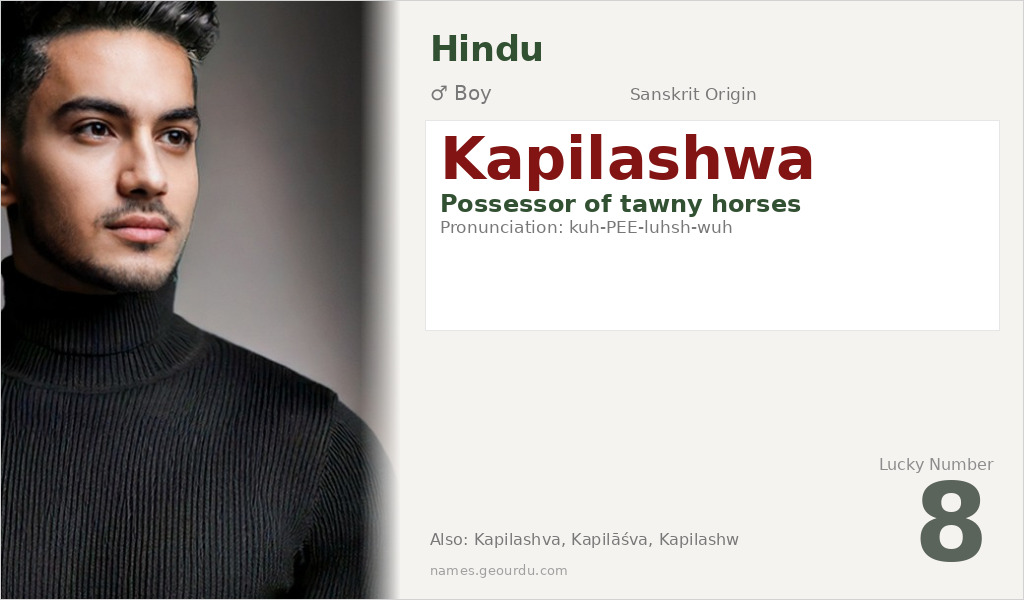
| 📛 Name | Kapilashwa |
| 💎 Meaning | Possessor of tawny horses |
| 👤 Gender | Boy |
| 🕌 Religion | Hindu |
| 🌍 Origin | Sanskrit |
| 🗣 Pronunciation | kuh-PEE-luhsh-wuh |
| ✍️ Urdu | کپلاشوا |
| ✍️ Arabic | كابيلاشوا |
| 🔢 Numerology | 8 |
| ✨ Spellings | Kapilashva, Kapilāśva, Kapilashw |
Origin & Cultural Significance
Kapilashwa originates from ancient Sanskrit, the classical language of India and Hinduism. Its earliest documented usage appears in the Rigveda, one of the oldest known religious texts in the world, dating back over 3,000 years. The name is deeply embedded in Hindu mythology as a specific epithet for Lord Indra, the ruler of the heavens and god of thunder, rain, and war. In Vedic culture, horses (ashwa) held immense symbolic value, representing speed, power, and nobility, while their coloration carried specific ritual significance. The name reflects the sophisticated compound word formation characteristic of Sanskrit, where descriptive elements combine to create meaningful epithets for deities and heroes.
Personality Traits
Those named Kapilashwa are often perceived as natural leaders with strong willpower and determination. The name’s mythological association with Lord Indra suggests qualities of protection, authority, and celestial influence. They may exhibit confidence in challenging situations and possess an innate sense of responsibility. The connection to horses symbolizes energy, freedom, and the ability to overcome obstacles with grace and power.
Similar Names
If you like Kapilashwa, consider: Indra, Ashwathama, Ashwin, Kapil, Ashwamedh, Hayagriva, Vajra, Arjuna, Surya, Varuna
Famous People Named Kapilashwa
- Kapilashwa (Mythological) — Epithet of Lord Indra in Hindu scriptures, particularly in the Rigveda where he is described as riding tawny horses
- Kapilashwa (Historical) — Name appears in ancient Indian texts and inscriptions, though no widely-known contemporary figures bear this name
Frequently Asked Questions About Kapilashwa
What does Kapilashwa mean?
Kapilashwa means 'Possessor of tawny horses' in Sanskrit. It's a compound name from 'kapila' (tawny/reddish-brown) and 'ashwa' (horse), specifically referring to Lord Indra's divine horses in Hindu mythology.
Is Kapilashwa a boy or girl name?
Kapilashwa is exclusively a boy's name in Hindu tradition. It's used as an epithet for the male deity Lord Indra and follows masculine grammatical forms in Sanskrit.
What is the origin of Kapilashwa?
Kapilashwa originates from Sanskrit, the ancient classical language of India. It first appears in Vedic texts like the Rigveda as an epithet for Lord Indra, dating back over 3,000 years in Hindu religious tradition.





