
Table of Contents
Kadamb is a beautiful and meaningful name deeply rooted in Indian culture and Hindu tradition. Derived from Sanskrit, it refers to the fragrant kadam tree, celebrated in mythology and literature for its association with divinity and natural beauty. This name evokes imagery of lush forests, spiritual serenity, and timeless heritage, making it a popular choice for boys in Hindu families. Explore the rich etymology, cultural significance, and personality traits associated with the name Kadamb.
Meaning of Kadamb
Kadamb comes from the Sanskrit word ‘kadamba’ (कदम्ब), which specifically denotes the Neolamarckia cadamba tree, also known as the burflower tree or kadam tree. This tree is renowned for its fragrant, orange, globe-shaped flowers and is native to tropical regions of South and Southeast Asia. In Hindu scriptures, the kadamb tree is closely linked to Lord Krishna, who is often depicted enjoying its shade and blossoms in Vrindavan, symbolizing divine playfulness and natural harmony. The name thus carries connotations of fragrance, beauty, spirituality, and ecological reverence, reflecting a deep connection to India’s botanical and mythological heritage.
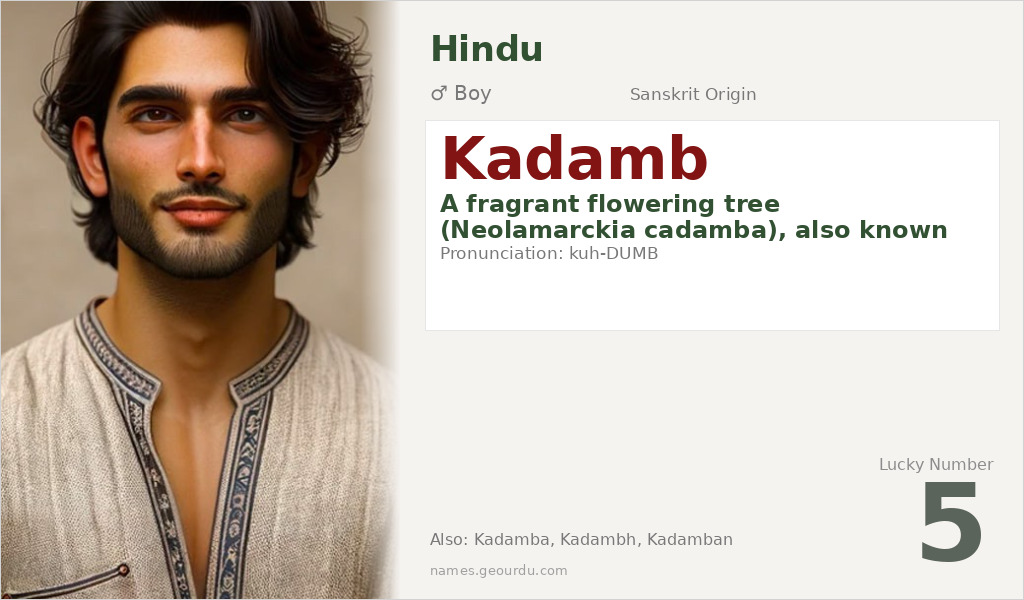
| 📛 Name | Kadamb |
| 💎 Meaning | A fragrant flowering tree (Neolamarckia cadamba), also known as the burflower tree or kadam tree |
| 👤 Gender | Boy |
| 🕌 Religion | Hindu |
| 🌍 Origin | Sanskrit |
| 🗣 Pronunciation | kuh-DUMB |
| ✍️ Urdu | کدمب |
| ✍️ Arabic | كادامب |
| 🔢 Numerology | 5 |
| ✨ Spellings | Kadamba, Kadambh, Kadamban |
Origin & Cultural Significance
The name Kadamb originates from ancient Sanskrit, India’s classical language, and has been used for centuries in Hindu communities. It appears in revered texts like the Mahabharata and Puranas, where the kadamb tree is mentioned in contexts of devotion and pastoral life. Culturally, the tree is associated with the monsoon season and is considered sacred in many regions, often planted near temples. As a personal name, Kadamb is predominantly given to boys in Hindu families, emphasizing values of growth, stability, and spiritual rootedness, inspired by the tree’s enduring presence in Indian folklore and religious practices.
Personality Traits
People named Kadamb are often perceived as calm, dependable, and deeply connected to their roots, much like the tree they are named after. They may exhibit a nurturing personality, supporting others with patience and strength, and often have an artistic or spiritual inclination. Their grounded nature helps them weather life’s challenges while maintaining a sense of grace and natural charm, making them beloved in their social circles.
Similar Names
If you like Kadamb, consider: Arjun, Ashok, Neel, Palash, Vriksh
Famous People Named Kadamb
- Kadambari Devi — 19th-century Bengali writer and sister-in-law of Rabindranath Tagore
- Kadambini Ganguly — One of India's first female physicians and a social reformer
Frequently Asked Questions About Kadamb
What does Kadamb mean?
Kadamb means 'fragrant kadam tree' (Neolamarckia cadamba), originating from Sanskrit. It refers to a tree celebrated in Hindu mythology for its beauty and association with Lord Krishna.
Is Kadamb a boy or girl name?
Kadamb is traditionally a boy's name in Hindu culture, though its botanical meaning could make it adaptable. It is overwhelmingly used for males in India.
What is the origin of Kadamb?
Kadamb originates from Sanskrit, an ancient Indian language, and is deeply embedded in Hindu tradition, literature, and ecology.





