
Table of Contents
Mahakram is a powerful Sanskrit name for boys that carries profound meaning and cultural significance. Derived from ancient Indian linguistic roots, this name symbolizes progress, advancement, and significant achievement. With its compound structure meaning ‘great step’, Mahakram represents the journey of life and the importance of meaningful progression. This name has been used for centuries in Hindu communities, reflecting values of determination and purposeful movement through life’s challenges.
Meaning of Mahakram
The name Mahakram has a clear and well-documented meaning in Sanskrit, the classical language of ancient India. It combines ‘Maha’ (महा), meaning ‘great, mighty, or supreme’, with ‘Kram’ (क्रम), meaning ‘step, stride, or progression’. The Sanskrit root √kram gives us words related to walking, proceeding, and sequential movement. In Hindu philosophical contexts, ‘kram’ can also refer to systematic progression or stages of development. Thus, Mahakram literally translates to ‘one who takes great steps’ or ‘maker of significant progress’. This name appears in various Sanskrit texts, sometimes as an epithet for deities who traverse great distances or accomplish monumental tasks, but primarily as a meaningful personal name emphasizing achievement and advancement.
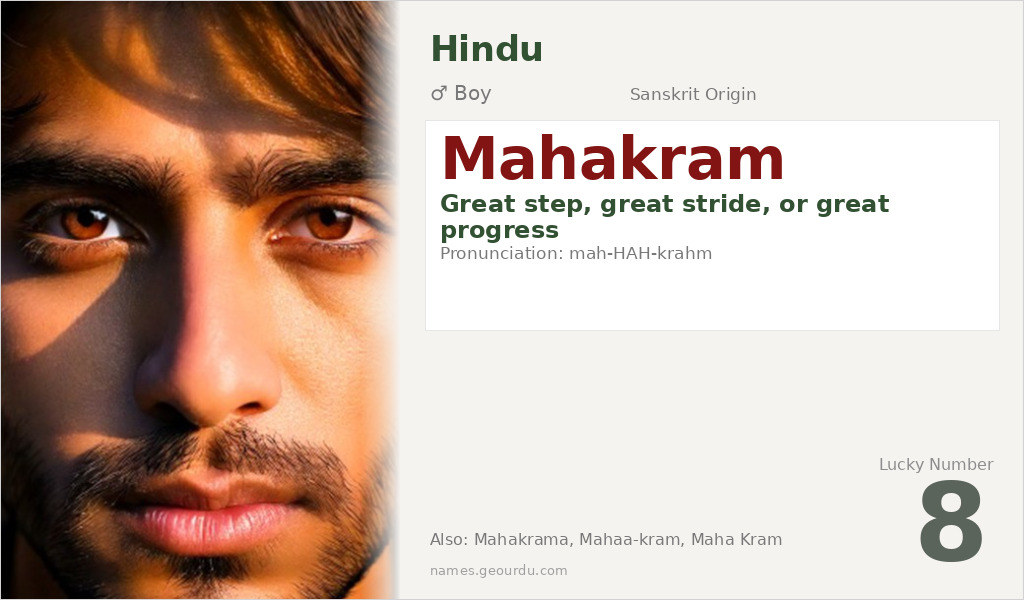
| 📛 Name | Mahakram |
| 💎 Meaning | Great step, great stride, or great progress |
| 👤 Gender | Boy |
| 🕌 Religion | Hindu |
| 🌍 Origin | Sanskrit |
| 🗣 Pronunciation | mah-HAH-krahm |
| ✍️ Urdu | مہاکرم |
| ✍️ Arabic | مهاكرام |
| 🔢 Numerology | 8 |
| ✨ Spellings | Mahakrama, Mahaa-kram, Maha Kram |
Origin & Cultural Significance
Mahakram originates from Sanskrit, one of the oldest Indo-European languages with documented use dating back over 3,500 years. As a compound name, it follows traditional Sanskrit naming conventions where meaningful elements are combined to create names with specific virtues or aspirations. The name reflects Hindu cultural values that emphasize personal growth, spiritual progression, and meaningful life journeys. While not among the most common Sanskrit names today, Mahakram appears in historical records and regional naming traditions across India, particularly in communities that preserve classical Sanskrit naming practices. The name’s structure and meaning align with Hindu philosophical concepts of Dharma (righteous path) and Krama (orderly progression through life’s stages).
Personality Traits
Those named Mahakram are often associated with qualities of determination, leadership, and progressive thinking. The name’s meaning suggests someone who doesn’t take small steps but makes significant advancements in whatever they pursue. This could manifest as academic achievement, career success, spiritual growth, or community leadership. People with this name are typically seen as purposeful individuals who approach life with measured determination, capable of overcoming obstacles through persistent effort and strategic planning. The name carries an expectation of meaningful contribution and the ability to inspire progress in others.
Similar Names
If you like Mahakram, consider: Mahavir, Mahadev, Mahakal, Kramadev, Mahaprabhu, Maharaj, Kramjit, Mahasena
Famous People Named Mahakram
- Mahakram Sharma — Indian classical musician and scholar
- Mahakram Singh — Historical figure mentioned in regional Rajasthani chronicles
Frequently Asked Questions About Mahakram
What does Mahakram mean?
Mahakram means 'great step', 'great stride', or 'great progress' in Sanskrit. It's a compound name combining 'Maha' (great) and 'Kram' (step/progression).
Is Mahakram a boy or girl name?
Mahakram is traditionally a masculine name in Hindu naming conventions. Sanskrit compound names ending with certain elements like 'kram' are typically masculine, though naming practices can vary regionally.
What is the origin of Mahakram?
Mahakram originates from Sanskrit, the classical language of ancient India. It follows traditional Hindu naming patterns and has been used for centuries in Indian communities, particularly those preserving Sanskrit naming traditions.





