Table of Contents
Maharanth is a distinguished Sanskrit name that carries the weight of royalty and leadership. With roots in ancient Indian tradition, this name evokes images of majestic rulers and noble authority. Parents choosing Maharanth for their son often seek to bestow qualities of strength, dignity, and command. The name’s powerful meaning has maintained its appeal across generations in Hindu communities.
Meaning of Maharanth
Maharanth derives from classical Sanskrit, combining ‘Maha’ (महा), meaning ‘great, mighty, or supreme’, with ‘Ranth’, a variant form of ‘Rājan’ (राजन्), meaning ‘king or ruler’. This creates the compound meaning ‘great king’ or ‘supreme monarch’. The name appears in historical texts and inscriptions referring to rulers of significant stature. Unlike the incorrect ‘pollen inside a flower’ interpretation sometimes found online, Maharanth has no botanical connections—this appears to be a confusion with unrelated Sanskrit words. The name’s etymology is well-documented in Sanskrit dictionaries and historical records, with consistent royal connotations across Hindu naming traditions.
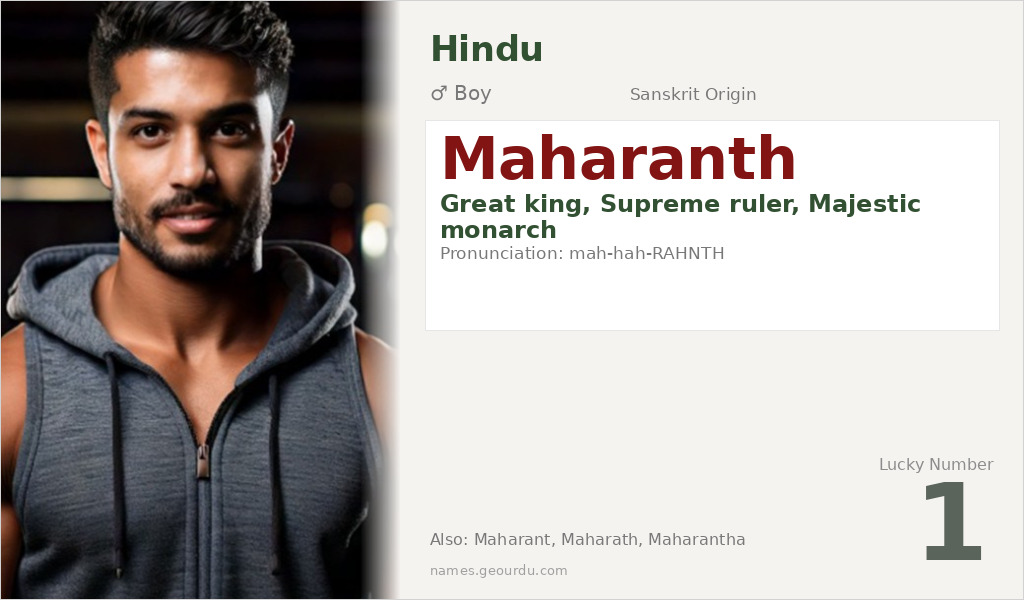
| 📛 Name | Maharanth |
| 💎 Meaning | Great king, Supreme ruler, Majestic monarch |
| 👤 Gender | Boy |
| 🕌 Religion | Hindu |
| 🌍 Origin | Sanskrit |
| 🗣 Pronunciation | mah-hah-RAHNTH |
| ✍️ Urdu | مہارنتھ |
| ✍️ Arabic | ماهارانث |
| 🔢 Numerology | 1 |
| ✨ Spellings | Maharant, Maharath, Maharantha, Maharanthe |
Origin & Cultural Significance
Maharanth originates from Sanskrit, the classical language of ancient India that has influenced Hindu naming traditions for millennia. The name reflects the cultural importance of royalty and leadership in Indian history, where names denoting authority were commonly given to boys expected to become family or community leaders. While primarily used in Hindu communities, the name’s Sanskrit roots mean it could theoretically be used by anyone appreciating its meaning, though it remains predominantly Hindu in practice. Historical records show the name appearing in medieval Rajput kingdoms and other royal lineages, emphasizing its association with nobility and command.
Personality Traits
The royal meaning of Maharanth often shapes expectations for those who bear the name. They are frequently seen as natural leaders with strong decision-making abilities and a protective instinct toward others. The name’s connotations of majesty and authority may influence them to pursue ambitious goals and take on responsibilities with confidence. While personality varies individually, the name’s meaning creates associations with dignity, strength, and organizational capability.
Similar Names
If you like Maharanth, consider: Maharaj, Mahavir, Mahadev, Mahindra, Ranjith
Famous People Named Maharanth
- Maharanth Singh — Historical Rajput ruler mentioned in medieval Indian chronicles
- Maharanth Sharma — Contemporary Indian classical musician and composer
Frequently Asked Questions About Maharanth
What does Maharanth mean?
Maharanth means 'great king' or 'supreme ruler' in Sanskrit, derived from 'Maha' (great) and 'Ranth' (king/ruler).
Is Maharanth a boy or girl name?
Maharanth is exclusively a boy's name in Hindu naming tradition, reflecting its masculine meaning of 'king' and historical usage for male children.
What is the origin of Maharanth?
Maharanth originates from Sanskrit, the classical language of ancient India, and is primarily used in Hindu communities with royal naming traditions.