
Table of Contents
Mokshi is a profound name with deep spiritual roots in Indian philosophy. Derived from the Sanskrit word for ‘liberation,’ this name carries the weight of ultimate spiritual freedom—release from the cycle of rebirth. While traditionally more common in Hindu communities, its universal philosophical appeal makes it meaningful across cultures. Today, Mokshi serves as both a beautiful name and a reminder of life’s highest spiritual aspirations.
Meaning of Mokshi
Mokshi originates from the Sanskrit term ‘mokṣa’ (मोक्ष), which literally translates to ‘liberation,’ ’emancipation,’ or ‘release.’ This concept is central to Dharmic religions including Hinduism, Jainism, and Buddhism, where it represents the final goal of human existence—freedom from the endless cycle of birth, death, and rebirth (saṃsāra). The word comes from the Sanskrit root ‘muc,’ meaning ‘to free, let go, or release.’ As a name, Mokshi embodies this powerful spiritual ideal, suggesting someone destined for or embodying spiritual freedom. Unlike many names that describe physical attributes or virtues, Mokshi represents an ultimate metaphysical state.
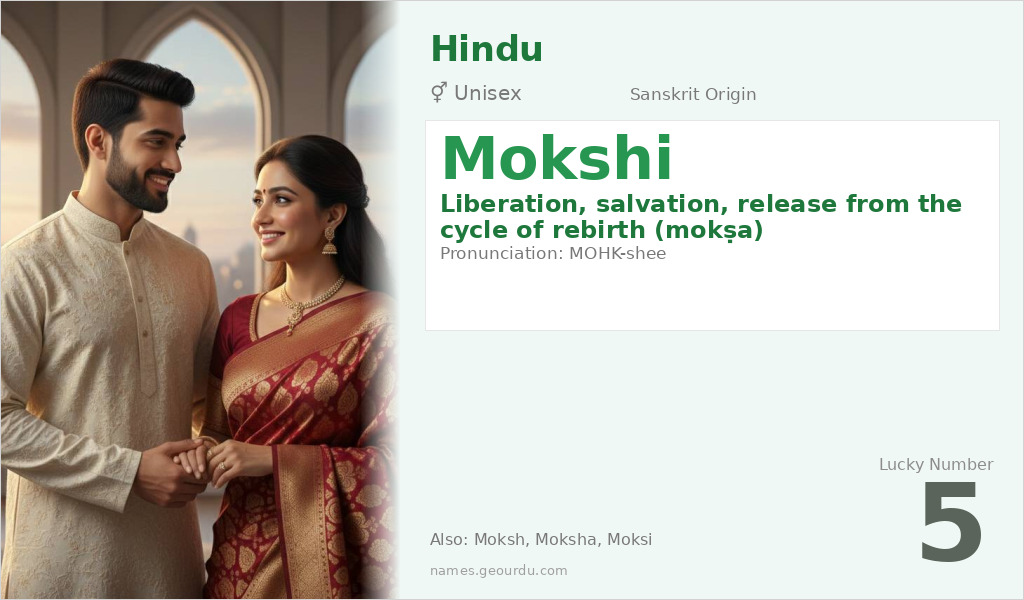
| 📛 Name | Mokshi |
| 💎 Meaning | Liberation, salvation, release from the cycle of rebirth (mokṣa) |
| 👤 Gender | Unisex |
| 🕌 Religion | Hindu |
| 🌍 Origin | Sanskrit |
| 🗣 Pronunciation | MOHK-shee |
| ✍️ Urdu | موکشی |
| ✍️ Arabic | موكشي |
| 🔢 Numerology | 5 |
| ✨ Spellings | Moksh, Moksha, Moksi, Mokshie |
Origin & Cultural Significance
Mokshi has its origins in ancient Sanskrit texts and Indian spiritual traditions dating back thousands of years. The concept of moksha appears in the Upanishads, Bhagavad Gita, and other foundational Hindu scriptures as the fourth and ultimate puruṣārtha (human goal), alongside dharma (duty), artha (prosperity), and kama (pleasure). While the name is most commonly used in Hindu communities in India and the diaspora, its philosophical significance extends to Jain and Buddhist contexts where similar concepts exist (kaivalya in Jainism, nirvana in Buddhism). In modern times, the name has gained popularity beyond strictly religious contexts as parents appreciate its profound meaning and melodic sound.
Personality Traits
Those named Mokshi often exhibit traits aligned with their name’s meaning—they tend to be introspective, spiritually curious, and value personal freedom. They may approach life with philosophical depth, questioning conventional paths and seeking authentic experiences. While individual personalities vary, the name suggests someone who doesn’t feel bound by tradition for tradition’s sake and may inspire others through their search for meaning.
Similar Names
If you like Mokshi, consider: Moksha, Mukti, Nirvana, Mukul, Mohan
Famous People Named Mokshi
- Moksh Juneja — Indian cricketer
- Moksh Khanna — Indian television actor known for 'Bepannah'
Frequently Asked Questions About Mokshi
What does Mokshi mean?
Mokshi means 'liberation' or 'salvation' in Sanskrit, specifically referring to release from the cycle of rebirth in Hindu, Jain, and Buddhist philosophy.
Is Mokshi a boy or girl name?
Mokshi is a unisex name, though it has been used for both boys and girls in Hindu communities. In recent years, it has become increasingly popular for girls in some regions.
What is the origin of Mokshi?
Mokshi originates from Sanskrit, the ancient language of India, and is deeply rooted in Dharmic religious traditions including Hinduism, Jainism, and Buddhism.