
Table of Contents
Nakshatra is a beautiful, celestial name with profound roots in ancient Hindu astronomy and Vedic tradition. Unlike ordinary star names, it carries specific astrological significance as one of the 27 lunar mansions that guide timekeeping and spiritual practices. This name connects the bearer to the cosmic rhythms of the universe, making it a meaningful choice for parents seeking both beauty and depth. Whether for a boy or girl, Nakshatra evokes imagery of the night sky and celestial guidance.
Meaning of Nakshatra
Nakshatra originates from the Sanskrit word ‘nakṣatra’ (नक्षत्र), which literally translates to ‘star’ or ‘constellation’. However, in Hindu and Vedic contexts, it has a more precise meaning: it refers to the 27 divisions of the ecliptic that the moon passes through during its monthly cycle, known as lunar mansions. Etymologically, it combines ‘nakṣ’ (to approach or worship) with ‘tra’ (instrument or protector), suggesting stars as celestial guides or protectors. This term appears in some of India’s oldest texts, including the Rigveda (circa 1500-1200 BCE), where it denotes stars and asterisms. Over millennia, nakshatras became central to Hindu astrology, astronomy, and ritual calendars, with each having specific deities, symbols, and influences.
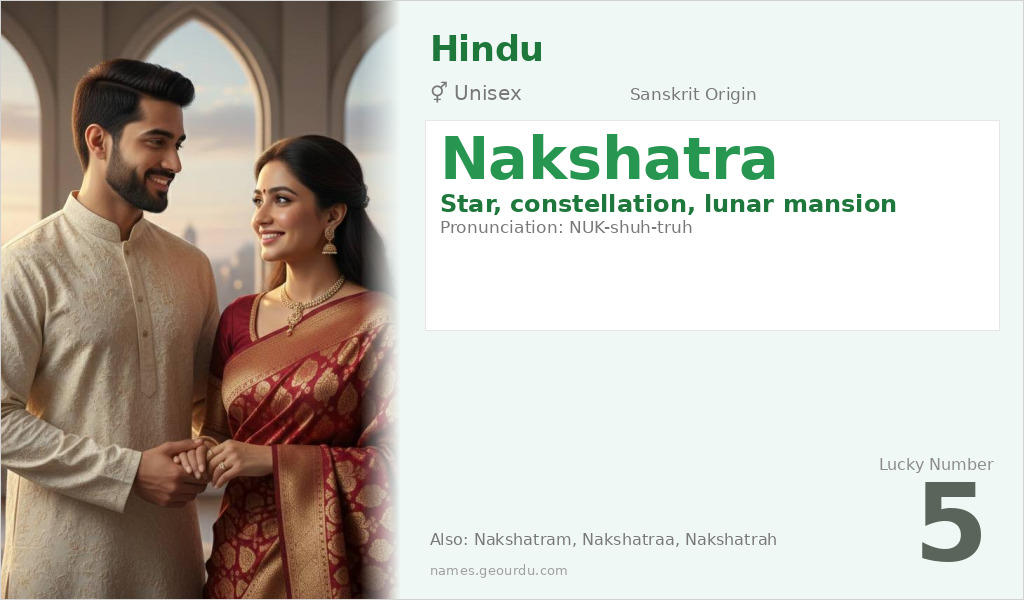
| 📛 Name | Nakshatra |
| 💎 Meaning | Star, constellation, lunar mansion |
| 👤 Gender | Unisex |
| 🕌 Religion | Hindu |
| 🌍 Origin | Sanskrit |
| 🗣 Pronunciation | NUK-shuh-truh |
| ✍️ Urdu | نکشتر |
| ✍️ Arabic | ناكشاترا |
| 🔢 Numerology | 5 |
| ✨ Spellings | Nakshatram, Nakshatraa, Nakshatrah |
Origin & Cultural Significance
Nakshatra has its origins in ancient Sanskrit language and Hindu culture, dating back to the Vedic period in India. It emerged from early astronomical observations where these 27 lunar mansions were used for timekeeping, navigation, and determining auspicious timings for rituals. The concept spread through Hindu, Buddhist, and Jain traditions across South and Southeast Asia. While primarily a Sanskrit term, it has influenced names in related languages like Hindi, Bengali, and Marathi, though it remains most authentic in its original form. Unlike many names that evolved regionally, Nakshatra retains its classical Sanskrit pronunciation and spelling in modern usage, reflecting its enduring cultural and spiritual importance.
Personality Traits
Those named Nakshatra are often associated with qualities of illumination, guidance, and cosmic awareness. They may exhibit a natural inclination toward spirituality, astronomy, or philosophy, with a personality that shines brightly in social settings. Their connection to the stars suggests a destiny intertwined with higher purposes, making them seekers of truth and harmony. While individual personalities vary, the name’s celestial roots often inspire a sense of wonder and a calm, steady presence.
Similar Names
If you like Nakshatra, consider: Tara, Chandra, Surya, Jyoti, Rohini
Famous People Named Nakshatra
- Nakshatra (character) — A character in Indian mythology and literature representing celestial beings
- Nakshatra (film) — A 2010 Indian Kannada-language film directed by debutant director
Frequently Asked Questions About Nakshatra
What does Nakshatra mean?
Nakshatra means 'star', 'constellation', or specifically 'lunar mansion' in Sanskrit, referring to the 27 divisions of the ecliptic in Hindu astrology.
Is Nakshatra a boy or girl name?
Nakshatra is a unisex name, used for both boys and girls in Hindu culture, though it is more commonly given to girls in modern times.
What is the origin of Nakshatra?
Nakshatra originates from Sanskrit language and Hindu tradition, with roots in Vedic astronomy and astrology dating back over 3,000 years.