
Table of Contents
Padman is a beautiful Sanskrit name for boys that carries deep spiritual resonance in Hindu culture. Meaning ‘lotus’ or ‘lotus-holder,’ this name evokes the sacred flower’s symbolism of purity, enlightenment, and divine beauty. With roots in ancient Indian traditions, Padman connects its bearer to timeless values of spiritual growth and resilience. Explore the rich etymology and cultural significance of this meaningful name.
Meaning of Padman
Padman derives from the Sanskrit word ‘padma’ (पद्म), meaning lotus, combined with the suffix ‘-man’ denoting possession or association. The lotus holds immense symbolic weight in Dharmic traditions—representing purity, spiritual awakening, and divine beauty as it rises unstained from muddy waters. In Hindu iconography, deities like Vishnu (as Padmanabha) and Lakshmi are closely associated with lotuses. The name thus signifies ‘one who holds lotuses’ or ‘lotus-like,’ often referring to divine qualities. This etymology is consistently documented across Sanskrit lexicons, religious texts, and classical literature, making its meaning unequivocal.
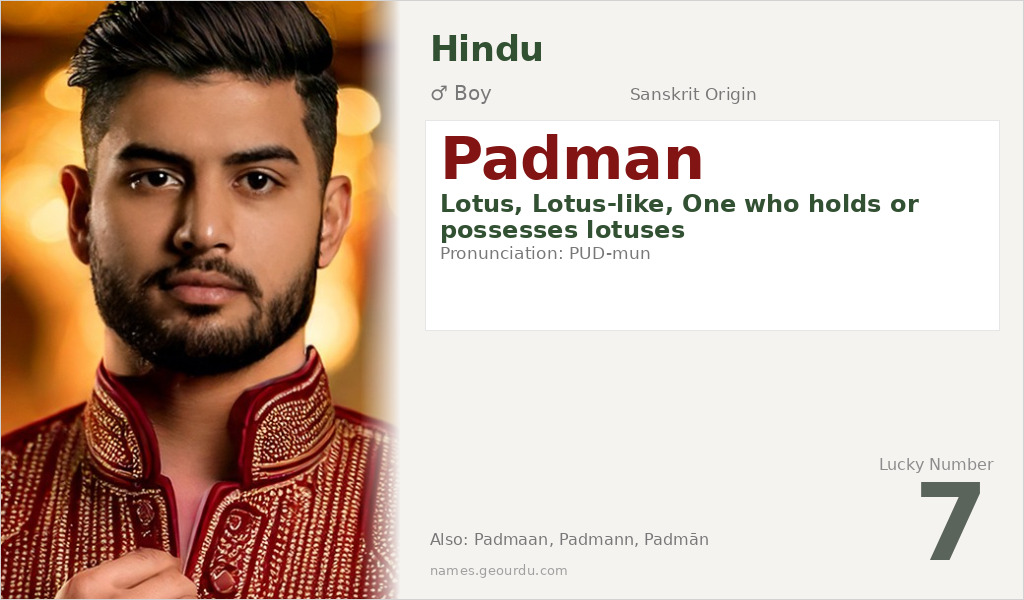
| 📛 Name | Padman |
| 💎 Meaning | Lotus, Lotus-like, One who holds or possesses lotuses |
| 👤 Gender | Boy |
| 🕌 Religion | Hindu |
| 🌍 Origin | Sanskrit |
| 🗣 Pronunciation | PUD-mun |
| ✍️ Urdu | پدمن |
| ✍️ Arabic | بادمان |
| 🔢 Numerology | 7 |
| ✨ Spellings | Padmaan, Padmann, Padmān |
Origin & Cultural Significance
Padman originates from classical Sanskrit, the ancient liturgical language of Hinduism, Buddhism, and Jainism. It appears in various Hindu scriptures and mythological contexts, particularly associated with Vishnu’s epithet ‘Padmanabha’ (lotus-naveled). The name reflects the profound cultural and spiritual significance of the lotus in Indian traditions, where it symbolizes creation, purity, and transcendence. While primarily used in Hindu communities, its Sanskrit roots give it pan-Indian appeal across regions and languages. The name maintains its traditional usage while embodying timeless spiritual values cherished in South Asian naming conventions.
Personality Traits
Those named Padman are often seen as embodying lotus-like qualities—graceful, spiritually aware, and resilient. They may exhibit artistic sensibilities, a calm disposition, and a natural inclination toward purity and integrity. The name suggests someone who navigates life’s challenges with poise, emerging stronger and more beautiful from difficulties. These personality associations stem from the lotus’s symbolic journey from murky waters to radiant bloom, reflecting inner strength and spiritual growth.
Similar Names
If you like Padman, consider: Padma, Padmaja, Padmapriya, Padmalaya, Padmavati
Famous People Named Padman
- Padmanabhaswamy — The deity of the famous Sri Padmanabhaswamy Temple in Thiruvananthapuram, India, whose name means 'Lord of the Lotus Navel'
- Padmanabh Singh — Maharaja of Jaipur, India, whose name incorporates the same 'padma' root meaning lotus
Frequently Asked Questions About Padman
What does Padman mean?
Padman means 'Lotus' or 'Lotus-holder' in Sanskrit, derived from 'padma' (lotus) and the suffix '-man' indicating possession.
Is Padman a boy or girl name?
Padman is traditionally a masculine name in Hindu naming conventions, though the root 'Padma' is often used for feminine names like Padmavati.
What is the origin of Padman?
Padman originates from Sanskrit, the ancient language of India, with deep roots in Hindu spirituality and mythology, particularly associated with lotus symbolism.





