
Table of Contents
Maladhar is a beautiful and meaningful Sanskrit name for boys that carries deep cultural and spiritual significance. Literally translating to ‘bearer of garlands,’ this name evokes images of divine adornment and ceremonial honor. With roots in ancient Hindu traditions, Maladhar connects modern bearers to a rich heritage of poetic and religious expression. Discover the fascinating etymology, historical context, and personality traits associated with this distinctive name.
Meaning of Maladhar
Maladhar is a classical Sanskrit compound name with clear etymological roots. The first component ‘mala’ (माला) specifically means ‘garland, wreath, or necklace,’ particularly referring to floral arrangements used in religious ceremonies and royal adornments. The second component ‘dhar’ (धर) derives from the Sanskrit root ‘dhṛ’ meaning ‘to hold, bear, or support.’ Combined, Maladhar literally means ‘one who bears or wears a garland.’ This name appears in Hindu texts as both a proper name and an epithet for deities, particularly those associated with beauty, devotion, and ceremonial honor. The garland in Hindu tradition symbolizes respect, celebration, and spiritual offering, making this name particularly significant in religious contexts.
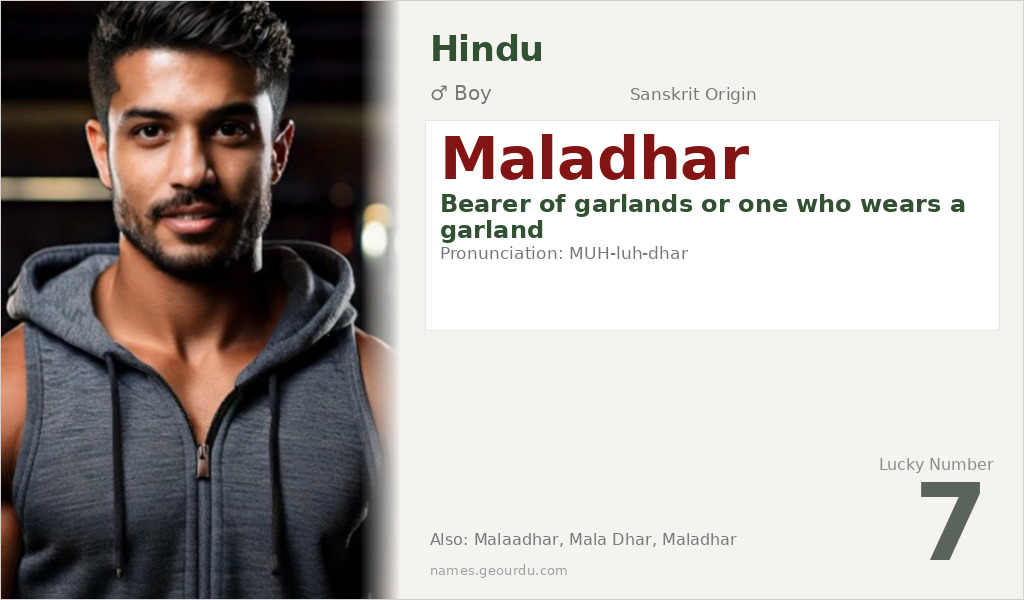
| 📛 Name | Maladhar |
| 💎 Meaning | Bearer of garlands or one who wears a garland |
| 👤 Gender | Boy |
| 🕌 Religion | Hindu |
| 🌍 Origin | Sanskrit |
| 🗣 Pronunciation | MUH-luh-dhar |
| ✍️ Urdu | ملادھر |
| ✍️ Arabic | مالادهار |
| 🔢 Numerology | 7 |
| ✨ Spellings | Malaadhar, Mala Dhar, Maladhar |
Origin & Cultural Significance
Maladhar originates from classical Sanskrit, the ancient liturgical language of Hinduism. As a compound name, it follows traditional Sanskrit naming patterns where meaningful elements are combined to create names with specific connotations. The name appears in early Bengali literature through the 15th-century poet Maladhar Basu, who composed the Sri Krishna Vijaya, indicating its historical usage in Eastern India. While primarily a Hindu name, its Sanskrit origins mean it could theoretically be used by anyone appreciating Indian linguistic heritage, though it remains predominantly within Hindu naming traditions. The name reflects the importance of floral symbolism in Indian culture, where garlands represent honor, devotion, and auspicious beginnings.
Personality Traits
Those named Maladhar are often perceived as having an aesthetic sensibility and appreciation for tradition. They may exhibit qualities of grace, diplomacy, and spiritual depth, with a natural inclination toward artistic or ceremonial pursuits. The name suggests someone who values harmony, beauty, and meaningful rituals in both personal and communal contexts. These individuals might excel in fields requiring attention to detail, cultural preservation, or interpersonal mediation.
Similar Names
If you like Maladhar, consider: Malakar, Malay, Dharam, Dhara, Malini
Famous People Named Maladhar
- Maladhar Basu — 15th-century Bengali poet and author of Sri Krishna Vijaya, one of the earliest Bengali narrative poems
- Maladhar — A name appearing in Hindu mythological texts as an epithet for deities who wear garlands
Frequently Asked Questions About Maladhar
What does Maladhar mean?
Maladhar means 'bearer of garlands' or 'one who wears a garland.' It is a Sanskrit compound name from 'mala' (garland) and 'dhar' (bearer).
Is Maladhar a boy or girl name?
Maladhar is traditionally a masculine name in Hindu naming conventions, though Sanskrit compound names can sometimes be adapted. Historical usage shows it as exclusively male.
What is the origin of Maladhar?
Maladhar originates from Sanskrit, the classical language of Hinduism. It is specifically a Hindu name with documented usage in Indian literature and religious contexts.





