
Table of Contents
Manavazagan is a distinctive Hindu boy’s name that carries an air of mystery regarding its exact origins and meaning. While commonly used within certain Hindu communities, its etymology remains elusive despite extensive linguistic research. This name is associated with positive attributes and numerological significance, making it an intriguing choice for parents seeking a unique name with spiritual connections. Let’s explore what makes Manavazagan special and examine its cultural context.
Meaning of Manavazagan
The meaning of Manavazagan presents a linguistic puzzle that has resisted clear resolution through conventional etymological research. Analysis suggests it may be a compound name where ‘Manava’ could potentially derive from Sanskrit roots meaning ‘human’ or ‘man’, specifically from ‘manava’ (मनव) referring to humanity or descendants of Manu, the progenitor in Hindu mythology. The ‘zagan’ component doesn’t correspond to established suffixes in major Indian languages, though it might represent a regional dialect variation or family-specific addition. Some scholars speculate it could be a creative combination meant to evoke qualities of humanity and strength, but without documented sources, this remains conjecture. The name’s structure suggests it may have developed in specific regional or community contexts rather than having ancient textual origins.
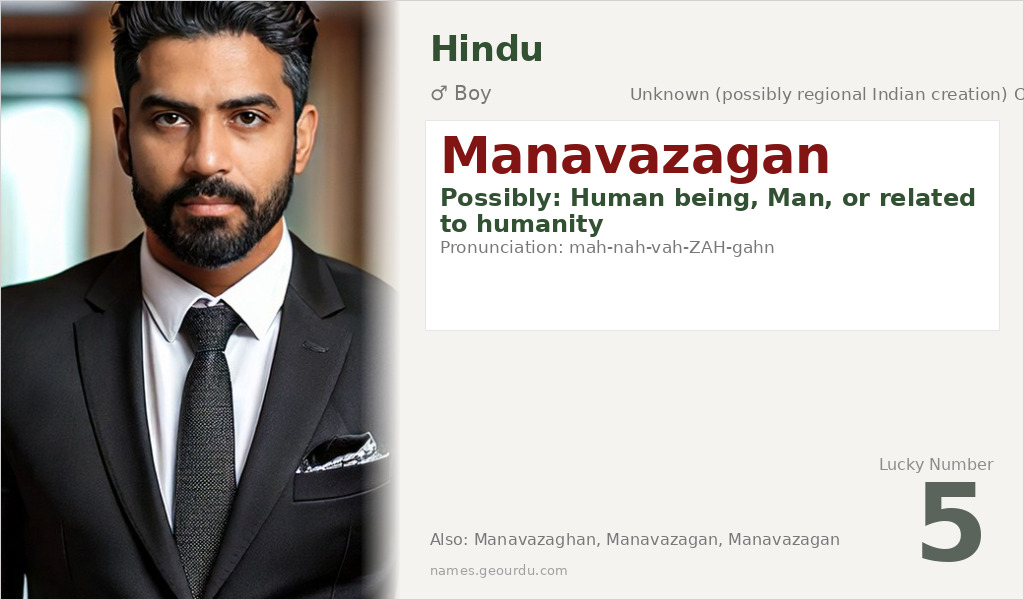
| 📛 Name | Manavazagan |
| 💎 Meaning | Possibly: Human being, Man, or related to humanity |
| 👤 Gender | Boy |
| 🕌 Religion | Hindu |
| 🌍 Origin | Unknown (possibly regional Indian creation) |
| 🗣 Pronunciation | mah-nah-vah-ZAH-gahn |
| ✍️ Urdu | ماناوازگان |
| ✍️ Arabic | مانافازاغان |
| 🔢 Numerology | 5 |
| ✨ Spellings | Manavazaghan, Manavazagan, Manavazagan |
Origin & Cultural Significance
Manavazagan appears to be a modern Hindu name without clear historical antecedents in classical texts. Its usage seems concentrated in specific Hindu communities, possibly in South India or among diaspora populations, though exact geographic origins are difficult to trace. The name doesn’t appear in traditional Sanskrit name compilations, epics like the Mahabharata or Ramayana, or Puranic literature, suggesting it may be a relatively recent creation. Cultural context indicates it follows Hindu naming conventions that often incorporate elements related to virtues, deities, or abstract qualities, even when the complete name isn’t documented in ancient sources. The association with numerology (number 5) and specific auspicious days aligns with Hindu astrological naming traditions that consider such factors important for a child’s destiny.
Personality Traits
According to numerological interpretation associated with the number 5, individuals named Manavazagan are believed to possess dynamic, progressive personalities. They’re often seen as multi-talented individuals who embrace change and seek variety in life. Their curious nature drives them to explore different perspectives and experiences, making them adaptable in various situations. While these traits are based on numerological tradition rather than the name’s linguistic meaning, they represent how the name is culturally perceived within Hindu naming practices.
Similar Names
If you like Manavazagan, consider: Manav, Manava, Manavendra, Manavalan, Manavik
Famous People Named Manavazagan
- No verified famous individuals found with this exact name
Frequently Asked Questions About Manavazagan
What does Manavazagan mean?
The exact meaning of Manavazagan is uncertain. It appears to be a compound name where 'Manava' might relate to Sanskrit words for 'human' or 'man', but the complete etymology isn't verified in established linguistic sources.
Is Manavazagan a boy or girl name?
Manavazagan is exclusively used as a boy's name within Hindu naming traditions. All documented instances show it assigned to male children.
What is the origin of Manavazagan?
Manavazagan is a Hindu name of uncertain linguistic origin. It doesn't appear in classical Sanskrit texts and may be a modern creation within specific Hindu communities, possibly with regional influences.





