
Table of Contents
Narasimha is a powerful Sanskrit name with deep roots in Hindu mythology and tradition. Meaning ‘man-lion’ or ‘lion-man’, this name carries the legacy of one of Vishnu’s most dramatic avatars. Parents choosing this name often seek to imbue their child with qualities of courage, protection, and divine strength. As a name that has traveled through centuries of Indian culture, Narasimha remains a meaningful choice with rich spiritual connotations.
Meaning of Narasimha
The name Narasimha originates from Sanskrit, one of the world’s oldest languages, and is a compound of two words: ‘nara’ meaning ‘man’ or ‘human being’ and ‘simha’ meaning ‘lion’. This creates the literal translation ‘man-lion’ or ‘lion-man’. In Hindu mythology, this specifically refers to the fourth avatar of Lord Vishnu, who took this hybrid form to defeat the demon king Hiranyakashipu while circumventing the boon that made the demon invulnerable to attack by man or beast, inside or outside, during day or night. The name appears in numerous Hindu scriptures including the Bhagavata Purana, Vishnu Purana, and various Upanishads. Linguistically, the name demonstrates the sophisticated compound word formation characteristic of Sanskrit, where two nouns combine to create a new concept with specific mythological significance.
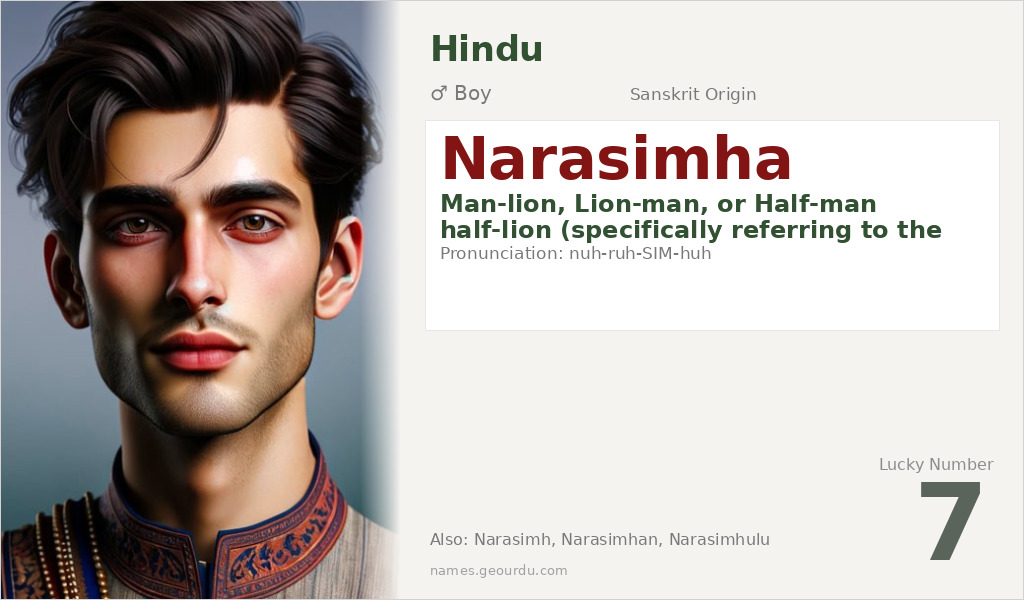
| 📛 Name | Narasimha |
| 💎 Meaning | Man-lion, Lion-man, or Half-man half-lion (specifically referring to the fourth avatar of Vishnu in Hindu mythology) |
| 👤 Gender | Boy |
| 🕌 Religion | Hindu |
| 🌍 Origin | Sanskrit |
| 🗣 Pronunciation | nuh-ruh-SIM-huh |
| ✍️ Urdu | نرسمہا |
| ✍️ Arabic | ناراسيمها |
| 🔢 Numerology | 7 |
| ✨ Spellings | Narasimh, Narasimhan, Narasimhulu, Nrisimha, Nrisinh |
Origin & Cultural Significance
Narasimha has its origins in ancient Sanskrit texts and Hindu religious traditions dating back thousands of years. The name gained prominence through the story of the Narasimha avatar in Hindu mythology, where Vishnu manifested as half-man, half-lion to protect his devotee Prahlada and restore dharma. This avatar story is particularly significant in Vaishnavism, where Narasimha is worshipped as a protective deity. The name spread throughout the Indian subcontinent and Southeast Asia through Hindu cultural expansion, with temples dedicated to Narasimha found across India, Nepal, and Indonesia. In modern times, the name remains popular in Hindu communities, particularly in South India where it appears in various regional forms and is associated with protection and divine intervention.
Personality Traits
Those named Narasimha are often associated with protective, courageous, and principled characteristics. Drawing from the mythological avatar’s qualities, they may exhibit fierce determination when defending their beliefs or protecting others. The name suggests someone who can navigate complex situations with wisdom and strength, balancing human intelligence with lion-like courage. These individuals often command respect and are seen as guardians of justice in their communities.
Similar Names
If you like Narasimha, consider: Vishnu, Krishna, Rama, Hanuman, Simha
Famous People Named Narasimha
- Narasimha Rao — Former Prime Minister of India (1991-1996)
- Narasimhan — Indian mathematician known for the Narasimhan-Seshadri theorem
Frequently Asked Questions About Narasimha
What does Narasimha mean?
Narasimha means 'man-lion' or 'lion-man' in Sanskrit, specifically referring to the fourth avatar of Lord Vishnu in Hindu mythology who appeared in a half-human, half-lion form.
Is Narasimha a boy or girl name?
Narasimha is exclusively a boy's name in Hindu naming traditions, as it refers to a male deity avatar and follows masculine grammatical forms in Sanskrit.
What is the origin of Narasimha?
Narasimha originates from Sanskrit, the ancient language of India, and comes from Hindu religious texts where it refers to one of Vishnu's ten principal avatars, specifically the man-lion incarnation.





