
Table of Contents
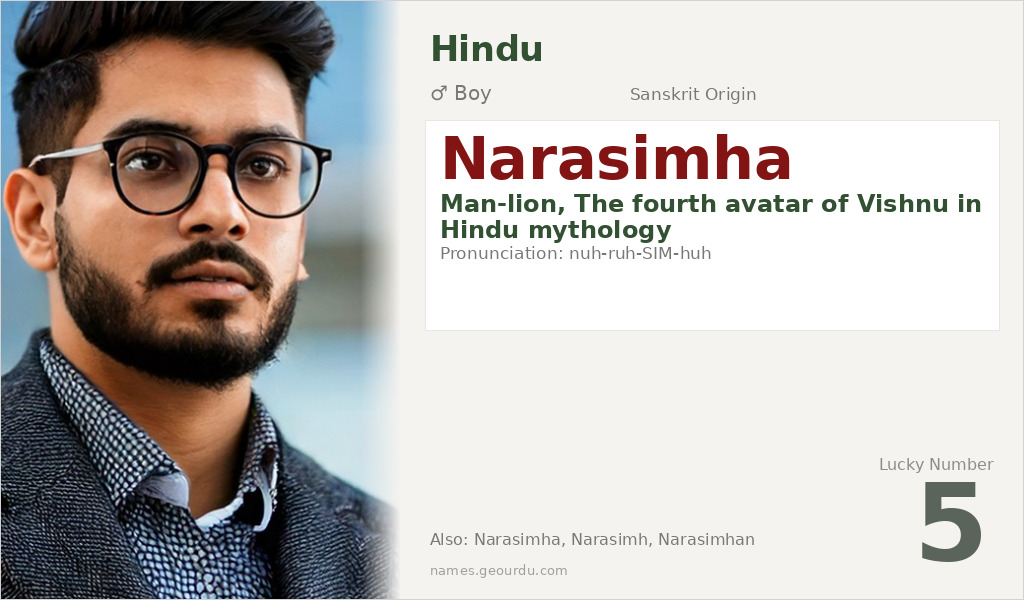
Narasimha is a powerful Sanskrit name with deep roots in Hindu mythology. Meaning ‘man-lion,’ this name refers to the fourth avatar of Lord Vishnu, who appeared in a unique half-human, half-lion form. As a boy’s name, Narasimha carries connotations of divine protection, courage, and the triumph of good over evil. This ancient name continues to be cherished in Hindu communities worldwide for its spiritual significance and heroic associations.
Meaning of Narasimha
Narasimha is a classical Sanskrit compound name with transparent etymology. The first component ‘nara’ (नर) derives from Proto-Indo-European *h₂nḗr meaning ‘man’ or ‘human,’ related to Greek anēr and Latin Nero. The second component ‘simha’ (सिंह) means ‘lion,’ tracing to Proto-Indo-Iranian *sinĝʰás. Together, they form ‘man-lion,’ specifically referring to the fourth avatar of Vishnu in Hindu theology. This avatar is described in texts like the Bhagavata Purana and Vishnu Purana as appearing to protect the child devotee Prahlada from his demon father Hiranyakashipu. The name’s meaning is therefore both literal (describing the hybrid form) and theological (identifying a specific divine manifestation).
| 📛 Name | Narasimha |
| 💎 Meaning | Man-lion, The fourth avatar of Vishnu in Hindu mythology |
| 👤 Gender | Boy |
| 🕌 Religion | Hindu |
| 🌍 Origin | Sanskrit |
| 🗣 Pronunciation | nuh-ruh-SIM-huh |
| ✍️ Urdu | نرسمہا |
| ✍️ Arabic | ناراسيمها |
| 🔢 Numerology | 5 |
| ✨ Spellings | Narasimha, Narasimh, Narasimhan, Nrisimha, Nrisinh |
Origin & Cultural Significance
Narasimha originates from ancient Sanskrit texts of Hinduism, particularly the Puranas composed between 300-1000 CE. The name is central to Vaishnavism, where it denotes one of the ten principal avatars of Vishnu. Culturally, the name is most prevalent in South Asian Hindu communities, especially in India, Nepal, and the diaspora. Historical usage includes temple names (like the famous Ahobilam Narasimha Temple in Andhra Pradesh) and royal titles. The name appears in classical Sanskrit literature, inscriptions, and continues in modern usage, often shortened to ‘Simha’ or combined with other elements in compound names.
Personality Traits
Those named Narasimha are often associated with protective qualities and moral courage, inspired by the avatar’s mythological role. They may exhibit leadership tendencies combined with a sense of justice and duty. The name suggests someone who stands firmly for principles and protects the vulnerable, much like the divine figure who intervened to save Prahlada from persecution. These associations make the name particularly meaningful in Hindu families valuing spiritual heritage and ethical strength.
Similar Names
If you like Narasimha, consider: Vishnu, Krishna, Rama, Hanuman, Varaha
Famous People Named Narasimha
- Narasimha Rao — Former Prime Minister of India (full name: Pamulaparthi Venkata Narasimha Rao)
- Narasimhan — Indian mathematician known for the Narasimhan-Seshadri theorem
Frequently Asked Questions About Narasimha
What does Narasimha mean?
Narasimha means 'man-lion' in Sanskrit and specifically refers to the fourth avatar of the Hindu god Vishnu, who appeared in a half-human, half-lion form to protect his devotee Prahlada.
Is Narasimha a boy or girl name?
Narasimha is exclusively a boy's name in Hindu naming traditions, as it refers to a male divine avatar and uses masculine grammatical forms in Sanskrit.
What is the origin of Narasimha?
Narasimha originates from Sanskrit, the classical language of ancient India, and comes from Hindu scriptures, particularly the Puranas composed between 300-1000 CE.





