Table of Contents
Nachiketa is a profound Sanskrit name with deep roots in Hindu philosophy and spirituality. Originating from the ancient Katha Upanishad, this name carries the legacy of a young seeker who fearlessly questioned death itself. Today, it represents intellectual curiosity, spiritual depth, and philosophical inquiry. Parents choosing this name often value wisdom, courage, and the pursuit of higher knowledge.
Meaning of Nachiketa
The name Nachiketa derives from Sanskrit, combining ‘na’ (meaning ‘not’) and ‘chiketa’ (meaning ‘knowing’ or ‘perceiving’). Literally translated as ‘one who is not aware’ or ‘unconscious’, in the spiritual context it signifies someone who transcends ordinary worldly awareness. In the Katha Upanishad, Nachiketa is the son of sage Vajasravasa who, dissatisfied with his father’s ritual sacrifices, seeks ultimate truth from Yama, the god of death. The name thus embodies the qualities of spiritual inquiry, fearlessness in facing fundamental questions, and the journey from ignorance to enlightenment. It represents the archetypal seeker who questions the nature of existence, consciousness, and the afterlife.
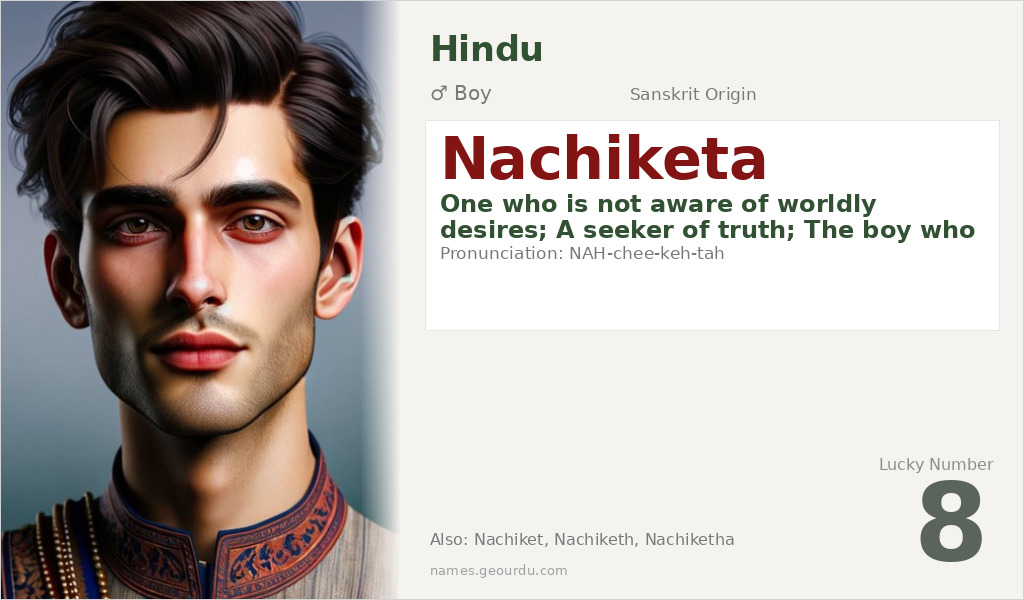
| 📛 Name | Nachiketa |
| 💎 Meaning | One who is not aware of worldly desires; A seeker of truth; The boy who questioned Yama (god of death) in Hindu mythology |
| 👤 Gender | Boy |
| 🕌 Religion | Hindu |
| 🌍 Origin | Sanskrit |
| 🗣 Pronunciation | NAH-chee-keh-tah |
| ✍️ Urdu | ناچیکیٹا |
| ✍️ Arabic | ناتشيكيتا |
| 🔢 Numerology | 8 |
| ✨ Spellings | Nachiket, Nachiketh, Nachiketha |
Origin & Cultural Significance
Nachiketa originates from ancient Sanskrit texts, most prominently featured in the Katha Upanishad (circa 5th century BCE), one of the primary Upanishads that form the philosophical foundation of Hinduism. The story of Nachiketa appears in the Taittiriya Brahmana of the Krishna Yajurveda tradition. This name has been preserved through millennia in Hindu philosophical discourse and spiritual literature. While primarily used in Hindu communities, the name’s philosophical significance has made it recognizable in academic and interfaith circles studying comparative religion. The narrative of Nachiketa questioning Yama about the nature of the soul (atman) and liberation (moksha) remains one of Hinduism’s most celebrated dialogues about spiritual inquiry.
Personality Traits
Those named Nachiketa often exhibit intellectual depth, philosophical curiosity, and spiritual sensitivity. They tend to be contemplative individuals who question surface realities and seek deeper meanings in life experiences. With natural analytical abilities and courage to explore unconventional paths, they often inspire others through their pursuit of truth and wisdom. Their namesake’s legendary dialogue with death gives them a perspective that values substance over superficiality in human endeavors.
Similar Names
If you like Nachiketa, consider: Nachiketas, Nachik, Nachi, Chiketa, Uddalaka
Famous People Named Nachiketa
- Nachiketa — Indian spiritual teacher and author known for his commentaries on the Upanishads
- Nachiketa Chakraborty — Bengali singer and composer known for his modern interpretations of spiritual music
Frequently Asked Questions About Nachiketa
What does Nachiketa mean?
Nachiketa means 'one who is not aware of worldly desires' or 'a seeker of truth' in Sanskrit. It comes from the ancient Hindu text Katha Upanishad, where Nachiketa questions Yama (god of death) about the nature of the soul and afterlife.
Is Nachiketa a boy or girl name?
Nachiketa is exclusively a boy's name in Hindu tradition. In the original Sanskrit texts, Nachiketa is a male character, and the name has been used for boys throughout its history in Hindu communities.
What is the origin of Nachiketa?
Nachiketa originates from Sanskrit, the ancient Indian language. It comes specifically from the Katha Upanishad (circa 5th century BCE), one of the primary philosophical texts of Hinduism, where Nachiketa is the central character who dialogues with Yama about spiritual truths.