Table of Contents
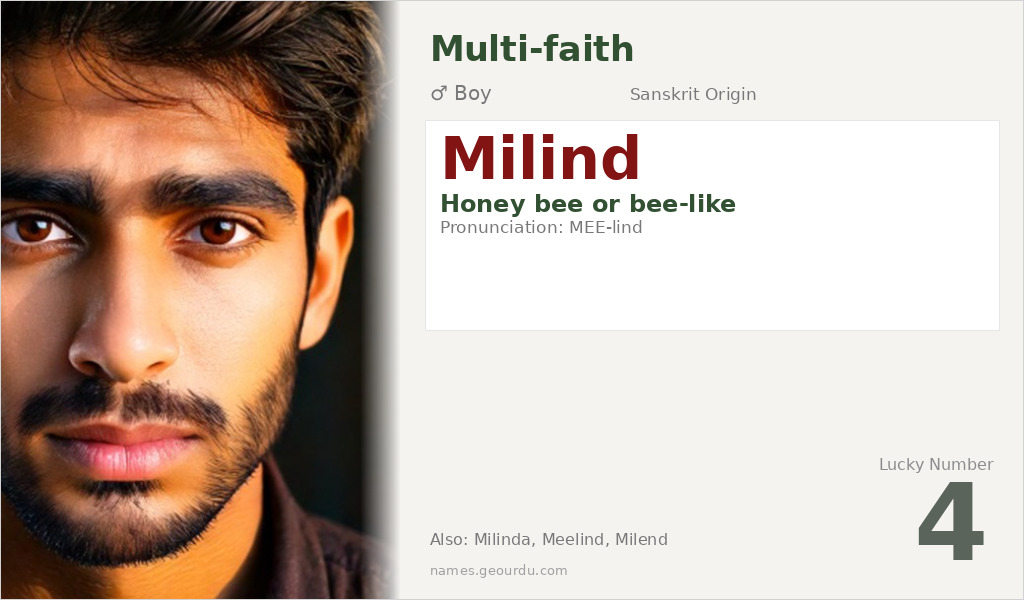
Milind is a distinctive boy’s name with sweet connotations and rich historical depth. Derived from Sanskrit meaning ‘honey bee,’ this name carries associations of industriousness, sweetness, and community. Most famously connected to the Indo-Greek king Milinda in Buddhist literature, the name bridges ancient wisdom with modern appeal. Today, it remains popular across South Asia and among diaspora communities worldwide.
Meaning of Milind
Milind originates from the Sanskrit word ‘मिलिन्द’ (milinda), which literally translates to ‘honey bee’ or ‘bee-like.’ The etymology combines elements suggesting meeting or joining (‘mili’) with the symbolic qualities of bees—sweetness, productivity, and social organization. In classical Indian literature, bees often represent eloquence, diligence, and the gathering of wisdom. The name’s most significant historical appearance is in the Pali Buddhist text ‘Milinda-pañha,’ where King Milinda engages in philosophical dialogue with the sage Nāgasena. This connection gives the name profound religious and philosophical dimensions beyond its literal meaning.
| 📛 Name | Milind |
| 💎 Meaning | Honey bee or bee-like |
| 👤 Gender | Boy |
| 🕌 Religion | Multi-faith |
| 🌍 Origin | Sanskrit |
| 🗣 Pronunciation | MEE-lind |
| ✍️ Urdu | ملند |
| ✍️ Arabic | ميليند |
| 🔢 Numerology | 4 |
| ✨ Spellings | Milinda, Meelind, Milend |
Origin & Cultural Significance
Milind has its roots in ancient Sanskrit, India’s classical language, and appears in both Hindu and Buddhist traditions. The name gained particular prominence through King Menander I (known as Milinda in Pali), a 2nd-century BCE Indo-Greek ruler who converted to Buddhism and appears in the important Buddhist text ‘The Questions of King Milinda.’ This historical connection makes the name significant in Buddhist communities across South and Southeast Asia. While commonly used in Hindu families today, the name transcends religious boundaries and is appreciated for its melodic sound and positive connotations. Its usage spans India, Nepal, Sri Lanka, and diaspora communities worldwide.
Personality Traits
Those named Milind are often associated with bee-like qualities: industrious, socially adept, and productive. They tend to be intelligent communicators who gather knowledge and share it sweetly with others. Their analytical nature makes them good at solving complex problems, while their social orientation helps them build strong communities. The name suggests someone who balances individual diligence with collective harmony.
Similar Names
If you like Milind, consider: Madhav, Madhukar, Bhramar, Shounak, Vrishabha
Famous People Named Milind
- Milind Soman — Indian actor, model, and fitness promoter
- Milind Gunaji — Indian actor and television host
- King Milinda (Menander I) — 2nd century BCE Indo-Greek king who features prominently in Buddhist literature
Frequently Asked Questions About Milind
What does Milind mean?
Milind means 'honey bee' or 'bee-like' in Sanskrit, with connotations of sweetness, industriousness, and community.
Is Milind a boy or girl name?
Milind is traditionally and almost exclusively a masculine name in all cultures where it's used, particularly in Indian naming traditions.
What is the origin of Milind?
Milind originates from Sanskrit and is most famously associated with King Milinda (Menander I) in Buddhist literature, though it's used across Hindu, Buddhist, and Jain communities.