
Table of Contents
Parthasarathi is a profound Sanskrit name with roots in one of Hinduism’s most sacred texts. Meaning ‘charioteer of Arjuna,’ this name directly references Lord Krishna’s pivotal role in the Mahabharata epic. As the divine guide who steered Arjuna’s chariot and delivered the Bhagavad Gita’s teachings, Krishna as Parthasarathi represents wisdom, protection, and spiritual direction. This name carries centuries of religious and cultural significance for Hindu families.
Meaning of Parthasarathi
Parthasarathi derives from classical Sanskrit, combining ‘Partha’ (meaning ‘son of Pritha,’ an epithet for Arjuna) and ‘Sarathi’ (meaning ‘charioteer’ or ‘guide’). The complete name translates precisely to ‘charioteer of Arjuna,’ specifically referring to Lord Krishna’s role during the Kurukshetra War. In the Bhagavad Gita, Krishna serves not only as Arjuna’s physical charioteer but also as his spiritual guide, making this name deeply symbolic. The term appears in ancient Hindu scriptures dating back millennia, with ‘sarathi’ deriving from the Sanskrit root ‘sar’ (to go or move) and ‘Partha’ being a patronymic form. This compound name perfectly captures the relationship between the human warrior and his divine companion.
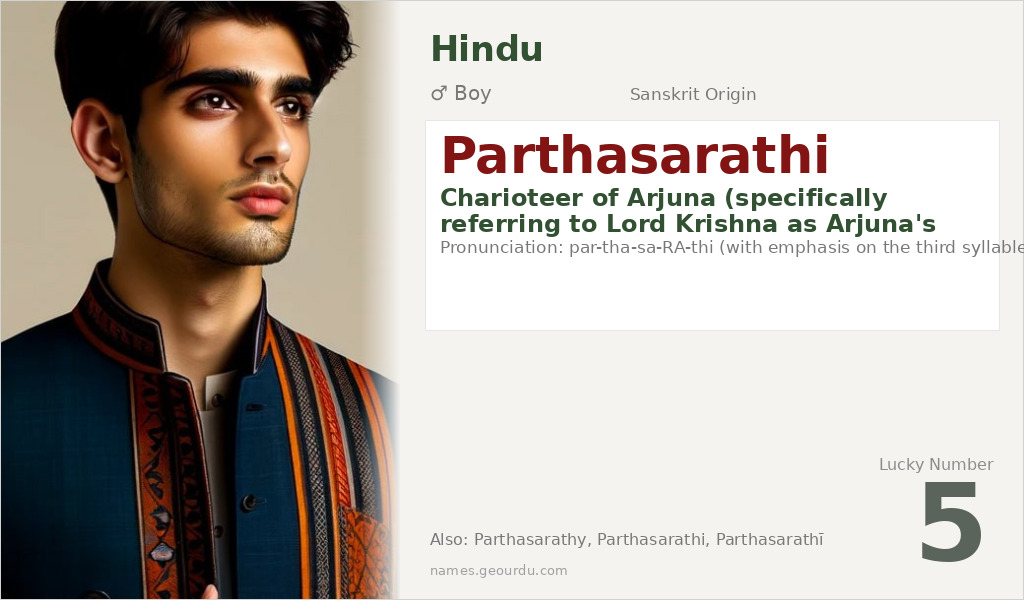
| 📛 Name | Parthasarathi |
| 💎 Meaning | Charioteer of Arjuna (specifically referring to Lord Krishna as Arjuna's charioteer in the Mahabharata) |
| 👤 Gender | Boy |
| 🕌 Religion | Hindu |
| 🌍 Origin | Sanskrit |
| 🗣 Pronunciation | par-tha-sa-RA-thi (with emphasis on the third syllable) |
| ✍️ Urdu | پارتھاسارتی |
| ✍️ Arabic | بارثاساراثي |
| 🔢 Numerology | 5 |
| ✨ Spellings | Parthasarathy, Parthasarathi, Parthasarathī |
Origin & Cultural Significance
Parthasarathi originates from ancient India’s Sanskrit literary tradition, specifically from the Mahabharata epic composed between the 4th century BCE and 4th century CE. The name emerges from the battlefield dialogue between Arjuna and Krishna in the Bhagavad Gita, where Krishna identifies himself as Arjuna’s charioteer. This name has been used for centuries in Hindu communities, particularly in South India where Sanskrit names remain prevalent. Unlike many modern invented names, Parthasarathi has direct textual evidence in classical Hindu literature. The name’s cultural significance extends beyond mere identification to represent the concept of divine guidance in human affairs.
Personality Traits
Those named Parthasarathi often embody qualities of guidance, wisdom, and steadfast support. Like Krishna steering Arjuna’s chariot, they may naturally assume roles as advisors or mentors in their communities. Their personality often combines strategic thinking with compassionate leadership, balancing practical direction with spiritual insight. The name suggests someone who remains calm in crises and provides clarity when others feel lost or uncertain.
Similar Names
If you like Parthasarathi, consider: Krishna, Arjuna, Sarathi, Partha, Govinda, Madhava, Hari, Vasudeva, Keshava, Narayana
Famous People Named Parthasarathi
- Parthasarathi Rajagopalachari — Indian spiritual leader and former president of the Sri Ram Chandra Mission
- Parthasarathi Sharma — Indian classical vocalist in the Hindustani tradition
Frequently Asked Questions About Parthasarathi
What does Parthasarathi mean?
Parthasarathi means 'charioteer of Arjuna' in Sanskrit, specifically referring to Lord Krishna's role as Arjuna's charioteer and guide in the Mahabharata epic.
Is Parthasarathi a boy or girl name?
Parthasarathi is exclusively a boy's name in Hindu tradition, as it refers to the male deity Krishna and his relationship with the male warrior Arjuna.
What is the origin of Parthasarathi?
Parthasarathi originates from Sanskrit and Hindu mythology, specifically from the Mahabharata epic where Krishna serves as Arjuna's charioteer (sarathi) during the Kurukshetra War.





