
Table of Contents
Pashunath is a profound Sanskrit name with deep roots in Hindu tradition and spirituality. Meaning ‘Lord of Animals’, this name carries the weight of divine protection and guardianship over all living creatures. As an epithet of Lord Shiva, Pashunath represents both spiritual authority and compassionate stewardship. This name continues to be chosen by Hindu families seeking a name with strong religious significance and beautiful meaning.
Meaning of Pashunath
Pashunath derives from two Sanskrit components: ‘pashu’ (पशु) meaning ‘animal, creature, or living being’ and ‘nath’ (नाथ) meaning ‘lord, master, or protector’. The compound literally translates to ‘Lord of Animals’ or ‘Master of Creatures’. In Hindu theology, this is one of the many names of Lord Shiva, who is considered the supreme protector of all existence. The term appears in various Hindu scriptures including the Shiva Purana and Mahabharata. Linguistically, it follows classical Sanskrit compounding rules (samāsa) to create a meaningful epithet. The name emphasizes Shiva’s role as the guardian and sustainer of all life forms in the universe.
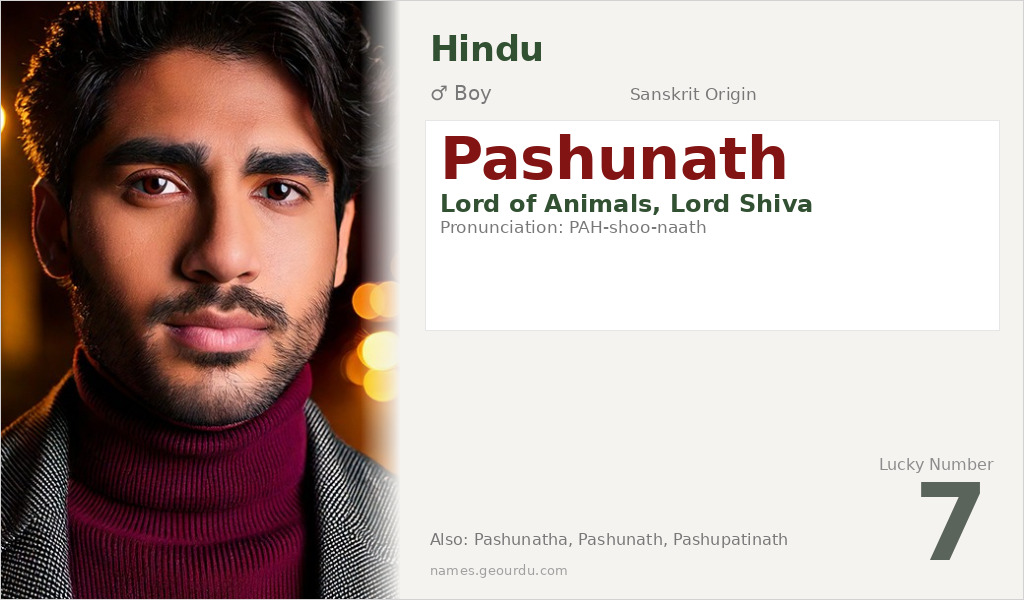
| 📛 Name | Pashunath |
| 💎 Meaning | Lord of Animals, Lord Shiva |
| 👤 Gender | Boy |
| 🕌 Religion | Hindu |
| 🌍 Origin | Sanskrit |
| 🗣 Pronunciation | PAH-shoo-naath |
| ✍️ Urdu | پشوناتھ |
| ✍️ Arabic | باشوناث |
| 🔢 Numerology | 7 |
| ✨ Spellings | Pashunatha, Pashunath, Pashupatinath |
Origin & Cultural Significance
Pashunath originates from ancient Sanskrit, the classical language of Hindu scriptures and philosophy. The name has been used for centuries within Hindu communities, particularly among devotees of Shiva. It reflects the Vedic concept of Shiva as Pashupati (another form meaning ‘Lord of Animals’), which dates back to the Indus Valley Civilization where seals depicting a proto-Shiva figure surrounded by animals have been found. The name is most prominent in Nepal, where the Pashupatinath Temple in Kathmandu serves as one of Hinduism’s most important pilgrimage sites. While primarily used in Hindu communities, the name’s Sanskrit roots give it pan-Indian recognition across various regions and linguistic groups.
Personality Traits
Those named Pashunath are often associated with protective and nurturing qualities, reflecting the name’s meaning as guardian of living beings. They may exhibit a balanced personality combining strength with compassion, and leadership with humility. The spiritual connotations of the name suggest individuals who value tradition, have a deep respect for nature, and possess a calm, steady demeanor. Many believe the name influences its bearers to develop a sense of responsibility toward others and the environment.
Similar Names
If you like Pashunath, consider: Pashupati, Pashupatinath, Bholenath, Shivanath, Nagesh
Famous People Named Pashunath
- Pashupatinath Temple — One of the most sacred Hindu temples dedicated to Lord Shiva, located in Kathmandu, Nepal
- Various Hindu religious figures and scholars have used Pashunath as a title or name in reference to Shiva
Frequently Asked Questions About Pashunath
What does Pashunath mean?
Pashunath means 'Lord of Animals' in Sanskrit. It is a compound name from 'pashu' (animal) and 'nath' (lord), and serves as an epithet of Lord Shiva in Hindu tradition.
Is Pashunath a boy or girl name?
Pashunath is exclusively a boy's name in Hindu naming tradition. As an epithet of the male deity Shiva, it carries masculine grammatical gender in Sanskrit and is used only for boys.
What is the origin of Pashunath?
Pashunath originates from Sanskrit, the classical language of ancient India. It has been used for centuries in Hindu religious contexts, particularly in reference to Lord Shiva as the protector of all living beings.





