
Table of Contents
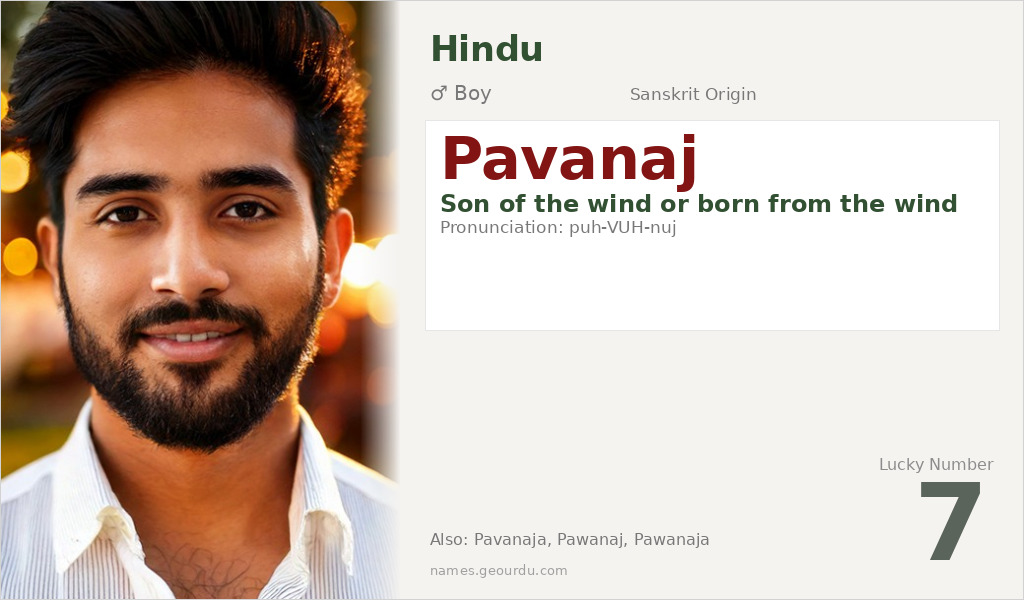
Pavanaj is a distinctive Sanskrit name with deep roots in Hindu mythology and tradition. Meaning ‘son of the wind’ or ‘born from the wind’, this name carries the powerful legacy of Hanuman, one of Hinduism’s most revered deities. As an epithet for the monkey god Hanuman, Pavanaj symbolizes strength, devotion, and divine origin. This name offers both cultural significance and a connection to ancient Indian spiritual heritage.
Meaning of Pavanaj
Pavanaj derives from the Sanskrit words ‘pavana’ (पवन), meaning ‘wind’, ‘air’, or ‘purifier’, and ‘ja’ (ज), meaning ‘born from’ or ‘son of’. The compound literally translates to ‘son of the wind’, referring specifically to Hanuman’s mythological birth as the offspring of the wind god Vayu. In Hindu texts, this name appears as one of Hanuman’s many epithets, highlighting his divine parentage and connection to the elemental forces. The ‘pavana’ element also carries connotations of purification and vitality, while ‘ja’ indicates origin or descent. This etymological construction is common in Sanskrit names, creating meaningful compounds that describe characteristics or origins.
| 📛 Name | Pavanaj |
| 💎 Meaning | Son of the wind or born from the wind |
| 👤 Gender | Boy |
| 🕌 Religion | Hindu |
| 🌍 Origin | Sanskrit |
| 🗣 Pronunciation | puh-VUH-nuj |
| ✍️ Urdu | پون کا بیٹا |
| ✍️ Arabic | ابن الريح |
| 🔢 Numerology | 7 |
| ✨ Spellings | Pavanaja, Pawanaj, Pawanaja |
Origin & Cultural Significance
Pavanaj originates from classical Sanskrit, the ancient liturgical language of Hinduism. The name emerges from Hindu mythology, specifically from the Ramayana epic where Hanuman, the devoted servant of Lord Rama, is described as the son of Vayu (the wind god). This mythological connection gives the name significant religious and cultural weight within Hindu communities. While primarily used in India and among Hindu diaspora communities, the name’s Sanskrit roots connect it to a broader Indo-European linguistic heritage. The name reflects the traditional practice of using divine epithets as personal names in Hindu culture, honoring deities through meaningful appellations.
Personality Traits
Those named Pavanaj are often associated with the heroic qualities of Hanuman—strength, loyalty, intelligence, and unwavering devotion. They may exhibit natural leadership abilities, physical vitality, and a protective instinct toward family and community. The wind symbolism suggests adaptability, freedom of thought, and the ability to navigate challenges with grace. These individuals often demonstrate resilience and determination, inspired by their namesake’s legendary feats in service of higher principles.
Similar Names
If you like Pavanaj, consider: Pavan, Pavana, Pawan, Vayuputra, Maruti, Anjaneya, Hanuman, Vayuj, Vayunandana
Famous People Named Pavanaj
- No widely known contemporary figures with this exact name found in records
- The name appears primarily in Hindu mythological contexts as an epithet for Hanuman
Frequently Asked Questions About Pavanaj
What does Pavanaj mean?
Pavanaj means 'son of the wind' or 'born from the wind' in Sanskrit. It is an epithet for Hanuman, referring to his mythological origin as the offspring of the wind god Vayu.
Is Pavanaj a boy or girl name?
Pavanaj is exclusively a boy's name in Hindu naming tradition, as it refers specifically to the male deity Hanuman and uses masculine Sanskrit grammatical forms.
What is the origin of Pavanaj?
Pavanaj originates from Sanskrit, the classical language of Hinduism. It comes from Hindu mythology where it appears as an epithet for Hanuman in texts like the Ramayana.





