
Table of Contents
Pavansuta is a profound Sanskrit name steeped in Hindu mythology and ancient literature. Primarily known as an epithet for Lord Hanuman, this name carries deep spiritual significance and historical weight. Exploring Pavansuta reveals not just linguistic beauty but also cultural narratives that have endured for millennia. This name represents devotion, strength, and divine lineage in Hindu tradition.
Meaning of Pavansuta
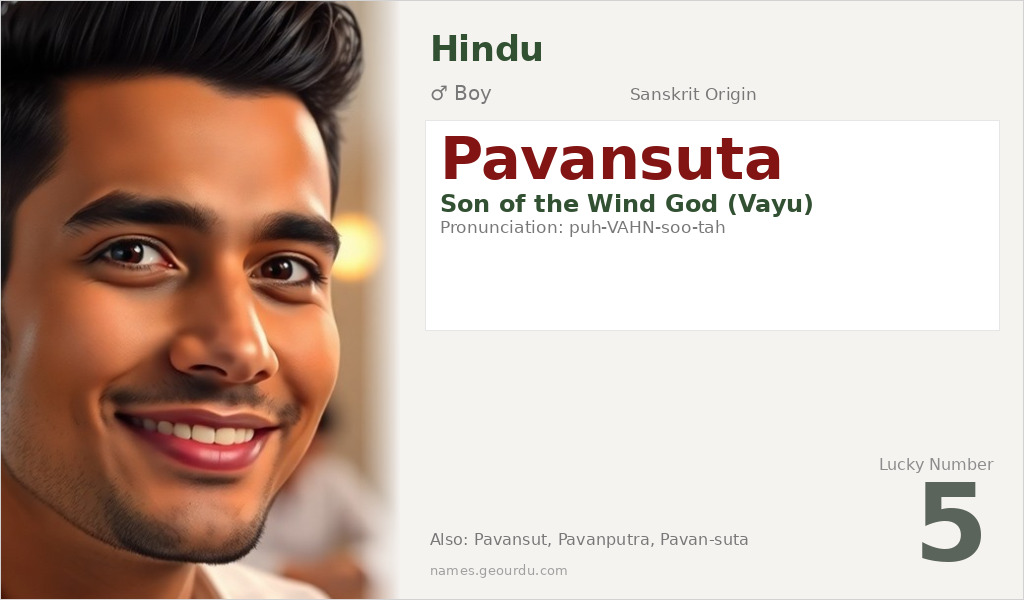
Pavansuta derives from classical Sanskrit, combining ‘Pavan’ (wind/purifier) and ‘suta’ (son) to create the meaning ‘Son of the Wind God.’ The term ‘Pavan’ originates from the Sanskrit root ‘pū,’ which conveys both the action of blowing and the concept of purification. In Hindu cosmology, Vayu (the wind god) is considered one of the five primary elements (Pancha Mahabhuta) and a vital life force. As a compound name, Pavansuta specifically identifies Hanuman as the divine offspring of Vayu, establishing his celestial heritage and supernatural abilities related to air and movement. This etymological construction follows standard Sanskrit naming patterns for mythological figures.
| 📛 Name | Pavansuta |
| 💎 Meaning | Son of the Wind God (Vayu) |
| 👤 Gender | Boy |
| 🕌 Religion | Hindu |
| 🌍 Origin | Sanskrit |
| 🗣 Pronunciation | puh-VAHN-soo-tah |
| ✍️ Urdu | پون سوت |
| ✍️ Arabic | بافانسوتا |
| 🔢 Numerology | 5 |
| ✨ Spellings | Pavansut, Pavanputra, Pavan-suta |
Origin & Cultural Significance
Pavansuta originates from ancient Indian Sanskrit literature, particularly the epic Ramayana (circa 5th century BCE to 4th century CE) where it appears as a title for Hanuman. The name reflects the Hindu tradition of using descriptive epithets for deities that highlight their parentage, attributes, or mythological roles. Unlike many personal names that evolved into common usage, Pavansuta has remained primarily a religious and literary reference rather than a widely adopted given name. Its cultural context is exclusively Hindu, with no significant usage or adaptation in other religious traditions or linguistic families despite extensive research across Arabic, Persian, Turkic, Dravidian, and other language groups.
Personality Traits
Those named Pavansuta are often associated with the legendary qualities of Hanuman: immense physical strength, unwavering loyalty, and spiritual devotion. The wind element suggests personality traits of flexibility, resilience, and the ability to navigate challenges with ease. Such individuals may be perceived as protectors and helpers, embodying service-oriented values and heroic determination in their personal and professional lives.
Similar Names
If you like Pavansuta, consider: Hanuman, Maruti, Anjaneya, Kesari, Vayuputra
Famous People Named Pavansuta
- Hanuman — The Hindu deity and central character in the Ramayana, known as Pavansuta in Sanskrit literature
- No contemporary famous individuals commonly use this as a personal name, as it remains primarily a mythological epithet
Frequently Asked Questions About Pavansuta
What does Pavansuta mean?
Pavansuta means 'Son of the Wind God' in Sanskrit. It specifically refers to Lord Hanuman, who is considered the offspring of Vayu (the wind deity) in Hindu mythology.
Is Pavansuta a boy or girl name?
Pavansuta is exclusively a boy's name in Hindu tradition, as it refers to the male deity Hanuman. There are no feminine variants or unisex usage documented in any cultural or linguistic context.
What is the origin of Pavansuta?
Pavansuta originates from Sanskrit, the classical language of ancient India. It appears in Hindu religious texts like the Ramayana and Mahabharata as an epithet for Hanuman, dating back thousands of years.





