
Table of Contents
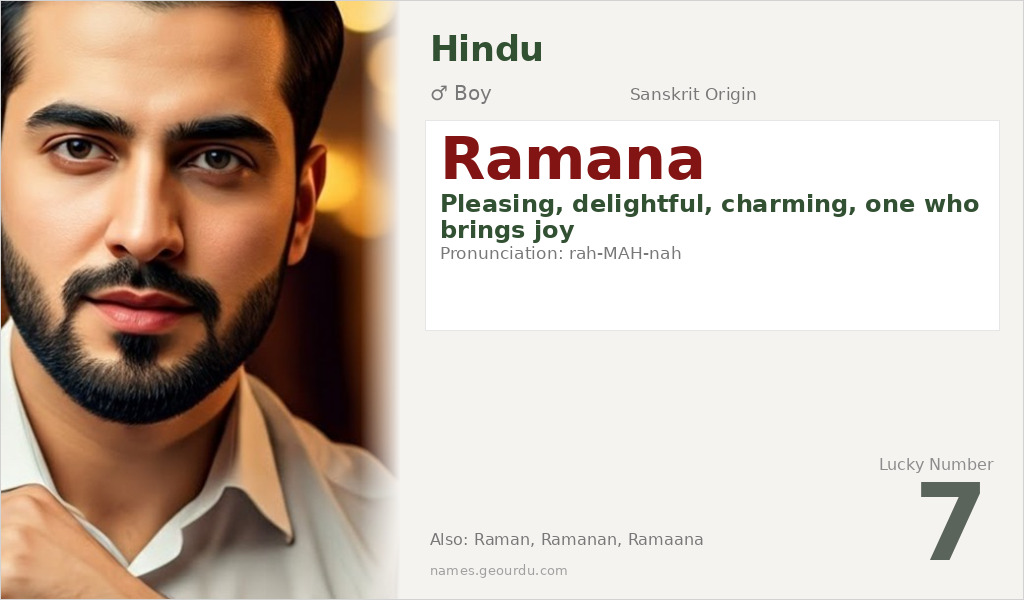
Ramana is a beautiful Sanskrit name with deep spiritual resonance in Hindu culture. Meaning ‘pleasing, delightful, or one who brings joy’, this name carries centuries of cultural and religious significance. Most famously associated with the revered sage Ramana Maharshi, the name embodies spiritual wisdom and inner peace. Its melodic sound and profound meaning make it a cherished choice for boys in Hindu families.
Meaning of Ramana
The name Ramana originates from the Sanskrit root ‘ram’ (रम्), which means ‘to delight, to please, to enjoy, or to sport’. In classical Sanskrit, ‘ramana’ functions as both an adjective meaning ‘pleasing, charming, delightful’ and as a noun referring to ‘one who causes delight or pleasure’. This etymological foundation appears in ancient Hindu scriptures including the Ramayana, where it’s used to describe pleasing qualities. The name maintains this core meaning across Indian languages, particularly in South India where it’s phonetically adapted while preserving its Sanskrit essence. In Tamil and Telugu traditions, Ramana specifically connotes spiritual delight and divine charm.
| 📛 Name | Ramana |
| 💎 Meaning | Pleasing, delightful, charming, one who brings joy |
| 👤 Gender | Boy |
| 🕌 Religion | Hindu |
| 🌍 Origin | Sanskrit |
| 🗣 Pronunciation | rah-MAH-nah |
| ✍️ Urdu | رامن |
| ✍️ Arabic | رامانا |
| 🔢 Numerology | 7 |
| ✨ Spellings | Raman, Ramanan, Ramaana, Ramanah |
Origin & Cultural Significance
Ramana has its roots firmly in ancient Sanskrit literature and Hindu tradition, dating back over two millennia. While primarily a Hindu name, it has been adopted in various Indian linguistic communities including Tamil, Telugu, Kannada, and Malayalam speakers. The name gained particular prominence in the 20th century through Ramana Maharshi, whose spiritual teachings attracted global followers. Unlike some names that cross religious boundaries, Ramana remains predominantly within Hindu naming traditions, though its phonetic variations appear in some Buddhist contexts in Sri Lanka. The name’s cultural significance is strongest in South India, where it’s associated with both spiritual masters and classical literature.
Personality Traits
Those named Ramana are often associated with contemplative and spiritually attuned personalities. Drawing from the name’s meaning of ‘bringing delight’, they frequently exhibit natural charm and an ability to create harmonious environments. Many Ramanas display a balance between introspection and compassionate engagement with others, reflecting the name’s connection to spiritual teachers like Ramana Maharshi. Their personality is typically marked by calm wisdom rather than overt exuberance.
Similar Names
If you like Ramana, consider: Raman, Ramanujan, Ram, Rama, Ramanathan, Ramachandra, Ramakrishna, Ramdas
Famous People Named Ramana
- Ramana Maharshi (1879-1950) — Renowned Indian Hindu sage and spiritual teacher from Tamil Nadu, one of the most influential spiritual figures of modern India
- Ramana Gogula — Indian music composer and singer known for his work in Telugu cinema
Frequently Asked Questions About Ramana
What does Ramana mean?
Ramana means 'pleasing, delightful, charming, or one who brings joy' in Sanskrit, derived from the root word 'ram' meaning 'to delight'.
Is Ramana a boy or girl name?
Ramana is traditionally a masculine name in Hindu culture, though rare feminine usage exists in some regional contexts with modified spellings.
What is the origin of Ramana?
Ramana originates from Sanskrit, the classical language of ancient India, and is primarily used in Hindu naming traditions, especially in South Indian communities.





