
Table of Contents
Paramesh is a powerful Sanskrit name with profound spiritual significance in Hindu culture. Meaning ‘Supreme Lord’ or ‘Highest Ruler’, this name carries centuries of religious and philosophical weight. Traditionally given to boys, Paramesh represents the ultimate divine authority and is associated with leadership and spiritual depth. Its rich etymology connects directly to ancient Indian scriptures and theological concepts.
Meaning of Paramesh
Paramesh derives from two Sanskrit components: ‘parama’ (परम) meaning ‘supreme, highest, ultimate’ and ‘īśa’ (ईश) meaning ‘lord, ruler, master, or god’. When combined, they create a name that literally translates to ‘Supreme Lord’ or ‘Highest Ruler’. In Hindu theology, this term specifically refers to the ultimate divine being, often identified with Shiva as Parameshvara or with Vishnu in different traditions. The name appears in numerous sacred texts including the Vedas, Upanishads, and Puranas as an epithet for the absolute reality. Its linguistic roots are firmly established in classical Sanskrit literature, making it one of the most spiritually significant names in Hindu tradition.
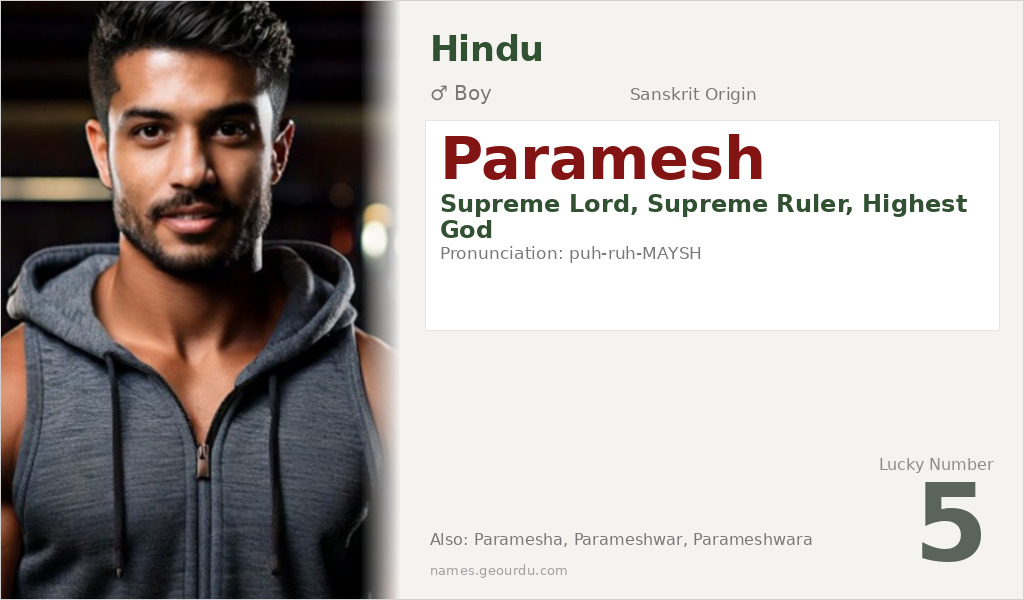
| 📛 Name | Paramesh |
| 💎 Meaning | Supreme Lord, Supreme Ruler, Highest God |
| 👤 Gender | Boy |
| 🕌 Religion | Hindu |
| 🌍 Origin | Sanskrit |
| 🗣 Pronunciation | puh-ruh-MAYSH |
| ✍️ Urdu | پرمیش |
| ✍️ Arabic | باراميش |
| 🔢 Numerology | 5 |
| ✨ Spellings | Paramesha, Parameshwar, Parameshwara, Parameshvar |
Origin & Cultural Significance
Paramesh originates from ancient Sanskrit, the classical language of India that dates back over 3,500 years. As a compound name, it reflects the sophisticated linguistic and philosophical traditions of Hindu civilization. The name has been used for centuries in India, Nepal, and other regions influenced by Hindu culture and Sanskrit literature. It appears in religious contexts as both a divine epithet and a given name for boys, particularly among Hindu families seeking names with deep spiritual meaning. While primarily associated with Hinduism, the name’s philosophical concept of a supreme ruler has resonance across various Indian religious traditions.
Personality Traits
Those named Paramesh often embody qualities of leadership, spiritual awareness, and moral authority. The name’s meaning suggests someone who may naturally assume positions of responsibility or guidance. Bearers of this name are frequently perceived as thoughtful, principled individuals with a strong sense of purpose. While personality traits vary by individual, the name’s association with supreme authority often influences how others perceive and interact with someone named Paramesh.
Similar Names
If you like Paramesh, consider: Parameshwara, Parameshwar, Parameshvari, Paramananda, Parameshthi, Parampreet, Paramprit, Parampreet, Paramprit
Famous People Named Paramesh
- Paramesh Banerjee — Indian footballer who played for East Bengal and the Indian national team
- Paramesh Acharya — Nepalese politician and former Minister of Industry
Frequently Asked Questions About Paramesh
What does Paramesh mean?
Paramesh means 'Supreme Lord' or 'Highest Ruler' in Sanskrit. It is a compound name from 'parama' (supreme) and 'īśa' (lord), referring to the ultimate divine being in Hindu theology.
Is Paramesh a boy or girl name?
Paramesh is traditionally a masculine name given to boys in Hindu culture. The name's meaning and grammatical structure in Sanskrit are masculine, though feminine forms like Parameshvari exist.
What is the origin of Paramesh?
Paramesh originates from Sanskrit, the ancient classical language of India. It has been used for centuries in Hindu religious texts and naming traditions, particularly in India and Nepal.





