
Table of Contents
Parameshwara is a profound Sanskrit name that carries immense spiritual weight in Hindu tradition. Meaning ‘Supreme Lord’ or ‘Highest Deity’, this name has been used for centuries in religious texts and South Indian culture. It represents the ultimate divine authority and is particularly significant in Shaivism, where it refers to Shiva as the supreme being. Choosing this name reflects a deep connection to Hindu philosophical concepts of divinity.
Meaning of Parameshwara
Parameshwara is a compound Sanskrit name with two distinct components that together create a powerful theological concept. The first part, ‘parama’ (परम), translates to ‘supreme’, ‘highest’, ‘ultimate’, or ‘transcendent’. The second component, ‘īśvara’ (ईश्वर), means ‘lord’, ‘god’, ‘master’, or ‘ruler’. When combined, Parameshwara specifically denotes the supreme deity who is above all other gods and beings. In Hindu philosophical systems, particularly in Advaita Vedanta and Shaiva Siddhanta, this term refers to the absolute reality that governs the universe. The name appears in ancient texts like the Shiva Purana and various Upanishads, establishing its deep roots in Hindu spiritual tradition.
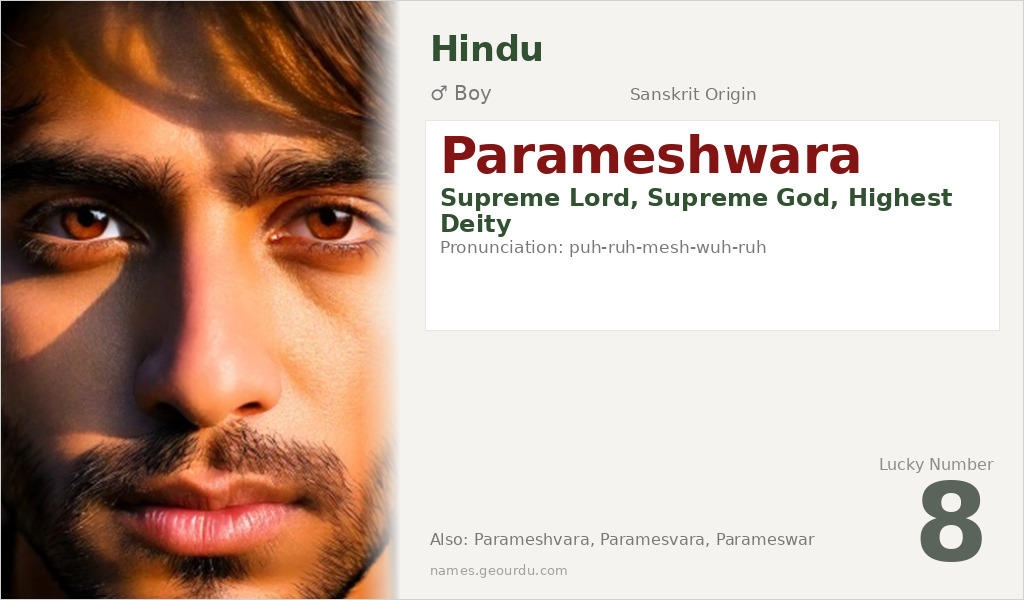
| 📛 Name | Parameshwara |
| 💎 Meaning | Supreme Lord, Supreme God, Highest Deity |
| 👤 Gender | Boy |
| 🕌 Religion | Hindu |
| 🌍 Origin | Sanskrit |
| 🗣 Pronunciation | puh-ruh-mesh-wuh-ruh |
| ✍️ Urdu | پرمیشور |
| ✍️ Arabic | باراميشوارا |
| 🔢 Numerology | 8 |
| ✨ Spellings | Parameshvara, Paramesvara, Parameswar, Parameshwar |
Origin & Cultural Significance
Parameshwara originates from classical Sanskrit, the sacred language of Hindu scriptures. Its usage dates back to ancient Hindu philosophical texts where it described the supreme cosmic principle. In South India, particularly in Karnataka, Andhra Pradesh, and Tamil Nadu, the name became popular as both a given name and a title for Shiva in temple worship. Historical records show rulers adopting ‘Parameshwara’ as part of their royal titles to signify divine authority. The name remains culturally significant in regions with strong Shaivite traditions, where it continues to be used in religious contexts and personal naming practices.
Personality Traits
Those named Parameshwara are often associated with qualities of leadership, spiritual depth, and authoritative presence. The name’s meaning suggests someone who may naturally take on guiding or protective roles in their community. They tend to be philosophical thinkers with a strong sense of purpose and responsibility. While individual personalities vary, the name carries connotations of wisdom, strength, and connection to higher principles.
Similar Names
If you like Parameshwara, consider: Maheshwara, Ishwara, Parameshwari, Paramesh, Paramananda, Parabrahma, Paratpara, Parashiva, Paravasu, Paranjothi
Famous People Named Parameshwara
- Parameshwara I — 14th century founder of the Sangama dynasty and the Vijayanagara Empire in South India
- Parameshwara — Historical title used by several South Indian rulers and temple deities, particularly in Shiva temples
Frequently Asked Questions About Parameshwara
What does Parameshwara mean?
Parameshwara means 'Supreme Lord' or 'Highest Deity' in Sanskrit. It's a compound name from 'parama' (supreme) and 'īśvara' (lord), specifically referring to the ultimate divine being in Hindu theology.
Is Parameshwara a boy or girl name?
Parameshwara is exclusively a boy's name in Hindu tradition. It carries masculine divine connotations and is not used for girls in any cultural context.
What is the origin of Parameshwara?
Parameshwara originates from Sanskrit, the ancient sacred language of Hinduism. It has been used for centuries in Hindu scriptures and South Indian cultural traditions, particularly in Shaivism where it refers to Shiva as the supreme deity.





