
Table of Contents
Parbrahm is not your typical baby name—it’s a profound philosophical concept from ancient Indian spirituality. Meaning ‘Supreme Spirit’ or ‘Ultimate Reality’, this Sanskrit term represents the highest transcendental truth in Hindu and Sikh theology. While occasionally used as a given name in modern contexts, its primary significance lies in spiritual philosophy rather than personal nomenclature. Understanding Parbrahm requires exploring centuries of metaphysical thought about the nature of existence itself.
Meaning of Parbrahm
Parbrahm derives from two Sanskrit components: ‘Par’ (पर) meaning ‘supreme, highest, or ultimate’, and ‘Brahm’ (ब्रह्म) meaning ‘spirit, absolute reality, or cosmic principle’. In Hindu philosophy, particularly Advaita Vedanta, Parbrahm refers to Nirguna Brahman—the formless, attributeless ultimate reality beyond all descriptions and dualities. Sikh theology extensively uses this term in Guru Granth Sahib to describe Waheguru’s transcendent aspect. Unlike personal deities, Parbrahm represents the infinite, all-pervading consciousness that underlies all existence. This makes it more a theological concept than a conventional personal name in traditional usage.
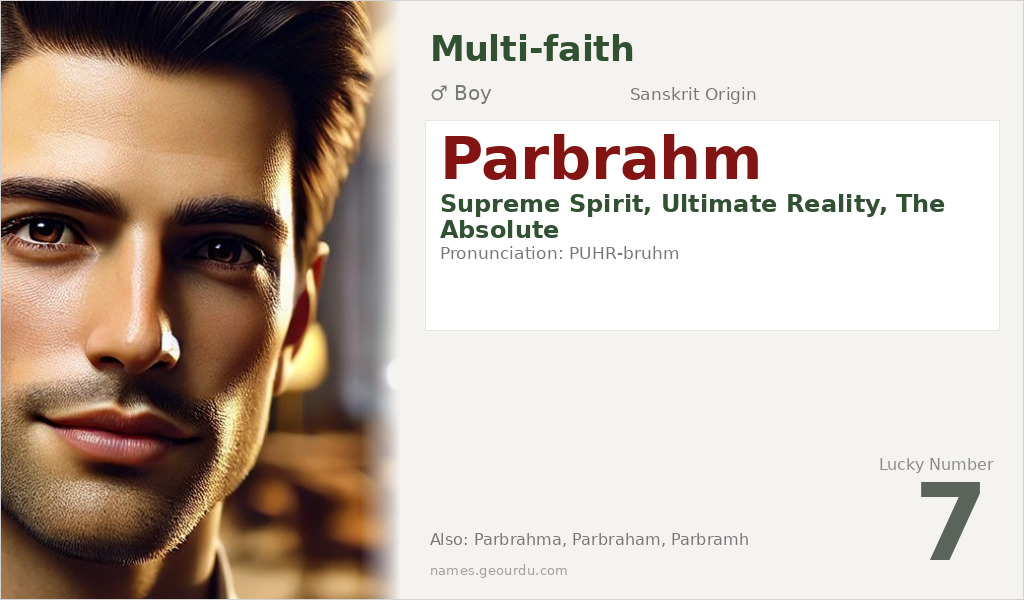
| 📛 Name | Parbrahm |
| 💎 Meaning | Supreme Spirit, Ultimate Reality, The Absolute |
| 👤 Gender | Boy |
| 🕌 Religion | Multi-faith |
| 🌍 Origin | Sanskrit |
| 🗣 Pronunciation | PUHR-bruhm |
| ✍️ Urdu | پربرم |
| ✍️ Arabic | باربراهم |
| 🔢 Numerology | 7 |
| ✨ Spellings | Parbrahma, Parbraham, Parbramh |
Origin & Cultural Significance
Originating from ancient Sanskrit scriptures, Parbrahm appears in Upanishadic texts dating back over 2,500 years as a term for the supreme reality. It gained particular prominence in medieval Indian spirituality through Bhakti and Sant traditions, and became central to Sikh theology from the 15th century onward. While the term is deeply embedded in Hindu and Sikh philosophical discourse, its use as a personal name is extremely rare historically and appears to be a modern innovation. The concept transcends specific religious boundaries, appearing in various Indian spiritual traditions that explore non-dual consciousness.
Personality Traits
While not a conventional personal name with established personality associations, the philosophical concept of Parbrahm suggests qualities of spiritual profundity, wisdom, and transcendental awareness. Someone named after this concept might be expected to exhibit contemplative depth, philosophical inclination, and a search for higher truths. The name carries connotations of infinity, unity, and the ultimate ground of being, potentially influencing how both the bearer and others perceive their spiritual identity.
Similar Names
If you like Parbrahm, consider: Brahma, Parameshwar, Parampurush, Akal, Nirankar
Famous People Named Parbrahm
- No notable historical or contemporary figures bear this as a personal name, as it's primarily a philosophical concept rather than a conventional given name
Frequently Asked Questions About Parbrahm
What does Parbrahm mean?
Parbrahm means 'Supreme Spirit' or 'Ultimate Reality' in Sanskrit. It's a compound of 'Par' (supreme) and 'Brahm' (spirit/absolute), representing the highest transcendental truth in Hindu and Sikh philosophy.
Is Parbrahm a boy or girl name?
When used as a name (which is rare), Parbrahm is typically masculine, reflecting its origins in Sanskrit grammatical gender and philosophical context. However, as a philosophical concept, it transcends gender entirely.
What is the origin of Parbrahm?
Parbrahm originates from Sanskrit, appearing in ancient Hindu scriptures like the Upanishads. It became particularly significant in Sikh theology through Guru Granth Sahib, where it describes the formless divine reality.





