
Table of Contents
Parijaat is a name steeped in Hindu mythology and Sanskrit tradition, carrying profound spiritual significance. Unlike ordinary floral names, it refers specifically to the divine Kalpavriksha or wish-fulfilling tree that emerged during the churning of the cosmic ocean. This celestial name evokes images of fragrant night-blooming flowers and divine grace, making it a meaningful choice for parents seeking a name with mythological depth. Used for both boys and girls, Parijaat connects the bearer to ancient Indian epics and spiritual symbolism.
Meaning of Parijaat
Parijaat derives from the Sanskrit words ‘pari’ (meaning ‘around’ or ‘about’) and ‘jaat’ (meaning ‘born’ or ‘produced’), collectively referring to something that is produced abundantly or universally. In Hindu scriptures, particularly the Vishnu Purana and Harivamsa, the Parijaat tree is described as a divine, fragrant tree with white flowers that bloom only at night and wilt by dawn. The tree was one of the treasures (ratnas) that emerged during Samudra Manthan (the churning of the ocean by devas and asuras) and was claimed by Lord Krishna. This mythological context gives the name layers of meaning including celestial origin, ephemeral beauty, wish-fulfillment, and divine connection.
| 📛 Name | Parijaat |
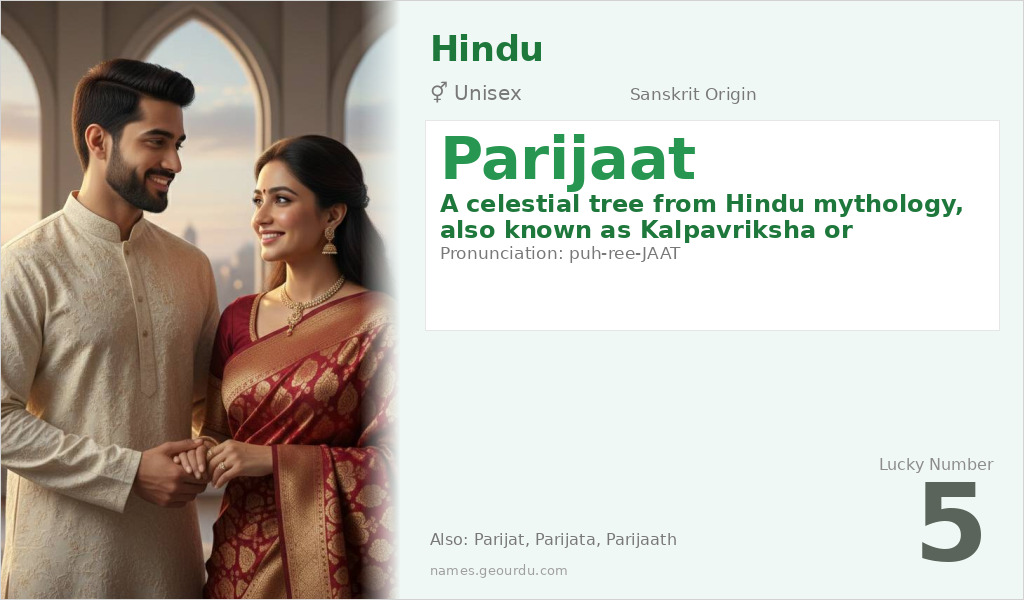
| 💎 Meaning | A celestial tree from Hindu mythology, also known as Kalpavriksha or wish-fulfilling tree |
| 👤 Gender | Unisex |
| 🕌 Religion | Hindu |
| 🌍 Origin | Sanskrit |
| 🗣 Pronunciation | puh-ree-JAAT |
| ✍️ Urdu | پاریجات |
| ✍️ Arabic | باريجات |
| 🔢 Numerology | 5 |
| ✨ Spellings | Parijat, Parijata, Parijaath, Parijaatha |
Origin & Cultural Significance
The name Parijaat originates from classical Sanskrit literature and Hindu mythology dating back to ancient India. It appears in multiple Puranic texts describing the celestial tree that grew in Indra’s heaven (Svarga) and was later brought to Earth by Krishna. The name is particularly significant in Vaishnavism due to Krishna’s association with the tree. While primarily used in Hindu communities across India and Nepal, the name has also been adopted by some Buddhists in the region due to shared cultural heritage. The famous Nepali writer Bishnu Kumari Waiba took ‘Parijat’ as her pen name, further popularizing it in literary circles.
Personality Traits
Those named Parijaat often embody the qualities associated with their mythological namesake—grace, beauty, and a nurturing presence. They tend to be creative individuals with strong intuitive abilities and a natural inclination toward spiritual or artistic pursuits. Like the night-blooming Parijaat flowers, they may have a quiet elegance that reveals itself in meaningful moments. Their association with the wish-fulfilling tree suggests they often become sources of inspiration and comfort to others.
Similar Names
If you like Parijaat, consider: Kalpavriksha, Ashoka, Kadamba, Champaka, Bakula
Famous People Named Parijaat
- Parijat (Bishnu Kumari Waiba) — Renowned Nepali poet and novelist, author of 'Siris Ko Phul'
- Parijat — Indian actress known for Tamil and Malayalam films
Frequently Asked Questions About Parijaat
What does Parijaat mean?
Parijaat means 'celestial wish-fulfilling tree' in Sanskrit, specifically referring to the divine Kalpavriksha from Hindu mythology that produces fragrant white flowers blooming at night.
Is Parijaat a boy or girl name?
Parijaat is a unisex name used for both boys and girls in Hindu communities, though it appears more frequently for girls in modern usage while maintaining traditional unisex status.
What is the origin of Parijaat?
Parijaat originates from Sanskrit and Hindu mythology, specifically from descriptions of the divine Parijaat tree in texts like the Vishnu Purana and Harivamsa as part of ancient Indian cultural heritage.