
Table of Contents
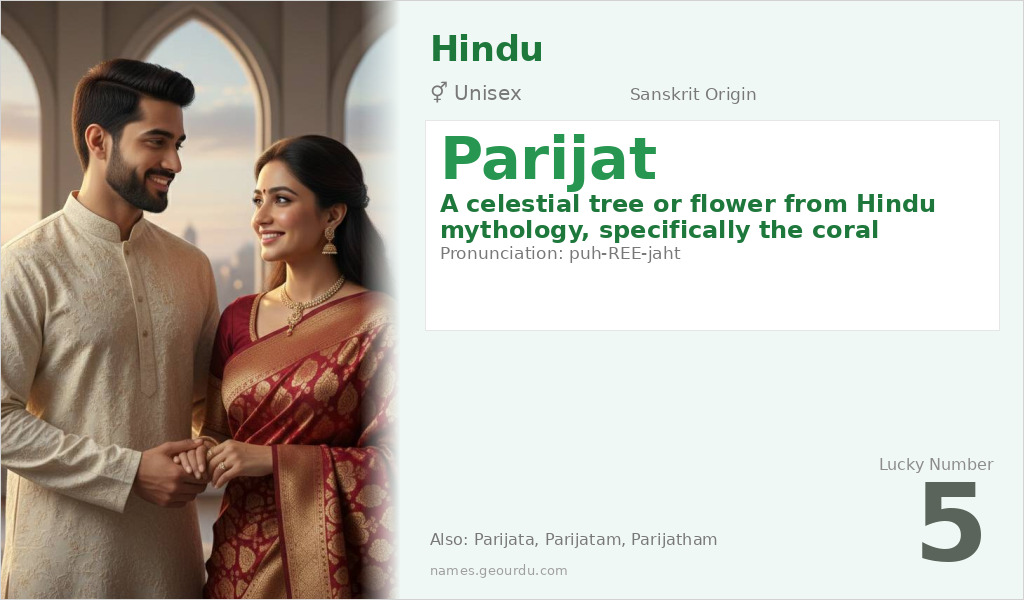
Parijat is a beautiful name steeped in Hindu mythology and Sanskrit tradition. Meaning ‘celestial tree’ or ‘divine flower,’ it carries associations with purity, beauty, and spiritual significance. This unisex name has been cherished for generations across South Asia, particularly in Hindu communities. Its mythological origins make it a name rich with cultural heritage and symbolic meaning.
Meaning of Parijat
Parijat derives from the Sanskrit words ‘pari’ (meaning ‘around’ or ‘about’) and ‘jat’ (meaning ‘born’ or ‘produced’), literally translating to ‘that which is produced all around.’ In Hindu mythology, it specifically refers to the celestial Parijat tree (Nyctanthes arbor-tristis), also known as the night-flowering jasmine or coral jasmine. This divine tree emerged during the Samudra Manthan (churning of the ocean of milk) and was claimed by Indra for his heavenly garden. The tree is described in texts like the Bhagavata Purana and Vishnu Purana as having fragrant white flowers with orange stems that bloom only at night and fall at dawn. The name thus symbolizes divine origin, ephemeral beauty, and spiritual purity.
| 📛 Name | Parijat |
| 💎 Meaning | A celestial tree or flower from Hindu mythology, specifically the coral jasmine tree (Nyctanthes arbor-tristis) |
| 👤 Gender | Unisex |
| 🕌 Religion | Hindu |
| 🌍 Origin | Sanskrit |
| 🗣 Pronunciation | puh-REE-jaht |
| ✍️ Urdu | پاریجات |
| ✍️ Arabic | باريجات |
| 🔢 Numerology | 5 |
| ✨ Spellings | Parijata, Parijatam, Parijatham, Parijath |
Origin & Cultural Significance
Parijat originates from ancient Sanskrit literature and Hindu mythology, with its earliest references appearing in Vedic and Puranic texts. The name is deeply embedded in Indian cultural traditions, particularly within Hinduism, where the Parijat tree is considered one of the five divine trees of heaven. While primarily used in Hindu communities across India, Nepal, and the South Asian diaspora, the name has also been adopted by some Buddhist communities in the region due to shared cultural heritage. The botanical counterpart, Nyctanthes arbor-tristis, grows across South and Southeast Asia, further cementing the name’s regional significance. In modern times, Parijat remains popular as both a given name and appears in literature, poetry, and place names throughout the subcontinent.
Personality Traits
Those named Parijat often embody the qualities associated with their celestial namesake—beauty, purity, and a gentle, nurturing presence. They tend to be creative individuals with artistic sensibilities and a deep appreciation for nature and spirituality. Like the night-blooming Parijat flower, they may have a quiet strength that reveals itself in meaningful moments. Their intuitive nature often makes them sensitive to others’ emotions and attuned to subtle beauty in the world around them.
Similar Names
If you like Parijat, consider: Padma, Kamala, Pushpa, Kusum, Sumana
Famous People Named Parijat
- Parijat (Bishnu Kumari Waiba) — Nepali poet and writer, first woman to win the Madan Puraskar literary award
- Parijat — Indian actress known for Tamil and Telugu films
Frequently Asked Questions About Parijat
What does Parijat mean?
Parijat means 'celestial tree' or 'divine flower' in Sanskrit, specifically referring to the mythological coral jasmine tree from Hindu tradition.
Is Parijat a boy or girl name?
Parijat is a unisex name used for both boys and girls in Hindu communities, though it may be slightly more common for girls in some regions.
What is the origin of Parijat?
Parijat originates from Sanskrit and Hindu mythology, where it refers to a divine tree that emerged during the churning of the ocean in Puranic texts.