
Table of Contents
Saka is a distinctive name with rich historical and linguistic roots spanning ancient civilizations and modern cultures. Often associated with meanings like ‘hunter’ or ‘warrior,’ it carries echoes of the nomadic Scythian peoples and tribal traditions. This name resonates across Hindu, Muslim, and secular contexts in South Asia and beyond, offering a unique blend of strength and heritage. Discover the fascinating story behind Saka and why it remains a meaningful choice today.
Meaning of Saka
The meaning of Saka is deeply rooted in ancient languages and historical contexts. In Sanskrit, it derives from ‘śaka’ (शक), referring to the Scythian invaders of ancient India, which evolved to signify ‘warrior’ or ‘hunter.’ In Pashto and Balochi, spoken in Afghanistan, Pakistan, and Iran, ‘Saka’ or ‘Sakah’ similarly means ‘hunter,’ reflecting tribal lifestyles. The name also connects to the Saka people, an Iranian nomadic group (part of the Scythians) who roamed Central Asia from the 1st millennium BCE. Linguistically, it may relate to the Sanskrit root ‘śak,’ meaning ‘to be able,’ hinting at qualities of capability and power. This multi-layered etymology showcases Saka’s enduring relevance across cultures.
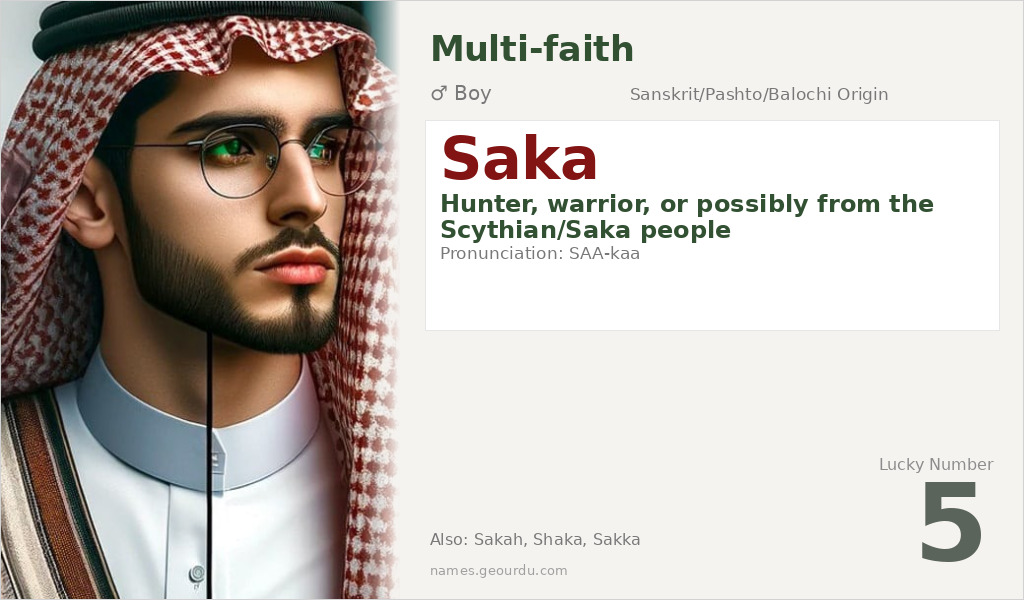
| 📛 Name | Saka |
| 💎 Meaning | Hunter, warrior, or possibly from the Scythian/Saka people |
| 👤 Gender | Boy |
| 🕌 Religion | Multi-faith |
| 🌍 Origin | Sanskrit/Pashto/Balochi |
| 🗣 Pronunciation | SAA-kaa |
| ✍️ Urdu | ساکا |
| ✍️ Arabic | ساكا |
| 🔢 Numerology | 5 |
| ✨ Spellings | Sakah, Shaka, Sakka |
Origin & Cultural Significance
Saka originates from a blend of Sanskrit, Pashto, and Balochi linguistic traditions, with historical ties to the Scythian (Saka) peoples of Central Asia. These nomadic tribes influenced regions from India to Persia, leaving a legacy in names and cultural exchanges. In Hindu contexts, the name appears in historical texts referencing the Śaka era or warriors, while in Muslim-majority areas like Afghanistan and Balochistan, it is used as a given name or surname among Pashtun and Baloch tribes. The name’s spread reflects ancient migrations and trade routes, making it a cross-cultural emblem of resilience and identity. Today, it is found in India, Pakistan, Afghanistan, and diaspora communities, often chosen for its strong, historical connotations.
Personality Traits
People named Saka are often perceived as bold and exploratory, embodying the hunter-like traits of vigilance and determination. They tend to be independent thinkers with a knack for problem-solving, thriving in dynamic environments. Their adventurous spirit may lead them to seek new experiences, while their practical nature helps them navigate challenges effectively. This combination of curiosity and capability makes Saka a name associated with leadership and adaptability.
Similar Names
If you like Saka, consider: Shakti, Saket, Sagar, Sahir, Sakib
Famous People Named Saka
- Saka Salwai — Vanuatuan politician and former Prime Minister of Vanuatu
- Saka Acquaye — Ghanaian musician and artist
Frequently Asked Questions About Saka
What does Saka mean?
Saka primarily means 'hunter' or 'warrior,' with origins in Sanskrit, Pashto, and Balochi languages, and historical connections to the Scythian (Saka) peoples.
Is Saka a boy or girl name?
Saka is traditionally a boy's name, used in Hindu, Muslim, and secular contexts across South Asia and Central Asia, though it can be unisex in some modern settings.
What is the origin of Saka?
Saka originates from Sanskrit (as 'śaka' for Scythians/warriors), Pashto, and Balochi languages, with deep roots in the history of the Saka nomadic tribes of Central Asia.





