
Table of Contents
Shanmuga is a powerful Hindu name with deep mythological roots in Sanskrit tradition. Derived from ancient scriptures, this name refers to the six-faced aspect of Lord Murugan, the god of war and son of Shiva. Popular particularly in South Indian communities, Shanmuga carries connotations of protection, courage, and divine strength. Parents choosing this name often seek to imbue their child with the noble qualities of this revered deity.
Meaning of Shanmuga
Shanmuga originates from the Sanskrit words ‘ṣaṇ’ meaning ‘six’ and ‘mukha’ meaning ‘face’ or ‘head,’ literally translating to ‘six-faced.’ This refers specifically to Lord Murugan (also known as Kartikeya or Skanda), who is depicted with six faces in Hindu iconography, each representing different attributes or directions. The name appears in ancient texts like the Skanda Purana, where Shanmuga is described as the commander of the divine army who defeated the demon Surapadman. In Tamil tradition, the name is particularly significant, with Arumugam (the Tamil equivalent) being a common variant. The six faces symbolize wisdom, preservation, destruction, grace, power, and knowledge, making this name rich with philosophical meaning beyond its literal translation.
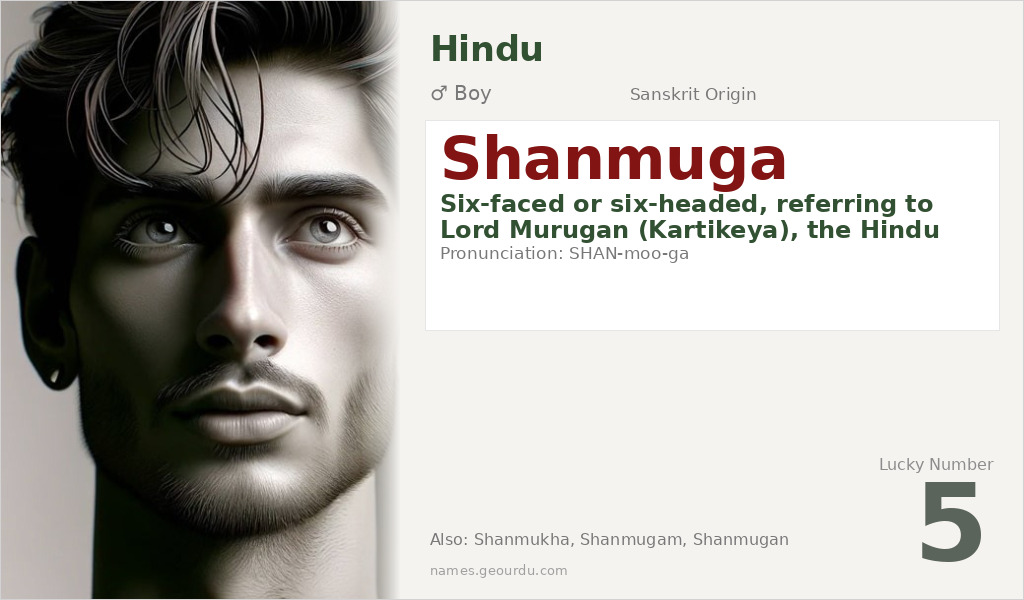
| 📛 Name | Shanmuga |
| 💎 Meaning | Six-faced or six-headed, referring to Lord Murugan (Kartikeya), the Hindu god of war and son of Shiva and Parvati |
| 👤 Gender | Boy |
| 🕌 Religion | Hindu |
| 🌍 Origin | Sanskrit |
| 🗣 Pronunciation | SHAN-moo-ga |
| ✍️ Urdu | شنموگا |
| ✍️ Arabic | شانموغا |
| 🔢 Numerology | 5 |
| ✨ Spellings | Shanmukha, Shanmugam, Shanmugan, Shanmuganathan |
Origin & Cultural Significance
Shanmuga has its origins in classical Sanskrit literature and Hindu mythology, dating back to at least the early centuries CE. The name is most prominently associated with South Indian Hindu tradition, particularly in Tamil Nadu where Lord Murugan is extensively worshipped. Historical references to Shanmuga appear in the Sangam literature of ancient Tamilakam (3rd century BCE to 3rd century CE) and later devotional poetry by saints like Arunagirinathar. The name spread through Hindu diaspora communities to Sri Lanka, Malaysia, Singapore, and other regions with Tamil populations. While fundamentally a Hindu name, its usage is primarily cultural rather than strictly religious, often chosen by families seeking to honor Tamil heritage and divine protection.
Personality Traits
Those named Shanmuga are often perceived as possessing the warrior-like qualities of their namesake deity—courageous, strategic, and protective. They tend to be natural leaders who approach challenges with determination and wisdom. The mythological association with the six-faced god suggests multidimensional personalities capable of seeing situations from multiple perspectives. These individuals often exhibit strong protective instincts toward family and community, along with a sense of justice and moral clarity.
Similar Names
If you like Shanmuga, consider: Murugan, Kartikeya, Skanda, Subrahmanya, Arumugam
Famous People Named Shanmuga
- Shanmuga Sundaram — Indian film director and screenwriter in Tamil cinema
- Shanmuga Raja — Indian politician from Tamil Nadu
Frequently Asked Questions About Shanmuga
What does Shanmuga mean?
Shanmuga means 'six-faced' in Sanskrit, specifically referring to Lord Murugan (Kartikeya), the Hindu god of war who is depicted with six faces in iconography.
Is Shanmuga a boy or girl name?
Shanmuga is exclusively a boy's name in Hindu tradition, as it refers to the male deity Lord Murugan, son of Shiva and Parvati.
What is the origin of Shanmuga?
Shanmuga originates from Sanskrit and is deeply rooted in Hindu mythology, particularly prominent in South Indian Tamil tradition where Lord Murugan is extensively worshipped.





