
Table of Contents
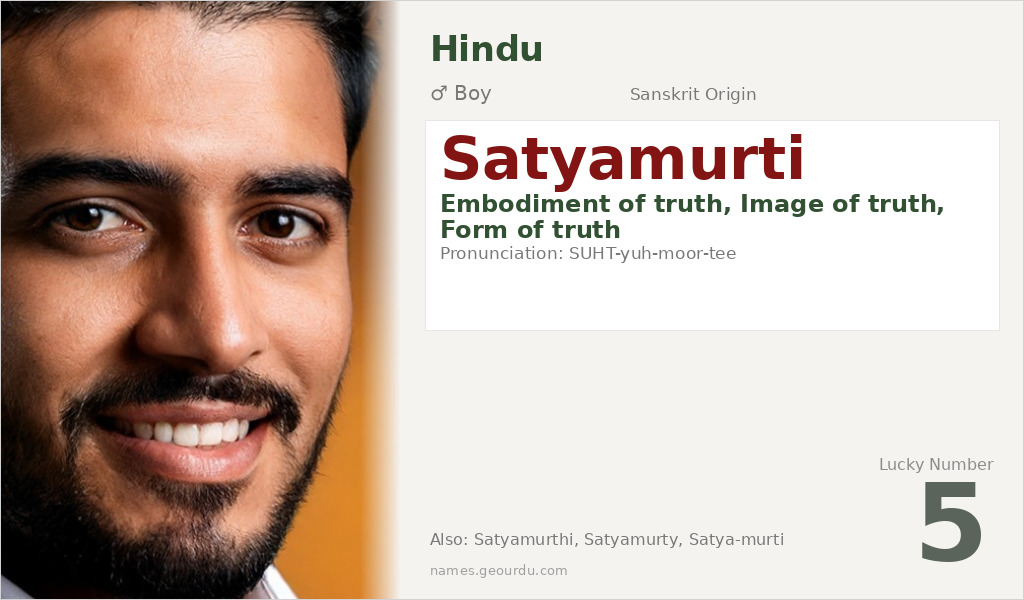
Satyamurti is a profound Sanskrit name that carries significant philosophical weight in Hindu tradition. Meaning ‘Embodiment of Truth’ or ‘Form of Truth’, this name represents one of the highest ideals in Indian spiritual thought. Used primarily for boys, Satyamurti connects the bearer to concepts of authenticity, reality, and divine manifestation. This name has been borne by notable figures in Indian history and continues to be chosen by parents seeking a name with deep spiritual resonance.
Meaning of Satyamurti
Satyamurti derives from two Sanskrit words: ‘Satya’ (सत्य) meaning ‘truth, reality, essence’ and ‘Murti’ (मूर्ति) meaning ‘form, embodiment, image, or manifestation’. In Sanskrit compound formation, the combination creates a meaning that is more than the sum of its parts—it signifies ‘one who is the very form of truth’ or ‘truth made manifest’. The concept of ‘murti’ in Hindu philosophy extends beyond mere physical form to include the idea of divine embodiment. This name appears in various Hindu texts and philosophical discussions about the nature of reality and divinity. The emphasis on ‘satya’ (truth) connects this name to fundamental Hindu principles, particularly the concept of Satya as one of the Yamas (ethical restraints) in Yoga philosophy.
| 📛 Name | Satyamurti |
| 💎 Meaning | Embodiment of truth, Image of truth, Form of truth |
| 👤 Gender | Boy |
| 🕌 Religion | Hindu |
| 🌍 Origin | Sanskrit |
| 🗣 Pronunciation | SUHT-yuh-moor-tee |
| ✍️ Urdu | ستیامورتی |
| ✍️ Arabic | ساتيامورتي |
| 🔢 Numerology | 5 |
| ✨ Spellings | Satyamurthi, Satyamurty, Satya-murti |
Origin & Cultural Significance
Satyamurti originates from classical Sanskrit, the ancient liturgical language of Hinduism, Buddhism, and Jainism. As a compound name, it reflects the sophisticated naming traditions of India where philosophical concepts are often transformed into personal names. The name has particular significance in Hindu communities across India, especially among those with philosophical or spiritual orientations. Historically, names containing ‘Satya’ have been popular among various Indian communities as they represent core values in Hindu ethics and metaphysics. While primarily used in Hindu contexts, the philosophical universality of the concept has made it recognizable across different Indian religious traditions.
Personality Traits
The name Satyamurti suggests a personality oriented toward truth, integrity, and spiritual depth. Those bearing this name are often expected to embody the qualities their name represents—honesty, authenticity, and moral clarity. In cultural context, such names are believed to influence the bearer’s character development, encouraging a life aligned with philosophical principles. The emphasis on ‘truth-embodiment’ implies a person who seeks to live authentically and maintain consistency between their values and actions.
Similar Names
If you like Satyamurti, consider: Satyanarayan, Satyendra, Satyajit, Satyavrat, Satyaki
Famous People Named Satyamurti
- Satyamurti Iyengar (1887–1943) — Indian independence activist and politician from Tamil Nadu, known as 'Firebrand of South India'
- Satyamurti Krishnan — Indian classical dancer and choreographer specializing in Bharatanatyam
Frequently Asked Questions About Satyamurti
What does Satyamurti mean?
Satyamurti means 'Embodiment of Truth' or 'Form of Truth' in Sanskrit, combining 'Satya' (truth) and 'Murti' (form/embodiment).
Is Satyamurti a boy or girl name?
Satyamurti is traditionally a masculine name in Hindu naming conventions, though names with philosophical meanings sometimes see unisex usage in modern contexts.
What is the origin of Satyamurti?
Satyamurti originates from Sanskrit, the classical language of ancient India, and is deeply rooted in Hindu philosophical and spiritual traditions.





