
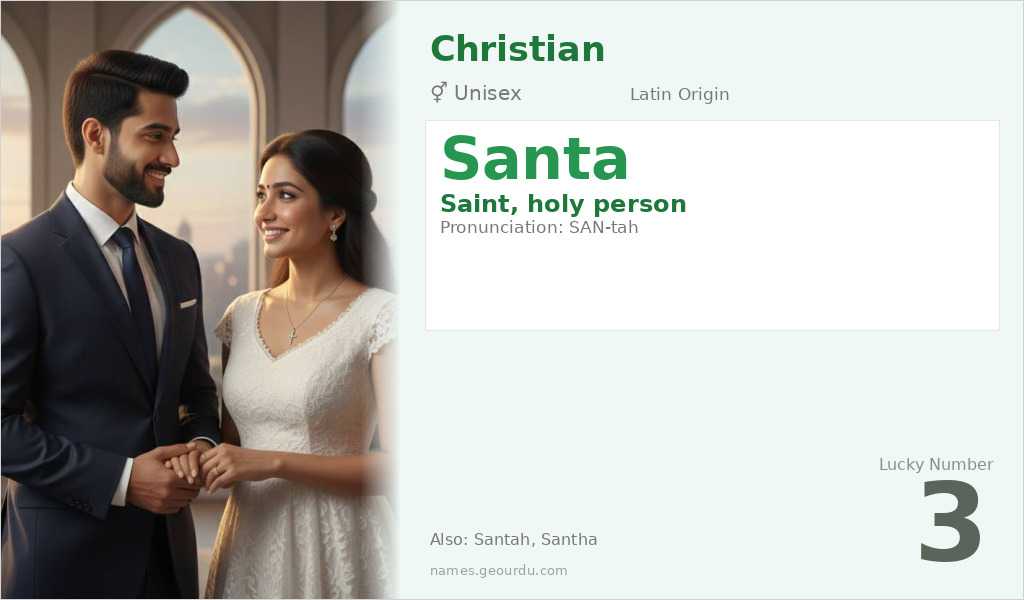
Table of Contents
Santa is a name with deep spiritual roots that transcends cultural boundaries. Derived from the Latin word for ‘holy’ or ‘saint’, this name carries connotations of sanctity and devotion. While commonly associated with Christmas folklore in Western cultures, Santa has genuine usage as a personal name in various regions. Its simplicity and profound meaning make it a distinctive choice for parents seeking a name with religious significance.
Meaning of Santa
The name Santa originates from the Latin word ‘sanctus’, which translates to ‘holy’, ‘sacred’, or ‘consecrated’. This Latin root gave rise to the Spanish, Italian, and Portuguese word ‘santa’ used as a feminine title for female saints (e.g., Santa Maria, Santa Lucia). In Christian contexts, it specifically refers to individuals recognized for exceptional holiness. While sometimes confused with the Christmas figure Santa Claus (from Dutch Sinterklaas), the name itself predates this association. In some South Asian contexts, it may relate to the Sanskrit-derived ‘Sant’ meaning ‘truthful person’ or ‘saint’, though this is linguistically distinct from the Latin origin.
| 📛 Name | Santa |
| 💎 Meaning | Saint, holy person |
| 👤 Gender | Unisex |
| 🕌 Religion | Christian |
| 🌍 Origin | Latin |
| 🗣 Pronunciation | SAN-tah |
| ✍️ Urdu | سانتا |
| ✍️ Arabic | سانتا |
| 🔢 Numerology | 3 |
| ✨ Spellings | Santah, Santha |
Origin & Cultural Significance
Santa has its primary origins in Latin Christianity, where it was used as an honorific for canonized women. The name spread through Romance languages and Christian missionary activity worldwide. In Spanish-speaking cultures, it remains common in compound names honoring saints. While occasionally used in India and neighboring regions, this is typically due to Christian communities or adaptation of the ‘Sant’ concept rather than traditional Hindu naming practices. The name’s association with Santa Claus developed in 19th-century America through Dutch immigrant traditions of Sinterklaas, but as a personal name, it maintains its original religious meaning.
Personality Traits
Those named Santa often embody qualities associated with their name’s meaning—they tend to be principled, compassionate, and spiritually inclined. They may demonstrate strong moral convictions and a desire to contribute positively to their communities. The name suggests someone who values integrity and tradition, potentially showing leadership in religious or ethical matters while maintaining a gentle, approachable demeanor.
Similar Names
If you like Santa, consider: Santana, Santino, Santosh, Santiago, Sant
Famous People Named Santa
- Santa Singh — Indian Sikh military officer and politician
- Santa Esmeralda — French-American disco group
Frequently Asked Questions About Santa
What does Santa mean?
Santa means 'saint' or 'holy person', originating from the Latin word 'sanctus' meaning 'holy, sacred'.
Is Santa a boy or girl name?
Santa is primarily used as a feminine name in Spanish/Italian contexts (meaning 'female saint'), but can be unisex, especially in South Asian regions where it relates to the gender-neutral 'Sant' concept.
What is the origin of Santa?
The name has Latin Christian origins, derived from 'sanctus'. It entered Romance languages as a title for saints and later became a personal name in various cultures.