
Table of Contents
Samant is a distinguished name with deep roots in ancient Indian culture, carrying the profound meaning of ‘universal’ or ‘complete.’ Derived from Sanskrit, this name has been cherished for centuries in Hindu traditions and appears in historical texts. Parents choosing Samant often appreciate its connection to wholeness and comprehensive understanding. This guide explores everything about this meaningful name.
Meaning of Samant
The name Samant originates from the Sanskrit word ‘samanta’ (समन्त), which literally translates to ‘universal,’ ‘whole,’ ‘complete,’ or ‘all-encompassing.’ Linguistically, it combines ‘sam’ (meaning ‘together’ or ‘completely’) with ‘anta’ (meaning ‘end’ or ‘boundary’), creating a concept of something that includes everything within its limits. This etymology reflects the philosophical depth of ancient Indian languages, where names often carried significant conceptual weight. The term appears in various Sanskrit texts, including philosophical and religious works, where it describes universal principles or complete entities. In modern usage across Indian languages like Hindi, Marathi, and Gujarati, the meaning remains consistent, though pronunciation may vary slightly.
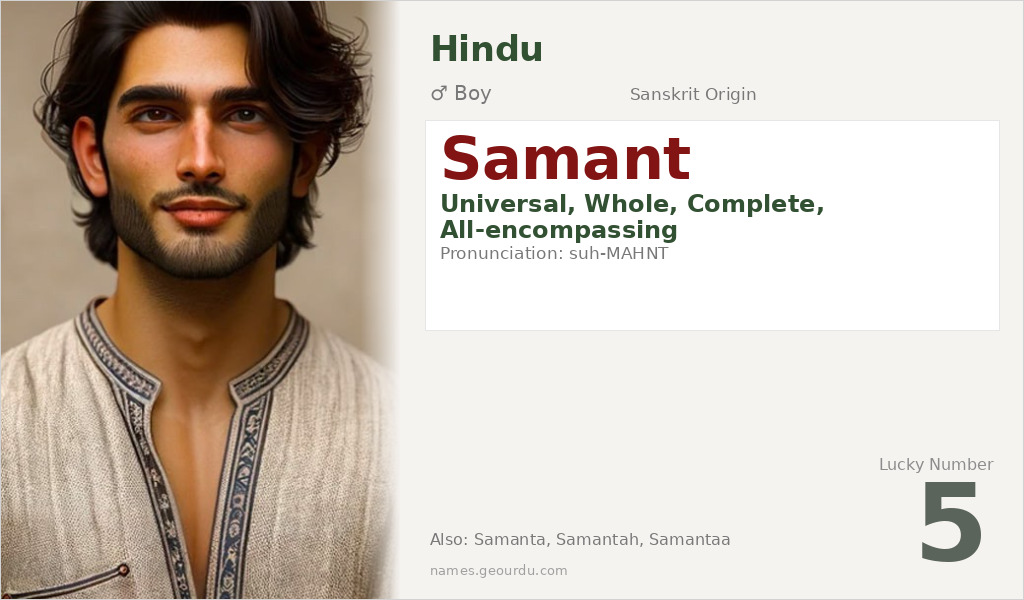
| 📛 Name | Samant |
| 💎 Meaning | Universal, Whole, Complete, All-encompassing |
| 👤 Gender | Boy |
| 🕌 Religion | Hindu |
| 🌍 Origin | Sanskrit |
| 🗣 Pronunciation | suh-MAHNT |
| ✍️ Urdu | سامنت |
| ✍️ Arabic | سامانت |
| 🔢 Numerology | 5 |
| ✨ Spellings | Samanta, Samantah, Samantaa |
Origin & Cultural Significance
Samant has its origins in ancient Sanskrit, the classical language of India that dates back over 3,500 years. The name appears in historical Indian contexts, including references in Jain and Buddhist literature alongside Hindu traditions. Historically, it was used by various communities across the Indian subcontinent, particularly among those valuing Sanskrit-derived names with philosophical meanings. While primarily associated with Hindu culture today, the name’s usage extends to other Indian religious and cultural groups who appreciate Sanskrit names. The name has maintained its traditional appeal while remaining relatively uncommon, giving it a distinctive quality among Indian names.
Personality Traits
Those named Samant are often associated with qualities of completeness and universality. They may exhibit broad-minded thinking, intellectual curiosity, and a desire to understand comprehensive systems. The name suggests someone who appreciates both detail and the bigger picture, potentially making them good at synthesis and analysis. These personality associations stem from the name’s meaning rather than empirical studies, reflecting cultural perceptions in naming traditions.
Similar Names
If you like Samant, consider: Samar, Samarth, Samir, Saman, Samvit
Famous People Named Samant
- Samant Bhadra — A prominent Jain scholar and philosopher from ancient India
- Various historical figures in Indian royalty and literature bearing variations of this name
Frequently Asked Questions About Samant
What does Samant mean?
Samant means 'universal,' 'whole,' 'complete,' or 'all-encompassing.' It originates from the Sanskrit word 'samanta' (समन्त), combining 'sam' (together/completely) and 'anta' (end/boundary).
Is Samant a boy or girl name?
Samant is traditionally a boy's name in Indian naming conventions. It follows masculine grammatical patterns in Sanskrit and is predominantly given to boys in Hindu families.
What is the origin of Samant?
Samant originates from Sanskrit, the ancient classical language of India. It has been used for centuries in Hindu, Jain, and Buddhist contexts across the Indian subcontinent.





