
Table of Contents
Saumendra is a distinguished Sanskrit name that beautifully blends celestial and regal elements from Hindu mythology. Meaning ‘lord of the moon,’ this name carries the divine essence of both Soma, the Vedic deity of the moon and immortality, and Indra, the powerful king of gods. With its rich linguistic heritage and profound spiritual significance, Saumendra offers a unique choice for parents seeking a name with deep cultural roots and poetic meaning.
Meaning of Saumendra
Saumendra is a classical Sanskrit compound name formed from two significant elements: ‘Soma’ and ‘Indra.’ Soma refers to both the Vedic moon deity and the sacred ritual drink that symbolizes immortality and divine consciousness in Hindu scriptures. Indra is the king of the devas (gods) in Vedic mythology, representing power, sovereignty, and thunder. The suffix ‘-endra’ means ‘lord’ or ‘ruler,’ making the complete meaning ‘lord of Soma’ or ‘ruler belonging to the moon god.’ This name appears in ancient Sanskrit literature and continues in modern Hindu naming traditions, particularly among families with appreciation for Vedic heritage and mythological references. The combination creates a name that signifies divine authority under lunar influence, suggesting both reflective wisdom and regal power.
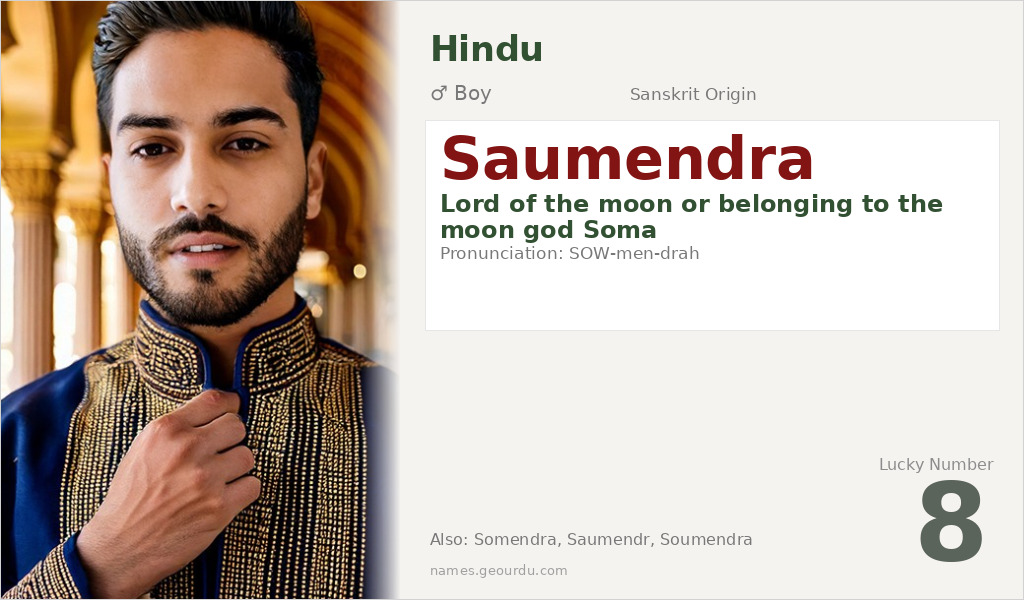
| 📛 Name | Saumendra |
| 💎 Meaning | Lord of the moon or belonging to the moon god Soma |
| 👤 Gender | Boy |
| 🕌 Religion | Hindu |
| 🌍 Origin | Sanskrit |
| 🗣 Pronunciation | SOW-men-drah |
| ✍️ Urdu | سومیندرا |
| ✍️ Arabic | سوميندرا |
| 🔢 Numerology | 8 |
| ✨ Spellings | Somendra, Saumendr, Soumendra |
Origin & Cultural Significance
Saumendra originates from classical Sanskrit, the ancient liturgical language of Hinduism, Buddhism, and Jainism. The name emerges from Vedic tradition, where Soma was one of the most important deities mentioned in the Rigveda, and Indra was the chief of the gods. This name reflects the sophisticated compound word formation characteristic of Sanskrit, where meaningful elements combine to create nuanced names. While primarily used in Hindu communities across India and the diaspora, the name maintains its pure Sanskrit form without significant adaptation in other languages or cultures. Its usage spans centuries, appearing in historical texts and continuing in contemporary times, particularly among families with scholarly or priestly backgrounds who value traditional Sanskrit names with mythological resonance.
Personality Traits
Those named Saumendra often embody the dual qualities suggested by their name’s etymology. From Soma, they may inherit calmness, intuition, and creative sensitivity—traditionally associated with lunar influence. From Indra, they might demonstrate leadership, courage, and protective instincts. This combination can result in individuals who are both reflective and decisive, able to navigate emotional depths while maintaining authoritative presence when needed. Their personality often balances philosophical contemplation with practical action.
Similar Names
If you like Saumendra, consider: Somendra, Chandrashekhar, Indrajit, Somesh, Somdev
Famous People Named Saumendra
- Saumendra Nath Tagore — 19th century Bengali scholar and translator
- Saumendra Barik — Contemporary Indian classical musician
Frequently Asked Questions About Saumendra
What does Saumendra mean?
Saumendra means 'lord of the moon' or 'belonging to Soma and Indra' in Sanskrit. It combines Soma (the Vedic moon deity) with Indra (king of gods), creating a name that signifies divine rulership under lunar influence.
Is Saumendra a boy or girl name?
Saumendra is exclusively a masculine name in Hindu naming tradition. All historical and contemporary usage records show it as a boy's name, derived from masculine deities in Sanskrit mythology.
What is the origin of Saumendra?
Saumendra originates from classical Sanskrit, the ancient language of Hindu scriptures. It is a compound name combining two Vedic deities: Soma (moon god) and Indra (king of gods), reflecting India's rich mythological heritage.





