
Table of Contents
Samartha is a meaningful and traditional name with deep roots in Sanskrit and Hindu culture. Often chosen for boys, it embodies qualities of capability, strength, and purpose. This name has been borne by historical figures and continues to be popular in Indian communities. In this guide, we explore its origins, meaning, and cultural relevance.
Meaning of Samartha
Samartha originates from Sanskrit, an ancient Indo-Aryan language central to Hindu scriptures and philosophy. It is a compound word formed from ‘sam,’ meaning ‘together’ or ‘completely,’ and ‘artha,’ meaning ‘meaning, purpose, wealth, or object.’ Together, Samartha translates to ‘having purpose together’ or ‘completely meaningful,’ but in common usage, it signifies someone who is capable, competent, powerful, and efficient. This meaning is well-documented in Sanskrit dictionaries and texts, such as the Amarakosha, where it describes ability and strength. The name reflects values of diligence and effectiveness, making it a popular choice for boys in Hindu families seeking to instill these traits.
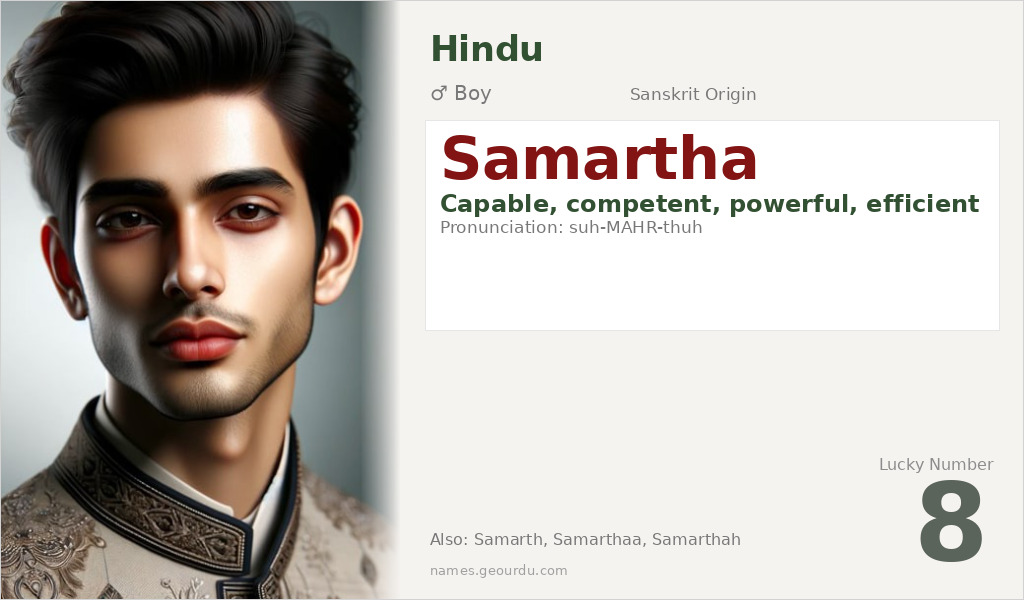
| 📛 Name | Samartha |
| 💎 Meaning | Capable, competent, powerful, efficient |
| 👤 Gender | Boy |
| 🕌 Religion | Hindu |
| 🌍 Origin | Sanskrit |
| 🗣 Pronunciation | suh-MAHR-thuh |
| ✍️ Urdu | سمارتھ |
| ✍️ Arabic | سامارثا |
| 🔢 Numerology | 8 |
| ✨ Spellings | Samarth, Samarthaa, Samarthah |
Origin & Cultural Significance
Samartha has its origins in Sanskrit, one of the oldest languages in the world and the liturgical language of Hinduism. It is primarily used within Hindu communities in India and among the diaspora, with historical usage dating back to classical Indian literature and religious texts. The name is associated with Hindu traditions, where names are often chosen for their auspicious meanings and phonetic qualities. Notable historical bearers include Samartha Ramdas, a revered saint from Maharashtra, highlighting its cultural significance in Indian history. While it is not commonly found in other language families like Arabic or Persian, its Sanskrit roots ensure a strong presence in Hindu naming practices.
Personality Traits
People named Samartha are often perceived as capable and determined, with a natural inclination toward leadership and problem-solving. Their name suggests a personality that is practical, resourceful, and focused on achieving objectives with efficiency. They may exhibit resilience and a strong sense of purpose, aligning with the name’s meaning of competence and power. In social settings, they are likely to be seen as reliable and influential individuals.
Similar Names
If you like Samartha, consider: Samar, Arth, Sarthak, Samarthan, Samarjit
Famous People Named Samartha
- Samartha Ramdas — 17th-century Hindu saint and spiritual guru from Maharashtra, India, known for his devotion to Lord Rama and influence on Maratha history
- Samarth Shandilya — Indian music composer and singer in Bollywood and regional cinema
Frequently Asked Questions About Samartha
What does Samartha mean?
Samartha means 'capable,' 'competent,' 'powerful,' or 'efficient.' It is derived from Sanskrit, combining 'sam' (together/completely) and 'artha' (meaning/purpose).
Is Samartha a boy or girl name?
Samartha is traditionally a boy name in Hindu culture, though names can sometimes be used unisexually in modern contexts. Its historical and common usage is for males.
What is the origin of Samartha?
Samartha originates from Sanskrit, an ancient language of India, and is primarily associated with Hindu religion and culture. It is not commonly found in other language families like Arabic or Persian.





