
Table of Contents
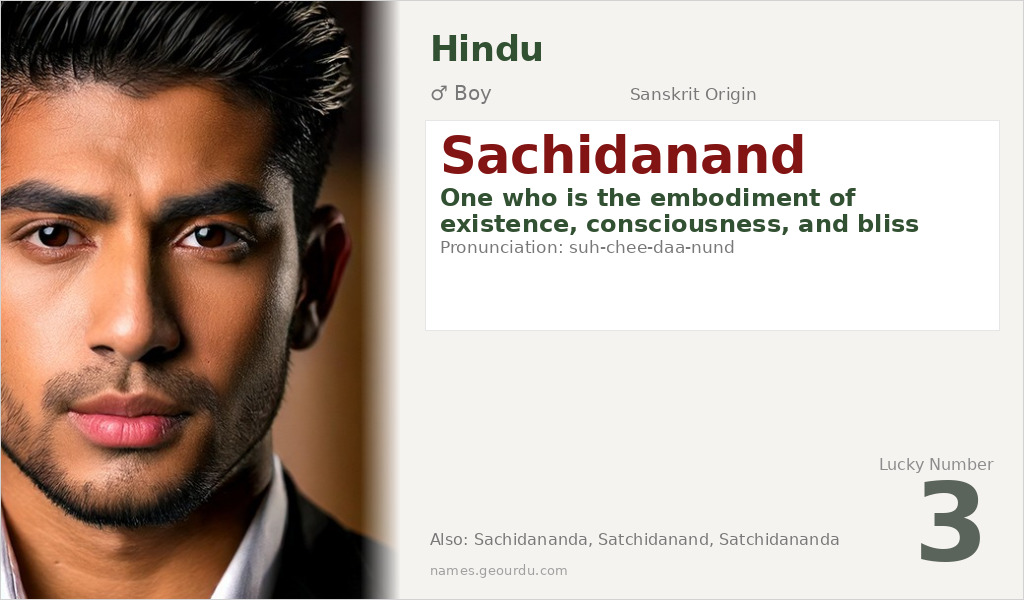
Sachidanand is a profound Sanskrit name with rich philosophical significance in Hindu tradition. Meaning ‘one who is the embodiment of existence, consciousness, and bliss’, this name represents one of the most important concepts in Hindu spirituality. Given primarily to boys, Sachidanand carries the weight of ancient wisdom and spiritual aspiration. Parents choosing this name often seek to imbue their child with qualities of truth-seeking, awareness, and inner joy.
Meaning of Sachidanand
Sachidanand is a compound Sanskrit name with three distinct components, each carrying deep philosophical weight. ‘Sat’ (सत्) refers to absolute existence or truth – that which is eternal and unchanging. ‘Chit’ (चित्) represents pure consciousness or awareness – the knowing principle that illuminates all experience. ‘Ananda’ (आनन्द) signifies supreme bliss or joy – not merely emotional happiness but the fundamental nature of reality itself. Together, these three elements describe the essential nature of Brahman (the ultimate reality) in Advaita Vedanta philosophy. The name thus represents an aspirational ideal of realizing one’s true nature as existence-consciousness-bliss. This tripartite concept appears in ancient texts like the Taittiriya Upanishad and has been central to Hindu spiritual thought for millennia.
| 📛 Name | Sachidanand |
| 💎 Meaning | One who is the embodiment of existence, consciousness, and bliss |
| 👤 Gender | Boy |
| 🕌 Religion | Hindu |
| 🌍 Origin | Sanskrit |
| 🗣 Pronunciation | suh-chee-daa-nund |
| ✍️ Urdu | سچید آنند |
| ✍️ Arabic | ساتشيداناند |
| 🔢 Numerology | 3 |
| ✨ Spellings | Sachidananda, Satchidanand, Satchidananda, Sachchidanand |
Origin & Cultural Significance
Sachidanand originates from classical Sanskrit, the ancient liturgical language of Hinduism. Its philosophical roots trace back to the Upanishads (circa 800-200 BCE), where the concept of Sat-Chit-Ananda first appears as a description of Brahman. The name gained prominence through Advaita Vedanta philosophy, particularly through the works of Adi Shankara (8th century CE) who systematized this understanding of ultimate reality. While primarily used in Hindu communities across India, the name has spiritual significance beyond religious boundaries due to its philosophical depth. In modern times, it remains a meaningful choice for parents seeking a name with spiritual resonance and intellectual heritage. The name is particularly popular among families with philosophical or spiritual orientations within Hindu tradition.
Personality Traits
Those named Sachidanand often embody qualities suggested by their name’s meaning. They tend to be contemplative individuals who value truth and self-awareness in their personal and professional lives. The ‘bliss’ component of their name frequently manifests as a generally positive outlook and ability to find joy in simple things. Their consciousness-oriented nature makes them attentive listeners and thoughtful decision-makers who consider multiple perspectives before acting.
Similar Names
If you like Sachidanand, consider: Anand, Chidanand, Satyam, Brahmanand, Vidyanand
Famous People Named Sachidanand
- Sachidanand Sinha — First temporary Chairman of the Constituent Assembly of India and prominent Indian politician
- Sachidanand Hiranand Vatsyayan 'Agyeya' — Renowned Hindi poet, novelist, and literary critic, considered a pioneer of modern Hindi poetry
Frequently Asked Questions About Sachidanand
What does Sachidanand mean?
Sachidanand means 'one who is the embodiment of existence, consciousness, and bliss' in Sanskrit. It's a philosophical compound name describing the nature of ultimate reality in Hindu thought.
Is Sachidanand a boy or girl name?
Sachidanand is traditionally a masculine name given to boys in Hindu communities. While names are becoming more fluid in modern times, it remains predominantly male in cultural usage.
What is the origin of Sachidanand?
Sachidanand originates from Sanskrit, the ancient language of Hindu scriptures. Its philosophical roots trace to the Upanishads and Advaita Vedanta tradition, where Sat-Chit-Ananda describes the essential nature of Brahman (ultimate reality).





