
Table of Contents
Stalin is a powerful name with deep historical roots in 20th-century politics. Derived from the Russian word for ‘steel’, this name carries connotations of strength, resilience, and determination. While primarily known as the pseudonym of Soviet leader Joseph Stalin, the name has occasionally been used in various cultures. Understanding its true origin and meaning requires looking beyond modern adaptations to its Russian linguistic roots.
Meaning of Stalin
The name Stalin originates from the Russian language, specifically from the word ‘сталь’ (stal) meaning ‘steel’. The suffix ‘-in’ is a common Russian patronymic or possessive ending, creating the meaning ‘of steel’ or ‘steel man’. This name was famously adopted by Joseph Stalin as a revolutionary pseudonym to symbolize his unwavering strength and revolutionary commitment. Unlike traditional given names with centuries of usage, Stalin emerged in the early 20th century as a political identifier. The name has no etymological connection to Sanskrit, Hindi, or other South Asian languages despite some modern usage in those regions.
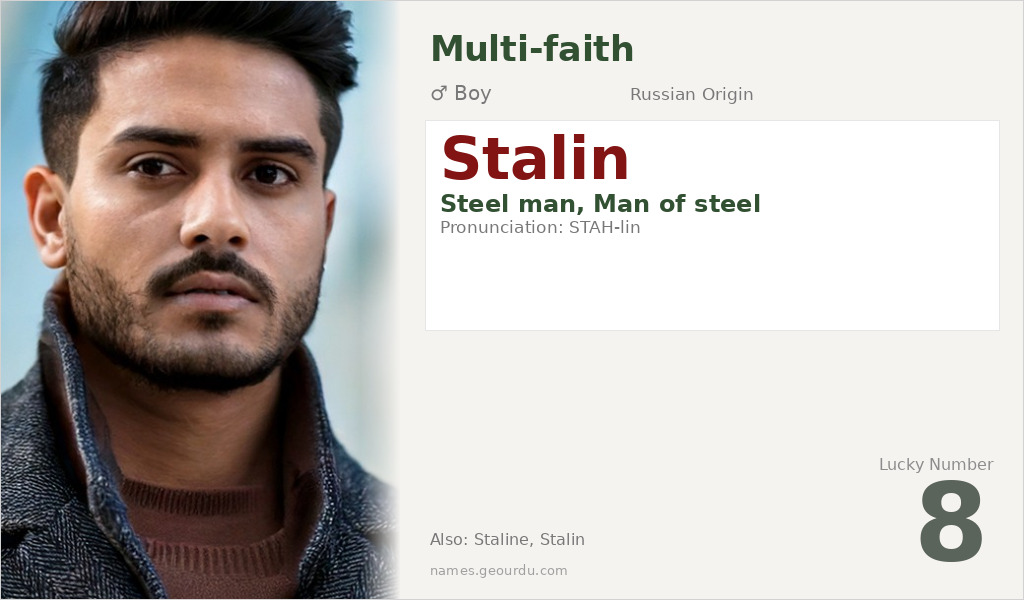
| 📛 Name | Stalin |
| 💎 Meaning | Steel man, Man of steel |
| 👤 Gender | Boy |
| 🕌 Religion | Multi-faith |
| 🌍 Origin | Russian |
| 🗣 Pronunciation | STAH-lin |
| ✍️ Urdu | سٹالن |
| ✍️ Arabic | ستالين |
| 🔢 Numerology | 8 |
| ✨ Spellings | Staline, Stalin |
Origin & Cultural Significance
Stalin’s origin is firmly rooted in early 20th-century Russian revolutionary politics. The name was created as a pseudonym by Ioseb Jughashvili, who later became the leader of the Soviet Union. It represents a deliberate choice to project strength and revolutionary fervor during a turbulent period in Russian history. While the name has been occasionally used in other cultures, particularly in regions with communist sympathies or among admirers of Soviet achievements, it remains primarily associated with Russian/Soviet history. The name’s cultural significance is overwhelmingly political rather than traditional or religious.
Personality Traits
Those named Stalin often carry the weight of historical associations, which can influence perceptions of their personality. The name suggests qualities of strength, determination, and leadership, reflecting its literal meaning of ‘steel’. However, it also carries complex historical baggage that may affect how bearers are perceived in different cultural contexts. The name’s strong connotations make it distinctive but potentially controversial in many settings.
Similar Names
If you like Stalin, consider: Steel, Stellan, Stanley, Stavros, Stas
Famous People Named Stalin
- Joseph Stalin — Soviet revolutionary and political leader who led the Soviet Union from 1924 to 1953
- Svetlana Alliluyeva (Stalina) — Daughter of Joseph Stalin, writer and defector to the United States
Frequently Asked Questions About Stalin
What does Stalin mean?
Stalin means 'steel man' or 'man of steel' in Russian, derived from the word 'сталь' (stal) meaning steel.
Is Stalin a boy or girl name?
Stalin is exclusively a boy's name, originally created as a masculine pseudonym and maintaining that gender association.
What is the origin of Stalin?
Stalin originates from 20th-century Russian revolutionary politics, specifically as the pseudonym adopted by Joseph Stalin, derived from the Russian word for steel.





