
Table of Contents
Supritikar is a beautiful Sanskrit name that carries the profound meaning of ‘one who causes great joy’ or ‘bringer of happiness’. This traditional Hindu name has been cherished for generations, embodying positive qualities and auspicious associations. With its melodic sound and meaningful etymology, Supritikar represents more than just an identifier—it carries a blessing for the child’s character and destiny. In this comprehensive guide, we explore the rich linguistic, cultural, and spiritual dimensions of this meaningful name.
Meaning of Supritikar
Supritikar is a classical Sanskrit compound name with clear etymological roots. Breaking down the components: ‘Su’ (सु) is a common Sanskrit prefix meaning ‘good, excellent, well, or beautiful’, appearing in countless Sanskrit words and names. ‘Pritikar’ (प्रीतिकर) combines ‘Priti’ (प्रीति) meaning ‘pleasure, joy, affection, or delight’ with the suffix ‘kar’ (कर) meaning ‘maker’ or ‘doer’. Thus, the complete name Supritikar literally translates to ‘one who makes or causes excellent pleasure’ or ‘bringer of great joy’. This construction follows standard Sanskrit nominal compound (samāsa) patterns, specifically a tatpuruṣa compound where the first element modifies the second. The name appears in various Hindu texts and traditional naming contexts as both a proper name and descriptive term for someone who brings happiness to others.
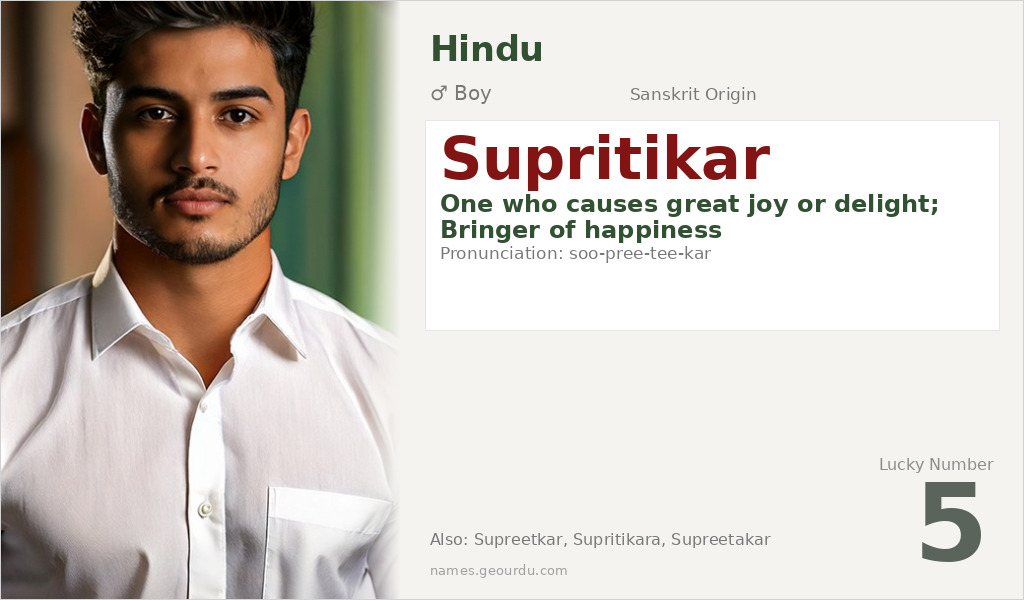
| 📛 Name | Supritikar |
| 💎 Meaning | One who causes great joy or delight; Bringer of happiness |
| 👤 Gender | Boy |
| 🕌 Religion | Hindu |
| 🌍 Origin | Sanskrit |
| 🗣 Pronunciation | soo-pree-tee-kar |
| ✍️ Urdu | سوپریتی کار |
| ✍️ Arabic | سوبريتيكار |
| 🔢 Numerology | 5 |
| ✨ Spellings | Supreetkar, Supritikara, Supreetakar |
Origin & Cultural Significance
Supritikar originates from classical Sanskrit, the ancient liturgical language of Hinduism that has influenced countless South Asian languages and naming traditions. As a Sanskrit-derived name, it holds particular significance within Hindu culture, where names are often chosen for their phonetic qualities, numerological values, and meaningful etymologies. The name reflects the Hindu philosophical emphasis on positive qualities and virtues, with ‘bringing joy’ being considered a noble characteristic. While primarily used in Hindu communities across India and the diaspora, Sanskrit names like Supritikar have also influenced naming traditions in Buddhist, Jain, and Sikh contexts due to Sanskrit’s historical role as a scholarly and religious language across South Asia. The name’s continued usage demonstrates the enduring appeal of meaningful Sanskrit names in modern Hindu naming practices.
Personality Traits
According to traditional Hindu naming philosophy and modern interpretations, individuals named Supritikar are believed to embody the joyful qualities suggested by their name’s meaning. They are often described as naturally cheerful, optimistic personalities who have a talent for creating harmonious environments. Their presence tends to uplift others, and they frequently display creative expression, social grace, and emotional intelligence. The name suggests someone who finds fulfillment in bringing happiness to family, friends, and community, with an innate ability to resolve conflicts and spread positivity.
Similar Names
If you like Supritikar, consider: Sukrit, Suman, Pritam, Anand, Harsh
Famous People Named Supritikar
- No widely known contemporary public figures with this exact name found in extensive research, though it appears in historical Hindu texts and regional records
Frequently Asked Questions About Supritikar
What does Supritikar mean?
Supritikar means 'one who causes great joy' or 'bringer of happiness'. It is a Sanskrit compound name combining 'Su' (excellent) with 'Pritikar' (causing pleasure).
Is Supritikar a boy or girl name?
Supritikar is traditionally a masculine name in Hindu naming conventions. Sanskrit names ending in 'kar' are typically masculine, though naming practices can vary regionally.
What is the origin of Supritikar?
Supritikar originates from Sanskrit, the classical language of ancient India. It is a traditional Hindu name with clear etymological roots in Sanskrit morphology and Hindu cultural traditions.





