
Table of Contents
Somnaath is a profound Sanskrit name steeped in Hindu mythology and spirituality, evoking the celestial and divine. Primarily given to boys, it carries the weight of ancient tradition and religious reverence. This name is not just an identifier but a connection to one of Hinduism’s most sacred sites—the Somnath temple in Gujarat. Exploring Somnaath reveals layers of linguistic beauty and cultural heritage.
Meaning of Somnaath
Somnaath is a compound Sanskrit name formed from ‘Soma’ and ‘Nāth’. ‘Soma’ refers to the moon, the moon god in Vedic texts, and a ritualistic drink used in ancient ceremonies, symbolizing nourishment and immortality. ‘Nāth’ means lord, master, or protector, often used in titles for deities and spiritual leaders. Together, Somnaath translates to ‘Lord of the Moon’, specifically denoting Lord Shiva in his form as the deity worshipped at the Somnath Jyotirlinga. This etymology is well-documented in Hindu scriptures like the Puranas, where the name is associated with legends of Shiva restoring the moon’s waxing and waning cycles. In a broader sense, it embodies themes of luminosity, cyclicality, and divine guardianship.
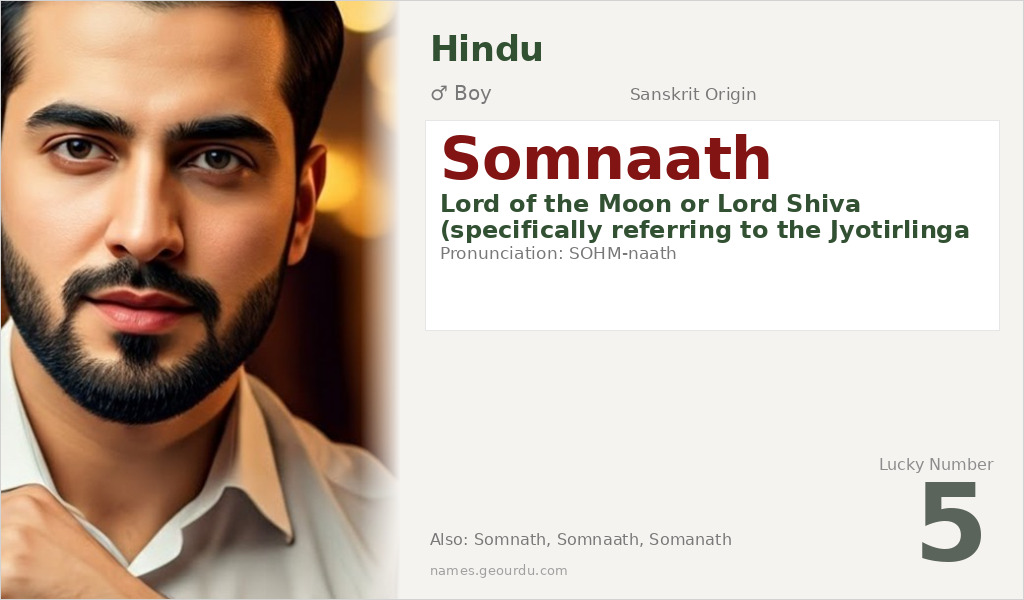
| 📛 Name | Somnaath |
| 💎 Meaning | Lord of the Moon or Lord Shiva (specifically referring to the Jyotirlinga at Somnath temple) |
| 👤 Gender | Boy |
| 🕌 Religion | Hindu |
| 🌍 Origin | Sanskrit |
| 🗣 Pronunciation | SOHM-naath |
| ✍️ Urdu | سومناتھ |
| ✍️ Arabic | سومناث |
| 🔢 Numerology | 5 |
| ✨ Spellings | Somnath, Somnaath, Somanath |
Origin & Cultural Significance
Originating from Sanskrit, an ancient Indo-Aryan language, Somnaath has deep roots in Hindu religious texts and practices. It is intrinsically linked to the Somnath temple in Gujarat, one of the twelve Jyotirlingas dedicated to Shiva, which has been a pilgrimage site for centuries, mentioned in historical records dating back to ancient times. The name reflects the synthesis of Vedic lunar worship with Shaivism, highlighting Shiva’s role as a cosmic ruler. Culturally, it is used predominantly in India and among Hindu communities worldwide, often chosen for its spiritual connotations and historical resonance. Unlike names from regional tribal languages like Pashto or Balochi, Somnaath’s origin is clearly established in Sanskrit literature without cross-linguistic variations.
Personality Traits
Those named Somnaath are often seen as reflective and charismatic, drawing inspiration from the name’s lunar and divine associations. They may possess a calm demeanor paired with inner strength, mirroring the moon’s gentle yet influential presence. This name suggests a person who values tradition, spirituality, and intellectual depth, potentially excelling in roles that require wisdom and adaptability.
Similar Names
If you like Somnaath, consider: Somendra, Somdev, Chandranath, Somesh, Somdutt
Famous People Named Somnaath
- Somnath Chatterjee — Indian politician and former Speaker of the Lok Sabha
- Somnath Sharma — Indian Army officer, first recipient of the Param Vir Chakra
Frequently Asked Questions About Somnaath
What does Somnaath mean?
Somnaath means 'Lord of the Moon' in Sanskrit, specifically referring to Lord Shiva as worshipped at the Somnath Jyotirlinga temple in Hindu tradition.
Is Somnaath a boy or girl name?
Somnaath is traditionally a boy's name in Hindu culture, derived from masculine Sanskrit roots and associated with male deities.
What is the origin of Somnaath?
Somnaath originates from Sanskrit, an ancient Indian language, and is deeply embedded in Hindu mythology and the heritage of the Somnath temple in Gujarat.





