
Table of Contents
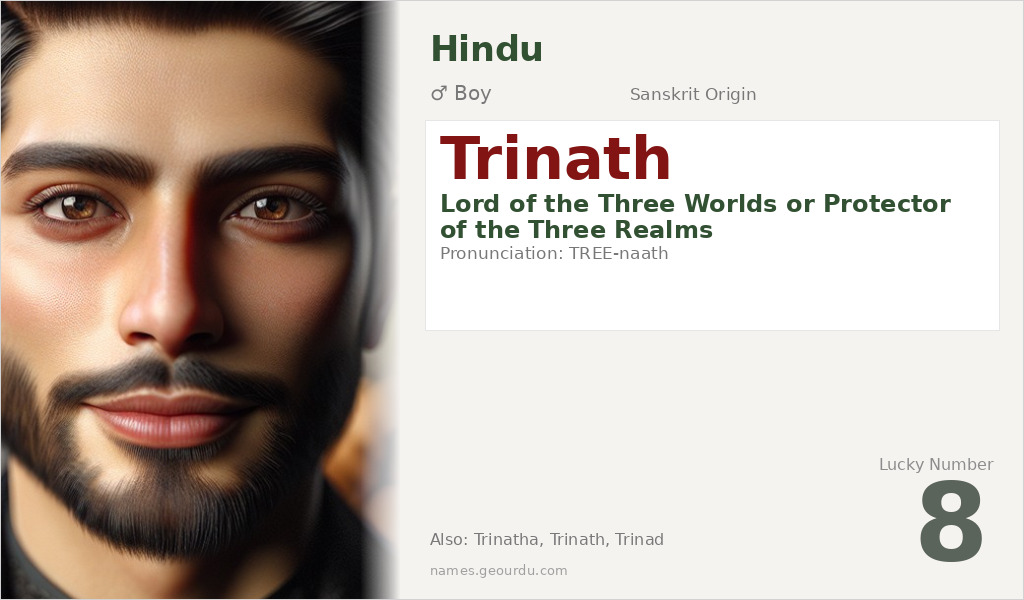
Trinath is a profound and spiritually rich name of Sanskrit origin, predominantly used in Hindu communities. It carries the powerful meaning of ‘Lord of the Three Worlds’, symbolizing divine protection and sovereignty. This name is often chosen for boys to invoke blessings of strength, wisdom, and cosmic balance. Rooted in ancient Hindu texts, Trinath reflects a deep connection to spiritual cosmology and revered deities.
Meaning of Trinath
Trinath is a compound Sanskrit name formed from ‘tri’ (three) and ‘nath’ (lord or protector). The ‘tri’ element refers to the three realms in Hindu cosmology: the earthly plane (Bhūloka), the intermediate space (Antarikṣa), and the celestial realm (Svarga). ‘Nath’ denotes a master, guardian, or refuge, often used in titles for gods and spiritual leaders. Thus, Trinath translates to ‘Lord of the Three Worlds’ or ‘Protector of the Three Realms’, emphasizing omnipresence and supreme authority. It is closely linked to Lord Shiva, who is revered as the destroyer and regenerator across all existence, though it can also apply to Vishnu in contexts where he is seen as the sustainer of the universe. The name embodies the concept of divine oversight and balance across multiple dimensions of reality.
| 📛 Name | Trinath |
| 💎 Meaning | Lord of the Three Worlds or Protector of the Three Realms |
| 👤 Gender | Boy |
| 🕌 Religion | Hindu |
| 🌍 Origin | Sanskrit |
| 🗣 Pronunciation | TREE-naath |
| ✍️ Urdu | تریناتھ |
| ✍️ Arabic | تریناث |
| 🔢 Numerology | 8 |
| ✨ Spellings | Trinatha, Trinath, Trinad |
Origin & Cultural Significance
Originating from Sanskrit, an ancient Indo-Aryan language foundational to Hinduism, Buddhism, and Jainism, Trinath has been used for centuries in Indian subcontinent cultures. It appears in Hindu scriptures and epics, often as an epithet for deities like Shiva, highlighting their role as rulers of the tripartite cosmos. The name is prevalent in regions with strong Hindu traditions, such as India, Nepal, and parts of Southeast Asia, and is commonly found among various linguistic groups including Hindi, Bengali, and Marathi speakers. Its usage reflects the enduring influence of Sanskrit on naming practices, where compound names convey spiritual attributes and philosophical ideals. While primarily Hindu, the name’s etymological roots in Sanskrit make it recognizable in other Dharmic religions that share linguistic heritage.
Personality Traits
Those named Trinath are often perceived as grounded yet visionary, with a natural inclination toward spirituality and leadership. They may exhibit a protective nature, mirroring the name’s meaning of guardianship over multiple realms. Their personality tends to blend practicality with philosophical depth, making them adept at navigating diverse life situations. This name inspires a sense of responsibility and a holistic worldview, encouraging balance between material and spiritual pursuits.
Similar Names
If you like Trinath, consider: Trilok, Trilokanath, Trivikram, Tridev, Trinetra
Famous People Named Trinath
- Trinath Rao — Indian classical musician and composer
- Trinath Mishra — scholar and author on Hindu philosophy
Frequently Asked Questions About Trinath
What does Trinath mean?
Trinath means 'Lord of the Three Worlds' or 'Protector of the Three Realms', derived from Sanskrit 'tri' (three) and 'nath' (lord).
Is Trinath a boy or girl name?
Trinath is traditionally a boy name in Hindu culture, though its unisex potential exists in modern contexts due to its meaning-focused nature.
What is the origin of Trinath?
Trinath originates from Sanskrit, an ancient language of India, and is deeply rooted in Hindu cosmology and deity epithets.





