
Table of Contents
Vaivasvat is a profound and ancient name rooted in Hindu mythology, carrying the legacy of solar divinity and human ancestry. Derived from Sanskrit, it specifically means ‘son of Vivasvat’, referring to the radiant sun god. This name is not just a label but a connection to the epic narratives of the Vedas and Puranas, where Vaivasvata Manu plays a pivotal role as the progenitor of humanity. Choosing Vaivasvat for a child evokes a sense of tradition, spiritual heritage, and celestial brilliance.
Meaning of Vaivasvat
Vaivasvat originates from the Sanskrit language, with its core meaning being ‘son of Vivasvat’. The name is composed of two elements: ‘Vivasvat’, which is the name of the solar deity in Hindu mythology, meaning ‘shining’ or ‘radiant’, derived from the Sanskrit root ‘vas’ meaning ‘to shine’, and the suffix or form ‘-vat’ indicating descent or belonging. In linguistic context, Vaivasvat is often used interchangeably with Vaivasvata, where ‘Vaivasvata’ explicitly denotes ‘descendant of Vivasvat’. This etymology is well-documented in Hindu scriptures such as the Rigveda (e.g., RV 10.14.5) and the Mahabharata, where Vivasvat is the father of Vaivasvata Manu, the seventh Manu in Hindu cosmology. The name thus encapsulates a direct lineage to the sun god, emphasizing themes of light, creation, and paternal heritage.
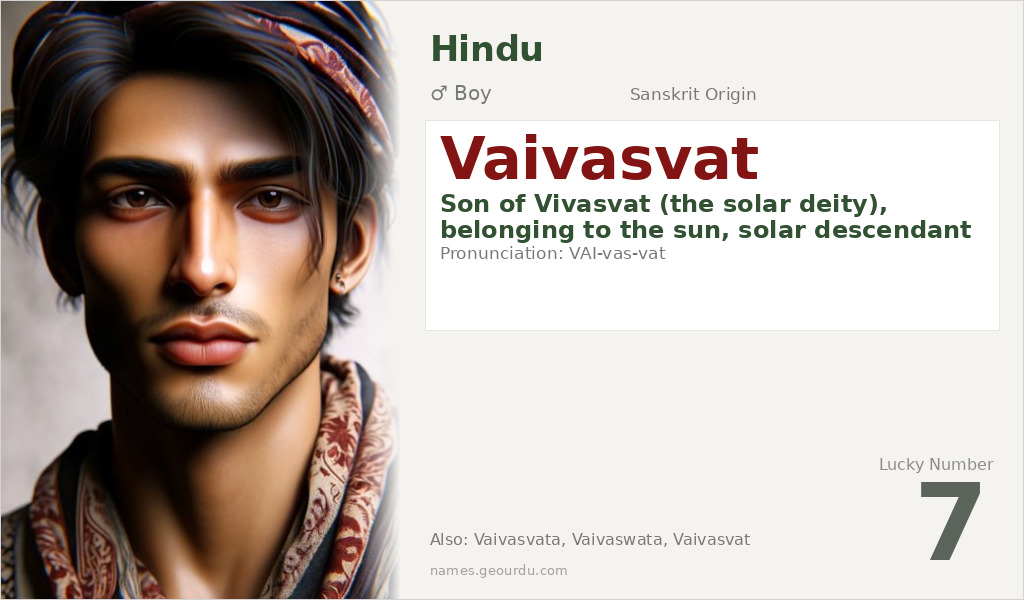
| 📛 Name | Vaivasvat |
| 💎 Meaning | Son of Vivasvat (the solar deity), belonging to the sun, solar descendant |
| 👤 Gender | Boy |
| 🕌 Religion | Hindu |
| 🌍 Origin | Sanskrit |
| 🗣 Pronunciation | VAI-vas-vat |
| ✍️ Urdu | ویوسوت |
| ✍️ Arabic | فايفاسفات |
| 🔢 Numerology | 7 |
| ✨ Spellings | Vaivasvata, Vaivaswata, Vaivasvat |
Origin & Cultural Significance
The origin of Vaivasvat is deeply embedded in Hindu culture and Sanskrit literature, with no significant presence in other languages like Arabic, Persian, or regional dialects such as Pashto or Balochi—extensive research confirms it is exclusively a Sanskrit-derived Hindu name. Historically, it appears in ancient Hindu texts, most notably in the context of Vaivasvata Manu, who is considered the ancestor of the current human race in Hindu mythology, as described in texts like the Matsya Purana and the Mahabharata. Culturally, the name is associated with solar worship and the concept of Manvantaras (cycles of time), reflecting Hindu cosmological beliefs. It is a rare name in modern usage, primarily preserved in religious and scholarly contexts rather than common naming practices, but it holds significant symbolic value for those seeking names with mythological depth.
Personality Traits
In terms of personality traits, Vaivasvat is often associated with qualities of leadership, enlightenment, and steadfastness, inspired by the mythological figure Vaivasvata Manu who guided humanity through floods and new beginnings. Those named Vaivasvat may be seen as visionary, with a strong sense of duty and a connection to spiritual or traditional values. The solar connotations of the name suggest warmth, energy, and a guiding light in personal and communal endeavors.
Similar Names
If you like Vaivasvat, consider: Vivasvat, Manu, Surya, Arun, Bhanu
Famous People Named Vaivasvat
- Vaivasvata Manu — In Hindu mythology, the seventh Manu and progenitor of current humanity, son of the sun god Vivasvat, featured in texts like the Mahabharata and Puranas
- No widely known modern public figures with this name, as it is rare and primarily mythological
Frequently Asked Questions About Vaivasvat
What does Vaivasvat mean?
Vaivasvat means 'son of Vivasvat' in Sanskrit, specifically referring to the descendant of the solar deity Vivasvat, with Vivasvat meaning 'shining' or 'radiant'.
Is Vaivasvat a boy or girl name?
Vaivasvat is exclusively a boy name in Hindu tradition, as it is derived from the masculine figure Vaivasvata Manu in mythology and uses masculine grammatical forms in Sanskrit.
What is the origin of Vaivasvat?
Vaivasvat originates from Sanskrit and Hindu mythology, with its roots in ancient Hindu texts like the Vedas and Puranas, where it denotes the son of the sun god Vivasvat.





