Table of Contents
Umay is a beautiful name with deep roots in Central Asian mythology and culture. Far from being a modern invention, this name carries centuries of tradition as the embodiment of maternal protection and fertility. Whether you’re drawn to its melodic sound or its rich historical significance, Umay offers a connection to ancient Turkic heritage that remains relevant today.
Meaning of Umay
The name Umay originates from the Old Turkic word ‘umay’, which literally means ‘womb’ or ‘placenta’, symbolizing the source of life and motherhood. In Turkic linguistic history, this term evolved to represent the maternal principle and the protective force surrounding childbirth and infancy. The name appears in the Orkhon inscriptions (8th century CE), some of the oldest known Turkic writings, where Umay is invoked as a divine protector. Across Turkic and Mongolian cultures, the name maintains this core meaning of life-giving maternal energy, distinguishing it from similar-sounding names in other language families.
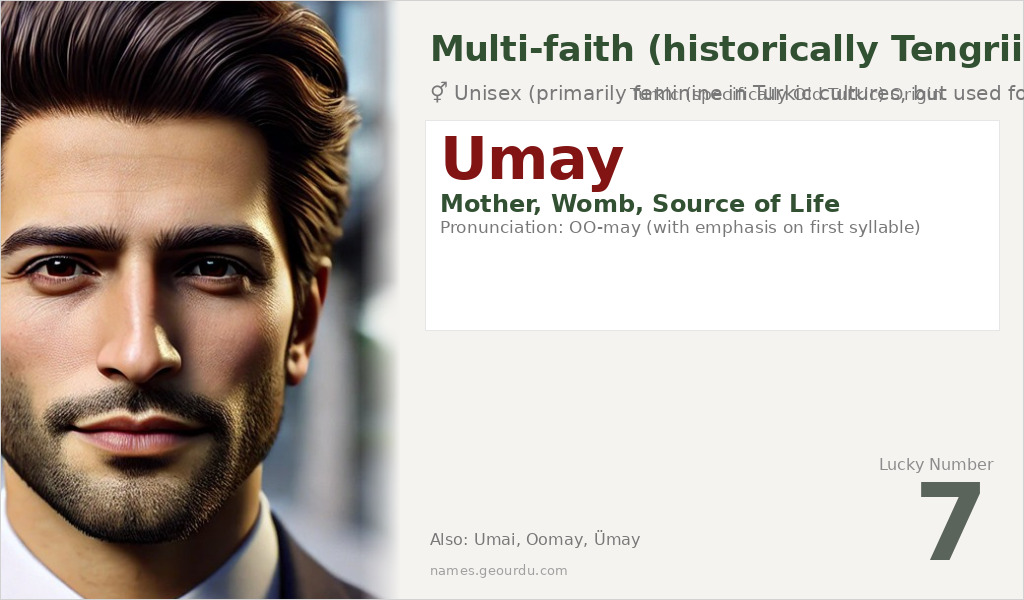
| 📛 Name | Umay |
| 💎 Meaning | Mother, Womb, Source of Life |
| 👤 Gender | Unisex (primarily feminine in Turkic cultures, but used for both genders in some contexts) |
| 🕌 Religion | Multi-faith (historically Tengriist/Shamanistic, now used by Muslims, Christians, and others in Turkic regions) |
| 🌍 Origin | Turkic (specifically Old Turkic) |
| 🗣 Pronunciation | OO-may (with emphasis on first syllable) |
| ✍️ Urdu | امی (though not traditionally used in Urdu-speaking cultures) |
| ✍️ Arabic | أوماي (transliteration, not native Arabic name) |
| 🔢 Numerology | 7 |
| ✨ Spellings | Umai, Oomay, Ümay, Umayı |
Origin & Cultural Significance
Umay has its origins in the pre-Islamic belief systems of Central Asia, particularly Tengriism and Turkic shamanism. The goddess Umay was one of the primary deities in the Turkic pantheon, alongside Tengri (sky god) and Erlik (underworld god). As Turkic peoples spread across Eurasia and adopted Islam, Christianity, and Buddhism, the name persisted as a cultural heritage element. Today, it remains popular in Turkey, Kazakhstan, Kyrgyzstan, and other Turkic-speaking regions, often given to honor ancestral traditions while fitting within modern religious frameworks. The name’s endurance across millennia demonstrates its deep cultural significance.
Personality Traits
Those named Umay often embody the nurturing qualities associated with their name’s mythological origins. They tend to be protective of loved ones, with a strong sense of family and community responsibility. The name’s connection to fertility and life-giving energy may manifest as creativity, compassion, and a natural inclination toward caregiving professions or roles. While personality varies by individual, the cultural associations with Umay suggest someone who provides stability and warmth to those around them.
Similar Names
If you like Umay, consider: Aisulu, Aynur, Gökçe, Asena, Almıla
Famous People Named Umay
- Umay Günay — Turkish actress known for roles in Turkish television series
- Umay Ana — Mythological Turkic mother goddess, central figure in Turkic creation myths
Frequently Asked Questions About Umay
What does Umay mean?
Umean means 'mother', 'womb', or 'source of life' in Turkic languages. It originates from the Old Turkic word for the maternal principle and life-giving force.
Is Umay a boy or girl name?
Umay is primarily a feminine name in Turkic cultures, associated with the mother goddess Umay Ana. However, in some modern contexts it may be used as a unisex name, though this is less traditional.
What is the origin of Umay?
Umay originates from Old Turkic language and mythology. It was the name of a major goddess in pre-Islamic Turkic religion and appears in 8th-century Orkhon inscriptions, making it one of the oldest documented Turkic names.