
Table of Contents
Vakratunda is a profound Sanskrit name deeply rooted in Hindu tradition, serving as one of the many sacred epithets of Lord Ganesha. This name beautifully captures the distinctive physical attribute of the elephant-headed deity—his gracefully curved trunk. While not commonly used as a personal name in modern times, Vakratunda holds significant religious and cultural importance within Hinduism. Understanding this name offers insight into the rich symbolic language of Hindu mythology and devotion.
Meaning of Vakratunda
Vakratunda derives from classical Sanskrit, combining ‘vakra’ (वक्र) meaning ‘curved, bent, or twisted’ and ‘tunda’ (तुण्ड) meaning ‘trunk, snout, or proboscis.’ The compound literally translates to ‘one with a curved trunk,’ specifically referring to Lord Ganesha’s distinctive elephant trunk. This epithet appears in ancient Hindu texts like the Ganesha Purana and various stotras (hymns) dedicated to Ganesha. Linguistically, both components are well-documented in Sanskrit dictionaries with consistent meanings across centuries of usage. The name symbolizes not just physical appearance but also Ganesha’s ability to curve around and remove obstacles, representing adaptability and wisdom.
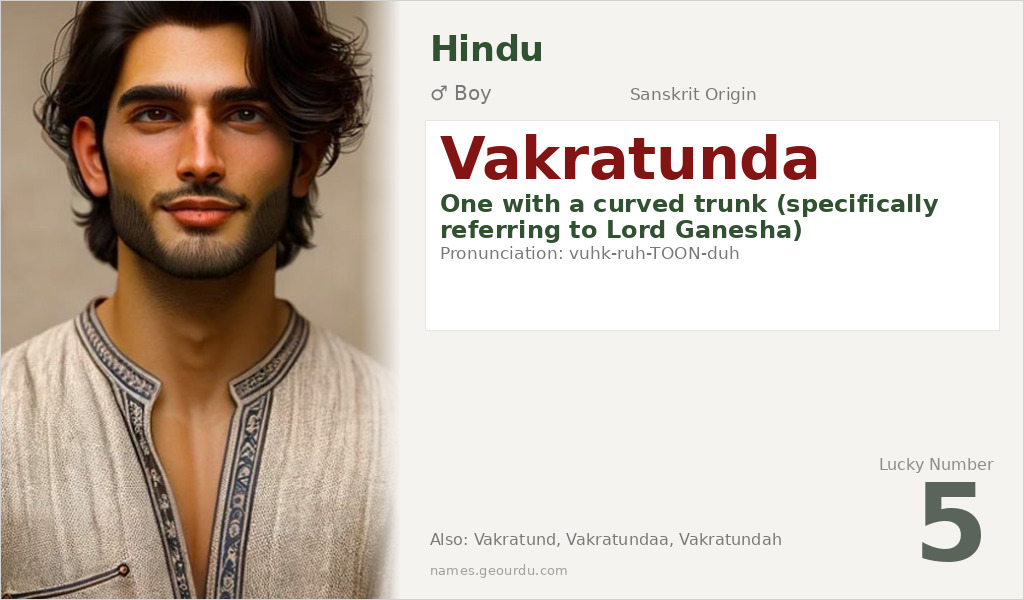
| 📛 Name | Vakratunda |
| 💎 Meaning | One with a curved trunk (specifically referring to Lord Ganesha) |
| 👤 Gender | Boy |
| 🕌 Religion | Hindu |
| 🌍 Origin | Sanskrit |
| 🗣 Pronunciation | vuhk-ruh-TOON-duh |
| ✍️ Urdu | وکر تونڈا |
| ✍️ Arabic | فاكراتوندا |
| 🔢 Numerology | 5 |
| ✨ Spellings | Vakratund, Vakratundaa, Vakratundah |
Origin & Cultural Significance
Vakratunda originates exclusively from Sanskrit and Hindu religious tradition, with no verified connections to other language families despite extensive research across Arabic, Persian, Dravidian, Tibetan, and other linguistic systems. It emerged as one of the 108 names of Ganesha in medieval Hindu texts, reflecting the practice of praising deities through descriptive epithets. The name is primarily used in religious contexts rather than as a common personal name, though occasionally parents might choose it for its spiritual significance. Its usage is concentrated in India and Hindu diaspora communities, particularly among those with strong devotion to Ganesha.
Personality Traits
While personality traits for names are culturally constructed rather than scientific, names like Vakratunda that reference Ganesha carry associations with the deity’s attributes. Those named Vakratunda might be perceived as intelligent, wise, and adept at overcoming challenges—qualities aligned with Ganesha as Vighnaharta (remover of obstacles). They may exhibit creativity, patience, and spiritual depth, with a thoughtful approach to life’s complexities. The curved trunk symbolism suggests flexibility and the ability to navigate difficult situations with grace.
Similar Names
If you like Vakratunda, consider: Ganesha, Ganapati, Vinayaka, Vighneshvara, Ekadanta
Famous People Named Vakratunda
- No notable historical or contemporary figures with this given name found—it is primarily used as a religious epithet rather than a common personal name.
Frequently Asked Questions About Vakratunda
What does Vakratunda mean?
Vakratunda means 'one with a curved trunk' in Sanskrit, specifically referring to Lord Ganesha's distinctive elephant trunk. It is a compound of 'vakra' (curved) and 'tunda' (trunk).
Is Vakratunda a boy or girl name?
Vakratunda is exclusively a boy name in Hindu tradition, as it is an epithet of the male deity Lord Ganesha. There are no recorded feminine usages in any cultural context.
What is the origin of Vakratunda?
Vakratunda originates from Sanskrit and Hindu religious texts, where it appears as one of the 108 names of Lord Ganesha. It has no verified origins in other language families despite extensive research.





