
Table of Contents
Tushratta is a name that carries the weight of ancient history, belonging to a Mitanni king who ruled around 1350 BCE. While occasionally used in modern Hindu communities, its origins trace back to the Hurrian civilization of northern Mesopotamia. This name offers a unique connection to Bronze Age diplomacy and royal correspondence preserved in the Amarna letters. Discover the fascinating story behind this historically significant name.
Meaning of Tushratta
The meaning of Tushratta is not definitively established but appears to derive from the Hurrian language, spoken by the Mitanni kingdom in ancient Mesopotamia. Some scholars suggest it might mean ‘having a chariot’ or ‘chariot-rider,’ reflecting the importance of chariotry in Mitanni military culture. The name is primarily known from historical records rather than linguistic dictionaries, making its precise etymology challenging to verify. Unlike many modern names with clear Sanskrit or Arabic roots, Tushratta represents an ancient linguistic tradition that has largely been lost. Its preservation comes mainly through diplomatic correspondence with Egyptian pharaohs, where King Tushratta appears as a significant political figure.
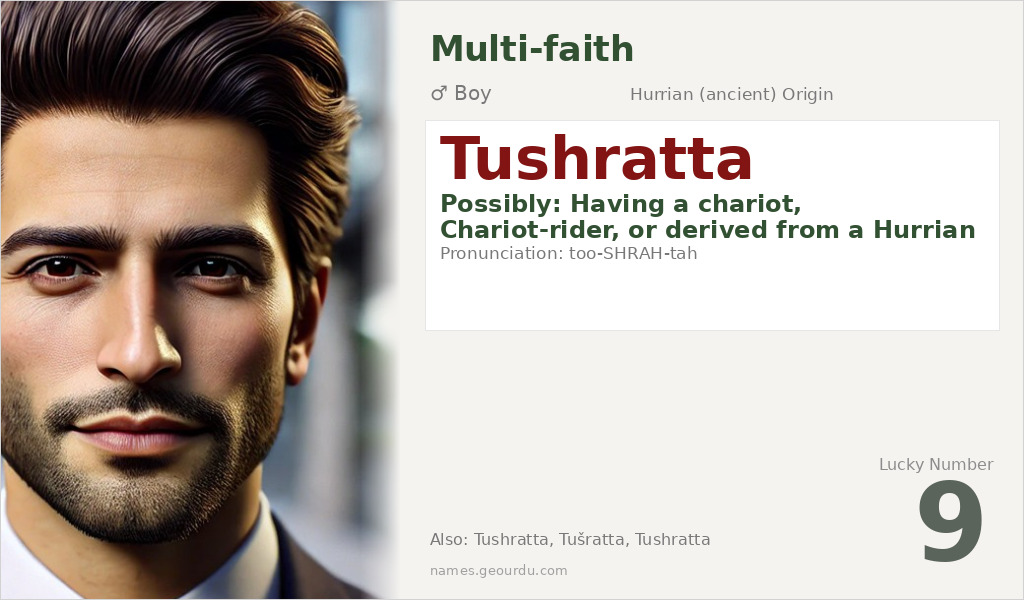
| 📛 Name | Tushratta |
| 💎 Meaning | Possibly: Having a chariot, Chariot-rider, or derived from a Hurrian royal name |
| 👤 Gender | Boy |
| 🕌 Religion | Multi-faith |
| 🌍 Origin | Hurrian (ancient) |
| 🗣 Pronunciation | too-SHRAH-tah |
| ✍️ Urdu | تشرت |
| ✍️ Arabic | تشرتا |
| 🔢 Numerology | 9 |
| ✨ Spellings | Tushratta, Tušratta, Tushratta |
Origin & Cultural Significance
Tushratta originates from the Hurrian civilization, specifically the Mitanni kingdom that flourished in northern Mesopotamia (modern-day Syria and Turkey) during the Late Bronze Age (c. 1500-1300 BCE). The name gained historical prominence through the Amarna letters—diplomatic correspondence between Egyptian pharaohs and neighboring rulers. King Tushratta of Mitanni appears in these letters negotiating marriages, alliances, and gifts with Egyptian rulers Amenhotep III and Akhenaten. While the name has been adopted by some Hindu families in modern times, this represents cultural borrowing rather than indigenous origin. The Hurrian language itself is extinct, making Tushratta a rare surviving example of Mitanni onomastics.
Personality Traits
Those named Tushratta often carry an air of historical significance and traditional values. The name’s royal associations suggest qualities of leadership, diplomacy, and strategic thinking. Individuals with this name may feel connected to ancient history and cultural heritage, potentially developing interests in archaeology, history, or international relations. The name’s rarity in modern times often results in distinctive personalities who value uniqueness and depth of character.
Similar Names
If you like Tushratta, consider: Tushar, Tushara, Tushita, Tushnim, Tusharika
Famous People Named Tushratta
- Tushratta — King of Mitanni (c. 1350 BCE) who corresponded with Egyptian pharaohs Akhenaten and Amenhotep III, known from the Amarna letters
- No contemporary famous people with this name found in verified sources
Frequently Asked Questions About Tushratta
What does Tushratta mean?
The exact meaning is not definitively verified, but it possibly means 'having a chariot' or 'chariot-rider' in the ancient Hurrian language, based on scholarly analysis of the Mitanni kingdom's culture.
Is Tushratta a boy or girl name?
Tushratta is exclusively a boy's name, both historically (as borne by a Mitanni king) and in modern usage across cultures where it appears.
What is the origin of Tushratta?
Tushratta originates from the Hurrian language of the ancient Mitanni kingdom in northern Mesopotamia (modern Syria/Turkey), dating back to approximately 1350 BCE.





