
Table of Contents
Tandava is a powerful Sanskrit name deeply rooted in Hindu mythology, representing one of the most profound concepts in Indian spirituality. This name evokes the cosmic dance of Lord Shiva that sustains the rhythm of the universe. While uncommon as a personal name, it carries immense cultural and religious significance for those who choose it. Understanding Tandava requires exploring ancient texts and dance traditions that have preserved this concept for millennia.
Meaning of Tandava
Tandava derives from the Sanskrit word ‘ताण्डव’ (tāṇḍava), which refers specifically to the vigorous, cosmic dance performed by Lord Shiva. This is not merely a physical dance but a metaphysical concept representing the cyclical nature of existence. In Hindu cosmology, Shiva performs the Tandava to destroy the universe at the end of each cosmic cycle (kalpa), making way for new creation. The term appears in foundational texts like the Natya Shastra (circa 200 BCE-200 CE), where it’s described as having multiple forms including the violent Rudra Tandava and the joyful Ananda Tandava. Linguistically, it connects to the root ‘tandu’ meaning to stretch or extend, reflecting the expansive nature of cosmic energy.
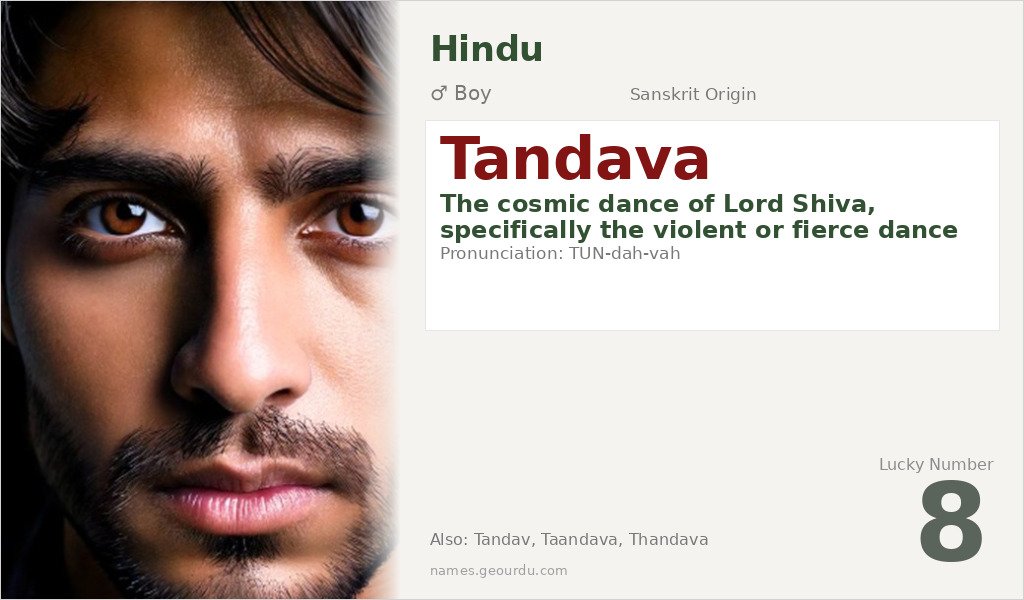
| 📛 Name | Tandava |
| 💎 Meaning | The cosmic dance of Lord Shiva, specifically the violent or fierce dance that destroys the universe at the end of a cosmic cycle |
| 👤 Gender | Boy |
| 🕌 Religion | Hindu |
| 🌍 Origin | Sanskrit |
| 🗣 Pronunciation | TUN-dah-vah |
| ✍️ Urdu | ٹنڈوا |
| ✍️ Arabic | تاندافا |
| 🔢 Numerology | 8 |
| ✨ Spellings | Tandav, Taandava, Thandava |
Origin & Cultural Significance
Tandava originates from ancient Sanskrit literature and Hindu religious texts, with its earliest references in Vedic and post-Vedic scriptures. The concept gained prominence through classical Indian dance traditions, particularly Bharatanatyam and Odissi, where dancers depict Shiva’s Tandava with specific mudras (hand gestures) and movements. While primarily a mythological and artistic concept rather than a common personal name, some parents choose Tandava for its profound spiritual associations. The name is exclusively Hindu in origin and usage, deeply embedded in Shaivism (worship of Shiva) traditions across India and Southeast Asia where Hindu culture spread historically.
Personality Traits
Those named Tandava are often associated with transformative energy and rhythmic purpose, mirroring the cosmic dance their name represents. They may possess intense focus and the ability to initiate significant changes in their environments. The dual nature of Shiva’s dance—both destructive and creative—might manifest as someone who can dismantle old structures to build anew. Their personality typically combines artistic sensitivity with formidable determination.
Similar Names
If you like Tandava, consider: Nataraja, Shiva, Rudra, Bharata, Lasya
Famous People Named Tandava
- Tandava Krishna — Indian classical dancer specializing in Shiva Tandava
- Various Indian classical dancers and performers who specialize in depicting the Tandava in dance dramas
Frequently Asked Questions About Tandava
What does Tandava mean?
Tandava means the cosmic dance of Lord Shiva in Sanskrit, specifically referring to the vigorous dance that destroys and renews the universe in Hindu cosmology.
Is Tandava a boy or girl name?
Tandava is exclusively a boy's name in Hindu naming traditions, as it refers to a masculine deity's (Shiva) cosmic activity.
What is the origin of Tandava?
Tandava originates from Sanskrit language and Hindu mythology, with documented usage in ancient Indian texts like the Natya Shastra and various Puranas.





