Table of Contents
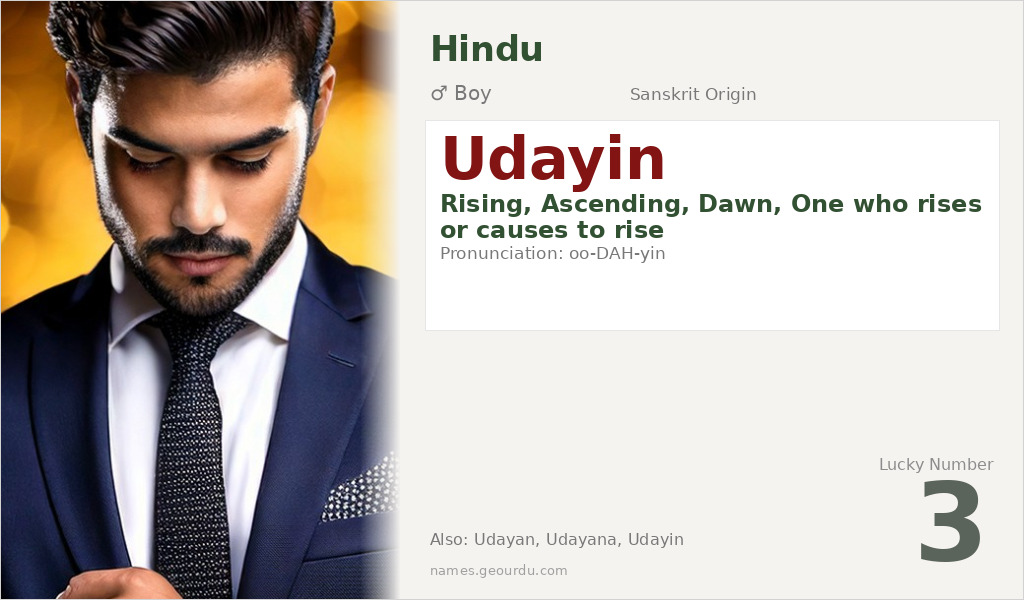
Udayin is a classic Sanskrit name with deep roots in Indian history and culture. Meaning ‘rising’ or ‘ascending,’ it evokes imagery of dawn, new beginnings, and upward progress. This name has been borne by historical figures and continues to be chosen for its positive, aspirational connotations. In this guide, we explore Udayin’s linguistic origins, cultural context, and modern relevance.
Meaning of Udayin
Udayin originates from the Sanskrit language, specifically from the root ‘ud’ (उद्), which means ‘to rise, ascend, or go up.’ Combined with the suffix ‘-in,’ it forms a word meaning ‘one who rises’ or ‘one who causes to rise.’ The related term ‘udaya’ (उदय) refers to sunrise, dawn, prosperity, or success, highlighting the name’s association with light, beginnings, and positive advancement. In Vedic and classical Sanskrit texts, derivatives of ‘ud’ are used in contexts of spiritual awakening, material prosperity, and natural phenomena like the rising sun. Thus, Udayin carries connotations of illumination, growth, and auspicious starts, making it a meaningful choice in Hindu naming traditions.
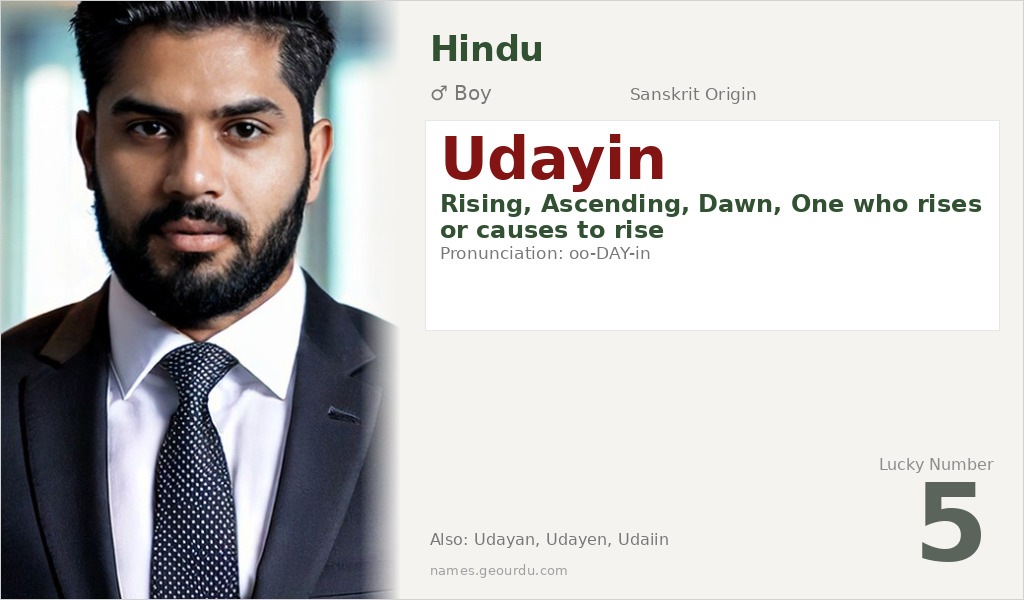
| 📛 Name | Udayin |
| 💎 Meaning | Rising, Ascending, Dawn, One who rises or causes to rise |
| 👤 Gender | Boy |
| 🕌 Religion | Hindu |
| 🌍 Origin | Sanskrit |
| 🗣 Pronunciation | oo-DAY-in |
| ✍️ Urdu | اُدین |
| ✍️ Arabic | أودايين |
| 🔢 Numerology | 5 |
| ✨ Spellings | Udayan, Udayen, Udaiin |
Origin & Cultural Significance
Udayin has its origins in ancient India, where Sanskrit was the primary liturgical and scholarly language. The name is documented in historical records, most notably referring to King Udayin (Udayabhadra), who ruled the Magadha empire around the 5th century BCE and is mentioned in Buddhist and Jain texts. This historical usage underscores the name’s long-standing presence in Indian culture. While primarily associated with Hinduism due to its Sanskrit roots, the name may also appear in Jain and Buddhist contexts, reflecting India’s diverse religious heritage. Unlike some names that cross linguistic boundaries, Udayin remains firmly rooted in Sanskrit without verified equivalents or meanings in Arabic, Persian, or other regional languages outside the Indian subcontinent.
Personality Traits
People named Udayin are often perceived as dynamic and forward-thinking, with a natural inclination toward leadership and innovation. Their name’s meaning—’rising’—suggests a personality that embraces change, seeks growth, and inspires others with optimism and energy. They may excel in roles that require initiative, creativity, or the ability to overcome challenges, embodying the dawn-like quality of bringing light and new possibilities to situations.
Similar Names
If you like Udayin, consider: Uday, Udaya, Udayveer, Udit, Udbhav
Famous People Named Udayin
- Udayin (King Udayabhadra) — 5th century BCE ruler of the Magadha empire in ancient India, successor to King Ajatashatru
- Udayin (character) — appears in classical Sanskrit literature and Jain texts as a historical or mythological figure
Frequently Asked Questions About Udayin
What does Udayin mean?
Udayin means 'rising,' 'ascending,' or 'dawn' in Sanskrit, derived from the root 'ud' (to rise) with the suffix '-in' (one who does).
Is Udayin a boy or girl name?
Udayin is traditionally a boy's name in Hindu and Indian cultures, with no common usage as a girl's name.
What is the origin of Udayin?
Udayin originates from Sanskrit, an ancient Indian language, and is associated with Hindu culture and history, including references to King Udayin of Magadha.