
Table of Contents
Tarakeshwar is a powerful Sanskrit name with deep roots in Hindu mythology and spirituality. Primarily used for boys, this name carries the weight of divine association and historical significance. As a compound name meaning ‘Lord of Taraka’, it represents one of the many sacred epithets of Lord Shiva. Understanding Tarakeshwar requires exploring its linguistic components and mythological background.
Meaning of Tarakeshwar
The name Tarakeshwar derives from classical Sanskrit, combining two meaningful elements: ‘Taraka’ and ‘Ishwar’. ‘Taraka’ has multiple layers of meaning in Sanskrit – it refers specifically to a demon in Hindu mythology whom Lord Shiva defeated, but more broadly can mean ‘star’, ‘savior’, or ‘one who helps cross over’. ‘Ishwar’ is a fundamental Sanskrit term meaning ‘lord’, ‘god’, ‘ruler’, or ‘supreme being’. When combined, Tarakeshwar literally translates to ‘Lord of Taraka’ or ‘the divine lord who is the savior’. In Hindu theological context, this name specifically references Shiva’s role in granting liberation (moksha) by overcoming obstacles, symbolized by his victory over the demon Taraka. The name thus embodies both destructive and protective aspects of the divine.
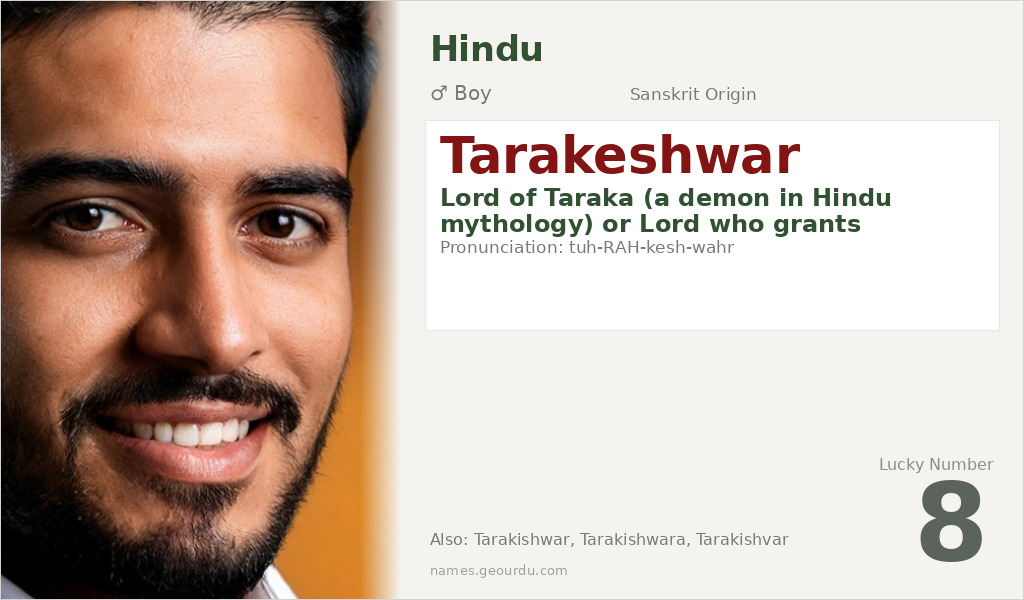
| 📛 Name | Tarakeshwar |
| 💎 Meaning | Lord of Taraka (a demon in Hindu mythology) or Lord who grants liberation |
| 👤 Gender | Boy |
| 🕌 Religion | Hindu |
| 🌍 Origin | Sanskrit |
| 🗣 Pronunciation | tuh-RAH-kesh-wahr |
| ✍️ Urdu | تراکیشور |
| ✍️ Arabic | تاراكيشوار |
| 🔢 Numerology | 8 |
| ✨ Spellings | Tarakishwar, Tarakishwara, Tarakishvar |
Origin & Cultural Significance
Tarakeshwar originates from ancient Sanskrit, the liturgical language of Hinduism, and has been used for centuries within Hindu communities across the Indian subcontinent. The name appears in various Hindu texts and traditions as an epithet of Lord Shiva, particularly in contexts emphasizing his role as a destroyer of evil and granter of liberation. Culturally, the name is most prevalent in India, Nepal, and among Hindu diaspora communities worldwide. Historically, names ending with ‘-ishwar’ have been popular in Hindu naming traditions, indicating devotion to the divine. Tarakeshwar represents a specific mythological reference within this broader naming pattern, connecting the bearer to Shiva’s victory over the demon Taraka as described in Puranic literature.
Personality Traits
Those named Tarakeshwar are often associated with qualities of strength, determination, and spiritual depth. The name’s connection to Lord Shiva suggests characteristics of transformation, resilience, and the ability to overcome challenges. Individuals with this name may be perceived as natural leaders with a protective instinct and a strong sense of duty. The mythological background lends an aura of spiritual significance and traditional values to the personality associated with this name.
Similar Names
If you like Tarakeshwar, consider: Tarakesh, Taraknath, Ishwar, Maheshwar, Vishveshwar
Famous People Named Tarakeshwar
- Tarakeshwar Dutta — Indian freedom fighter and revolutionary
- Tarakeshwar Sinha — Indian politician and former Member of Parliament
Frequently Asked Questions About Tarakeshwar
What does Tarakeshwar mean?
Tarakeshwar means 'Lord of Taraka' or 'the divine lord who grants liberation'. It is a Sanskrit compound name where 'Taraka' refers to a demon in Hindu mythology (or more broadly means 'savior') and 'Ishwar' means 'lord' or 'god'.
Is Tarakeshwar a boy or girl name?
Tarakeshwar is exclusively a boy's name in Hindu naming tradition. The '-ishwar' suffix is typically masculine in Sanskrit grammar and Hindu cultural practice.
What is the origin of Tarakeshwar?
Tarakeshwar originates from Sanskrit, the classical language of Hinduism. It is a traditional Hindu name that functions as an epithet of Lord Shiva, with specific reference to mythological stories about Shiva defeating the demon Taraka.





