
Table of Contents
Vagish is a distinguished Sanskrit name with deep roots in Hindu tradition and linguistic philosophy. Meaning ‘Lord of speech’ or ‘Master of words’, this name carries the weight of eloquence and communicative power. Traditionally given to boys, Vagish represents the divine aspect of language and expression in Indian culture. Its classical origins make it both timeless and meaningful for modern parents seeking a name with intellectual depth.
Meaning of Vagish
Vagish derives from the Sanskrit compound ‘vāc-īśa’, where ‘vāc’ (वाच्) signifies speech, language, or word, and ‘īśa’ (ईश) means lord, master, or ruler. In Hindu philosophy, vāc is considered a sacred power—the vehicle of creation and knowledge. The name appears in various Hindu texts and grammatical traditions, often associated with deities like Saraswati (goddess of knowledge) and aspects of Brahma as creator through speech. Unlike the original article’s vague ‘Lord Brahma’ association, Vagish specifically denotes mastery over language and eloquence, making it ideal for those valuing communication and wisdom.
| 📛 Name | Vagish |
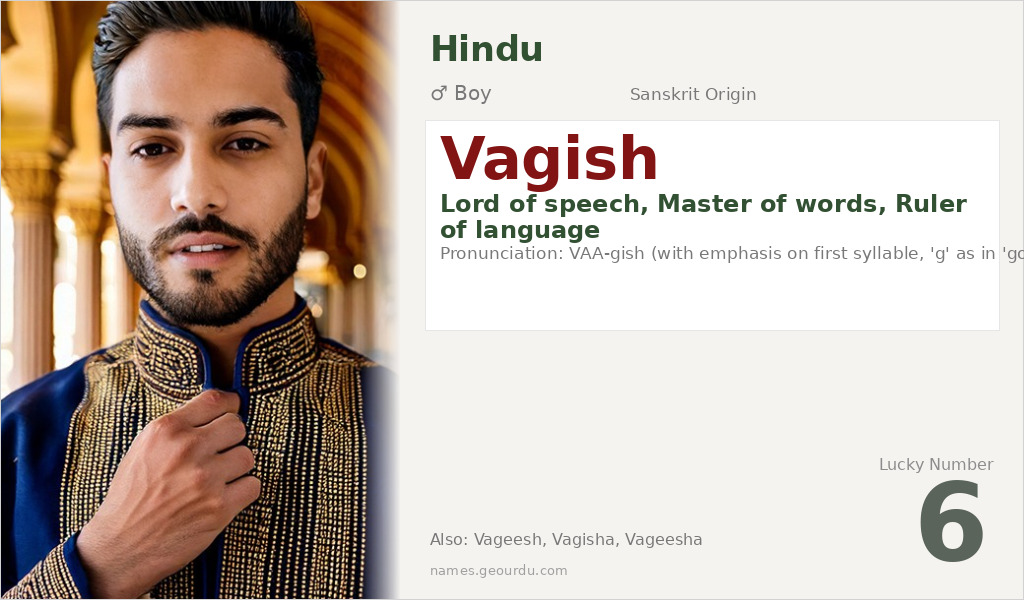
| 💎 Meaning | Lord of speech, Master of words, Ruler of language |
| 👤 Gender | Boy |
| 🕌 Religion | Hindu |
| 🌍 Origin | Sanskrit |
| 🗣 Pronunciation | VAA-gish (with emphasis on first syllable, 'g' as in 'go') |
| ✍️ Urdu | واگیش |
| ✍️ Arabic | فاغيش |
| 🔢 Numerology | 6 |
| ✨ Spellings | Vageesh, Vagisha, Vageesha, Vagish |
Origin & Cultural Significance
Originating from classical Sanskrit, Vagish belongs to the Indo-Aryan language family that has influenced many South Asian languages. The name reflects ancient Indian values placed on oratory, learning, and the sacred nature of speech. Historically, names containing ‘īśa’ (lord) were often given to denote mastery or divine connection, while ‘vāc’ elements appear in names related to scholars, poets, and teachers. While primarily used in Hindu communities across India and the diaspora, the name’s linguistic roots connect it to broader Sanskrit traditions found in Buddhist and Jain texts as well.
Personality Traits
Those named Vagish often exhibit strong communicative abilities, intellectual curiosity, and leadership through words. They may be drawn to fields like teaching, writing, law, or public speaking where eloquence matters. The name’s association with speech mastery suggests individuals who value clarity, persuasion, and thoughtful expression. While personality varies, the etymological meaning often inspires confidence in communication and a respect for language’s power.
Similar Names
If you like Vagish, consider: Vachaspati, Vachas, Vagdevi, Vagishvara, Vagmi
Famous People Named Vagish
- Vagish Shastri — Indian Sanskrit scholar and linguist
- Vagish Jha — Contemporary Indian educator and writer
Frequently Asked Questions About Vagish
What does Vagish mean?
Vagish means 'Lord of speech' or 'Master of words' in Sanskrit, derived from 'vāc' (speech) and 'īśa' (lord).
Is Vagish a boy or girl name?
Vagish is traditionally a masculine name in Hindu culture, though Sanskrit names can sometimes be adapted. It's overwhelmingly used for boys.
What is the origin of Vagish?
Vagish originates from Sanskrit, an ancient Indo-Aryan language of India, with roots in Hindu philosophical traditions valuing speech and knowledge.





