
Table of Contents
Vighneshwar is a powerful Sanskrit name with deep roots in Hindu tradition and mythology. As one of the primary names of Lord Ganesha, this name carries significant spiritual weight and cultural importance. Parents choosing this name often seek to invoke the blessings of the remover of obstacles for their child. With its rich linguistic heritage and religious significance, Vighneshwar remains a meaningful choice in Hindu communities worldwide.
Meaning of Vighneshwar
Vighneshwar derives from the Sanskrit compound ‘vighna’ (obstacle) + ‘īśvara’ (lord), literally translating to ‘Lord of Obstacles’ or ‘Controller of Obstacles’. This name specifically refers to Lord Ganesha, the elephant-headed deity who is worshipped first in Hindu rituals to remove impediments. The term ‘vighna’ appears in ancient Vedic texts, while ‘īśvara’ is a common Sanskrit honorific for deities and rulers. In Hindu theology, Vighneshwar represents Ganesha’s dual nature—both creating obstacles for the unrighteous and removing them for devotees. This name has been consistently used in Hindu scriptures for over a millennium, particularly in texts dedicated to Ganesha worship like the Ganesha Purana and Mudgala Purana.
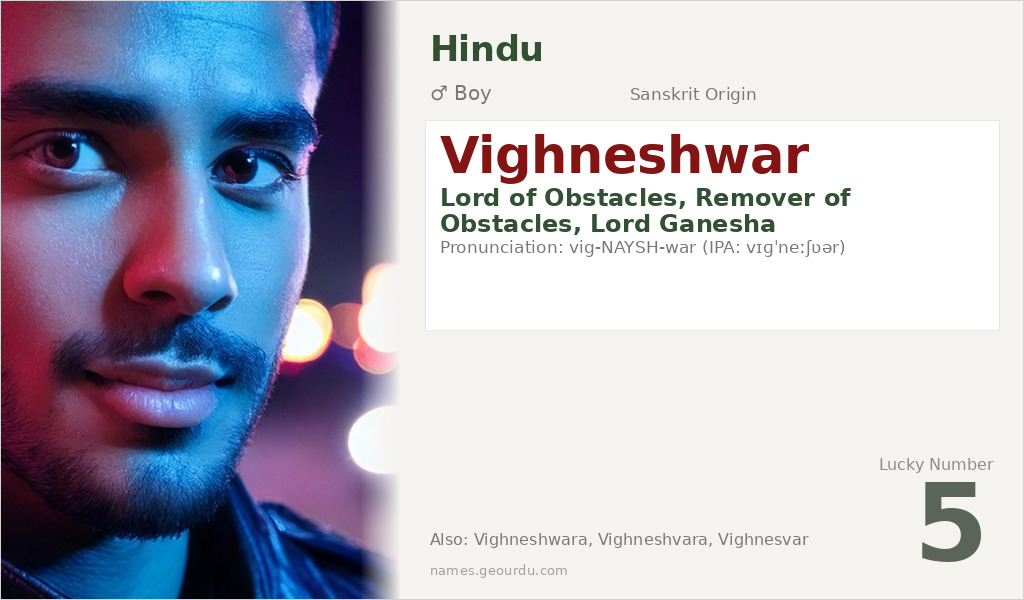
| 📛 Name | Vighneshwar |
| 💎 Meaning | Lord of Obstacles, Remover of Obstacles, Lord Ganesha |
| 👤 Gender | Boy |
| 🕌 Religion | Hindu |
| 🌍 Origin | Sanskrit |
| 🗣 Pronunciation | vig-NAYSH-war (IPA: vɪɡˈneːʃʋər) |
| ✍️ Urdu | ویگنیشور |
| ✍️ Arabic | فيغنشوار |
| 🔢 Numerology | 5 |
| ✨ Spellings | Vighneshwara, Vighneshvara, Vighnesvar, Vighneswar |
Origin & Cultural Significance
Vighneshwar originates from classical Sanskrit, the liturgical language of Hinduism, with its earliest documented usage appearing in medieval Hindu texts dedicated to Ganesha worship. The name gained prominence through the Ganesha Purana (circa 12th-16th century CE), where Vighneshwar is listed among Ganesha’s 108 principal names. Culturally, this name is particularly significant in Maharashtra and South India, where Ganesha worship is especially prominent. Many ancient temples across India are dedicated to ‘Vighneshwar’ or ‘Vighneshwara’, most notably the Ashtavinayak temples in Maharashtra. The name continues to be used in Hindu communities globally, maintaining its religious and cultural significance across generations.
Personality Traits
Those named Vighneshwar are often associated with qualities of their namesake deity—intelligence, wisdom, and the ability to overcome challenges. They tend to be natural problem-solvers who approach obstacles with creativity and determination. Many exhibit protective instincts and leadership qualities, often serving as guides or helpers in their communities. The name’s connection to Ganesha also suggests artistic inclinations and a balanced approach to both spiritual and practical matters.
Similar Names
If you like Vighneshwar, consider: Ganesh, Ganapati, Vinayak, Vignesh, Vighnaharta, Ekadanta, Heramba, Lambodara, Siddhivinayak
Famous People Named Vighneshwar
- Vighnesh Iyer — Indian classical musician and composer specializing in Carnatic music
- Vighneshwar Temple — Famous ancient temple in Ozar, Maharashtra dedicated to Lord Ganesha as Vighneshwar
Frequently Asked Questions About Vighneshwar
What does Vighneshwar mean?
Vighneshwar means 'Lord of Obstacles' or 'Remover of Obstacles' in Sanskrit. It is one of the primary names of Lord Ganesha, the elephant-headed Hindu deity worshipped as the remover of impediments.
Is Vighneshwar a boy or girl name?
Vighneshwar is exclusively a boy's name in Hindu tradition, as it refers to the male deity Lord Ganesha. There are no feminine variants of this name in common usage.
What is the origin of Vighneshwar?
Vighneshwar originates from Sanskrit, the classical language of Hinduism. It is a compound of 'vighna' (obstacle) and 'īśvara' (lord), and has been used in Hindu scriptures for centuries, particularly in texts dedicated to Ganesha worship.





