
Table of Contents
Vayujat is a distinctive Sanskrit name with deep roots in Hindu tradition and mythology. Meaning ‘son of the wind’ or ‘born of Vayu’, this name carries the powerful symbolism of the wind god Vayu. While relatively uncommon in modern usage, it represents a meaningful choice for parents seeking a name with spiritual and elemental connections. The name’s etymology directly links to one of Hinduism’s important deities and his most famous son.
Meaning of Vayujat
Vayujat is a Sanskrit compound name with clear etymological components. The first element ‘Vayu’ (वायु) refers to both the natural element of wind and the Vedic deity Vayu, who is the god of wind and one of the Pancha Mahabhutas (five great elements). The second element ‘jat’ (जात) is a Sanskrit suffix meaning ‘born of’ or ‘originating from’. Thus, Vayujat literally translates to ‘born of Vayu’ or ‘son of the wind god’. This naming pattern is common in Sanskrit where ‘jat’ combines with deity names to indicate divine lineage. The name specifically references the mythological relationship where Hanuman, the monkey god, is considered the son of Vayu, making Vayujat an epithet for Hanuman in certain texts.
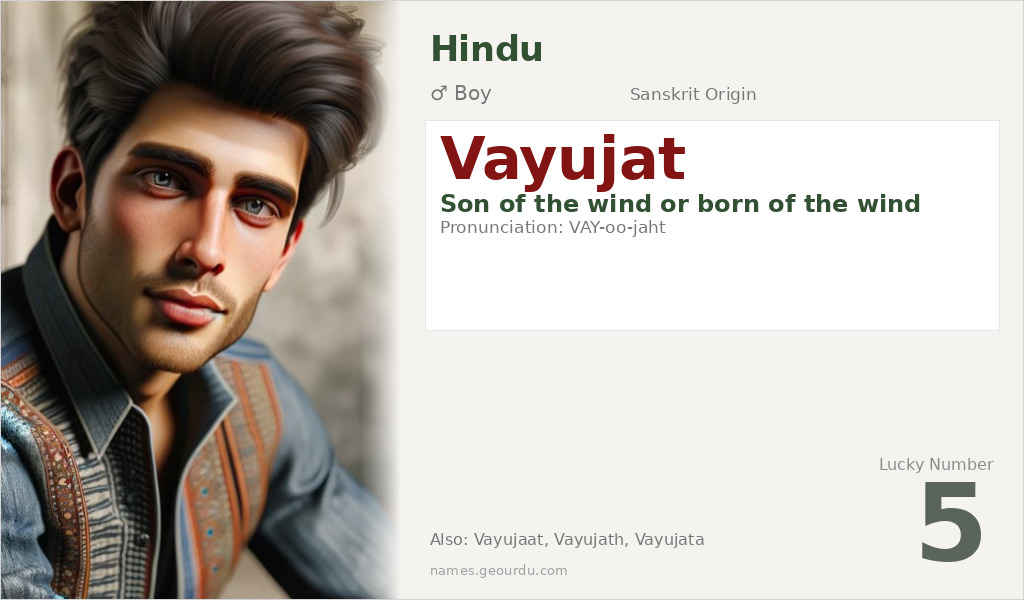
| 📛 Name | Vayujat |
| 💎 Meaning | Son of the wind or born of the wind |
| 👤 Gender | Boy |
| 🕌 Religion | Hindu |
| 🌍 Origin | Sanskrit |
| 🗣 Pronunciation | VAY-oo-jaht |
| ✍️ Urdu | ویوجت |
| ✍️ Arabic | فايوجات |
| 🔢 Numerology | 5 |
| ✨ Spellings | Vayujaat, Vayujath, Vayujata |
Origin & Cultural Significance
Vayujat originates from classical Sanskrit, the ancient liturgical language of Hinduism. The name emerges from Hindu mythological traditions where Vayu, the wind god, plays significant roles in various scriptures including the Vedas, Puranas, and the Ramayana. In these texts, Vayu is not only a natural force but also a father figure to Hanuman, one of Hinduism’s most beloved deities. The name Vayujat reflects the common Sanskrit practice of creating compound names that denote divine parentage or attributes. While the name appears in traditional contexts, it remains relatively rare as a given name in contemporary usage, preserved more in textual references than common naming practice.
Personality Traits
Those named Vayujat are often associated with qualities reminiscent of their wind-inspired etymology. They may exhibit energetic and dynamic personalities, capable of adapting to various situations with ease. The connection to Vayu suggests traits of movement, freedom, and spiritual strength, while the association with Hanuman implies loyalty, devotion, and protective instincts. Such individuals might be perceived as having strong principles and the ability to influence their surroundings positively.
Similar Names
If you like Vayujat, consider: Vayu, Maruti, Pavanputra, Anjaneya, Hanuman
Famous People Named Vayujat
- No widely known contemporary figures with this name found in verified sources
- The name appears in Hindu mythological contexts as an epithet for Hanuman, who is called 'Vayujat' meaning 'son of Vayu' in Sanskrit texts
Frequently Asked Questions About Vayujat
What does Vayujat mean?
Vayujat means 'son of the wind' or 'born of Vayu' in Sanskrit, combining 'Vayu' (wind/wind god) and 'jat' (born of).
Is Vayujat a boy or girl name?
Vayujat is exclusively a boy's name in Hindu naming tradition, as it uses masculine Sanskrit morphology and refers to male mythological figures.
What is the origin of Vayujat?
Vayujat originates from Sanskrit, the classical language of Hinduism, specifically from Hindu mythological traditions where it denotes being born of the wind god Vayu.





